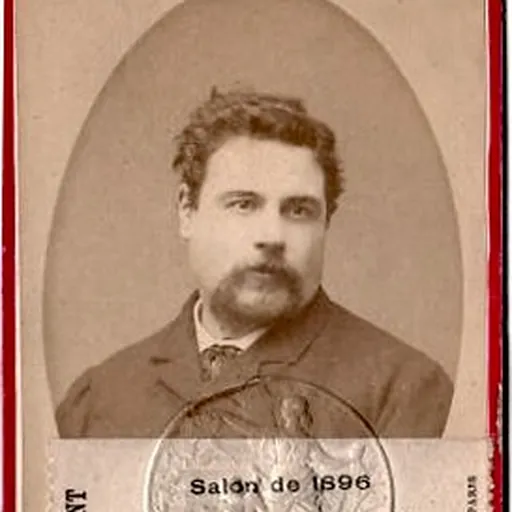
About Paul Biva
Lived 1851 – 1900 (aged 48). Paul Biva was a French painter.
Paul Biva (Montmartre 19 September 1851 – 13 June 1900, Avon, Seine-et-Marne) was a French painter. His paintings, both Realist, Naturalist in effect, principally represented intricate landscape paintings or elaborate flower settings, much as the work of his older brother, the artist Henri Biva (1848–1929). Paul Biva was a distinguished member of National Horticultural Society of France from 1898 until his untimely death two years later.
Biography Biva Paul was raised in a family originally from Alsace and Grisons. His father, Charles Biva (1821 Mulhouse – 1884 Paris) was a graphic designer and entrepreneur. In 1845 he opened a wallpaper factory in Montmartre. Very young, the two brothers, Paul and Henri Biva, learned to draft designs for the family business. Biva's delicacy and sureness of line features, colors and compositions of bouquets and still lifes comes in part from this particular training—also in the artistic context of Montmartre at the time.
In addition to the burden of work for the family business, Paul Biva enlisted in the Garde Nationale for compulsory military service during a difficult political and social period: the War of 1870 just ended, initiating the insurgency period of the City of Paris.
After the Salon of 1878, Paul Biva almost continuously exhibited to Salon des artistes français and other salons in Paris and Province until his untimely death in 1900.
The Baron Alphonse James de Rothschild purchased Chrysanthèmes, exhibited by Paul Biva at the Salon of 1893 and donated to the Musée de Saint-Malo.
Paul Biva lived at 128, rue du Faubourg-Poissonnière, and from 1897 at 12, rue d'Hauteville, according to the catalogue of 1912 Salon de la Société des artistes français.
Œuvre His artistic legacy mixes the baroque tradition of Dutch still lifes, the simplicity of Jean-Baptiste-Siméon Chardin (1699–1779), rediscovered at the time by the artistic community, and the energy of painters Realist painting after the biennial Salon of 1850. Thereafter, Paul Biva became sensitive to Impressionist movement of the 1870s.
The influence of the artistic environment in Montmartre also played a vital role, as expressed by André Roussard:
From Romanticism of the 1830s to Surrealism of the 1820s, we can state that Montmartre was at the origin, or at least involved in the creative period of the various successive movements. And especially, from 1850 to 1914, assembled here was an ensemble of painters and artists, poets, writers and musicians unparalleled in history, who revolutionized the arts and particularly the Fine arts. They lived in an artistic atmosphere and intellectual ferment which undoubtedly will never exist again with such intensity.
Whereas his brother Henri Biva focused primarily on landscapes representing the western suburbs of Paris in the plein-air tradition, Paul Biva's favorite subjects were flowers, especially roses and peonies in full bloom. He paid great attention to the subtly nuanced variations of direct and reflected light on flower petals, while using vivid contrasts to highlight the expressive colors of his subject matter.
The Biva family
The literature in the press often confuses the two brothers, Paul's work is sometimes likened to that of Henri Biva, the elder who lived 30 years longer, and whose production was therefore much more abundant. The "Causerie" of Jacques Mauprat, published in Le Progrès Illustré (18 February 1894) mentions 'the flowers of both Biva's' exhibited at the Salon Lyonnais, and in 1993, Élisabeth Hardouin-Fugier and Étienne Grafe, in their book titled Les Peintres de Fleurs en France, de Redouté à Redon repeatedly mention "Biva", without specifying a first name to distinguishing between the two, even though several of their paintings are discussed and reproduced in the ouvrage.
Paul Biva's wife, Julienne Jouatte, niece of the painter Alphonse Jouatte (1827-1892), exhibited a still-life with fruit (Nature morte aux fruits) at the Salon in 188 Their daughter, Jeanne Biva, a student of Victor Marec and Paul Biva, was in one of the first coeducational classes at École des beaux-arts de Paris in 1897. where she studied under William Bouguereau. She exhibited pastels at the Salon des artistes français in 1908 (Boules de neige), 1910 (Boules de neige et muguet), 1912 (Renoncules) and 1913 (Anémones).
Their granddaughter, Huguette Graux-Berthoux (1917–2003) studied at l'Ecole de dessin of Suzanne and Gigi Coutant, then at the École des beaux-arts de Paris, and exhibited at the Salon des artistes français and in several other Salons in Paris and Province.
The son of Henri Biva, Lucien Biva (1878-1965), also a painter, emigrated to the United States in 1919 where he continued to paint and work as an ornamental designer for textile fabrics and similar articles of manufacture, patenting over 80 designs between 1920 and 1950. He became an American citizen in 1928.
Charles Biva, Henri Biva, Paul Biva, Julienne Jouatte, Lucien Biva and Huguette Berthoux-Graux are mentioned in the Benezit Dictionary of Artists.
Gallery
Public collections Le matin à Villeneuve l’Étang, before 1873, Musée des beaux-arts de Troyes Roses, 1889, Musée Gétraud, Barbezieux-Saint-Hilaire, Charente Corbeille de Pivoines, before 1892, Musée d'art et d'histoire de Saint-Brieuc Les Roses, Salon de 1896, Musée des Beaux-Arts de Dijon Les Pavots, Salon des artistes français, 1898, Musée des beaux-arts et d'archéologie Joseph-Déchelette, Roanne Pivoines, Mairie d’Isdes, Loiret Works by Paul Biva are also conserved at Château de Dieppe, Musée des beaux-arts de Rouen and at Musée des beaux-arts de Tourcoing.
Salons
Salon des artistes français
1878, Le matin à Villeneuve l’Étang 1879, Dans le parc, L’Étang de Villeneuve l’Étang, Anémones (gouache) 1880, Pensées 1881, Fruits, Provisions 1883, Fleurs et fruits 1884, Dans le parc de Villeneuve l’Étang, le matin 1889, Roses 1890, Pivoines, Dans la vallée de Brunoy 1891, Panier de roses 1892, Pivoines 1893, Roses, Pavots 1894, Porte fleurie, Fleurs de printemps 1895, Pavots 1896, Roses, Pavots 1897, Fleurs de printemps, Pavots 1898, Roses trémières, Pavots 1899, Fleurs de Printemps, Pavots 1900, Floraison d’un matin 1901, Pavots au clair de lune
Don’t just read it —
keep it.
Full-length biographies made to live with: read them, listen on the way to work, watch them tonight.
- E-book
- Audio
- Video
Instant download · yours to keep · every purchase keeps this site free
Important facts
People in Paul Biva's life
Named in this biography and alive at the same time
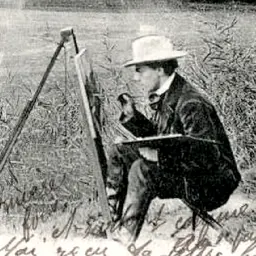


Related people
Same field, nearest in time
Contemporaries
People whose lives overlapped Paul Biva's



Frequently asked questions
Who was Paul Biva?
French painter (1851-1900)
When was Paul Biva born?
Paul Biva was born on 19 September 1851 in Montmartre.
When did Paul Biva die?
Paul Biva died on 13 June 1900 in Avon.
What was Paul Biva's occupation?
Paul Biva was a painter.
What nationality was Paul Biva?
Paul Biva was French.
Sources & further reading
Cite this page
APA: Biography.guide. (2026). Paul Biva. https://biography.guide/paul-biva/
MLA: "Paul Biva." Biography.guide, https://biography.guide/paul-biva/.
Chicago: "Paul Biva." Biography.guide. https://biography.guide/paul-biva/.
Data last updated: 2026-09-22 · Spot an error? Report a correction.
Portrait: Wikimedia Commons · author & licence
Page generated 2026-09-27 05:04 UTC