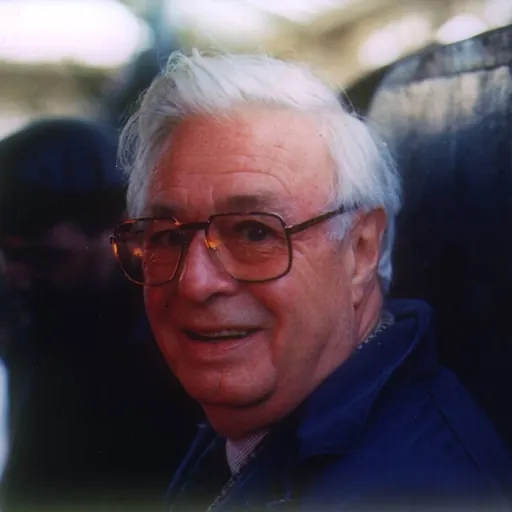
About Patrick Whitehouse
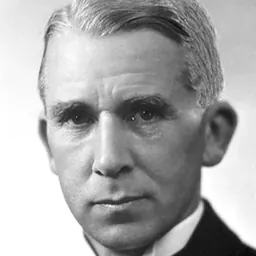
Lived 1922 – 1993 (aged 71). Patrick Whitehouse was a writer, railway historian and historian, known for Heritage railway.
Patrick Bruce Whitehouse OBE (25 February 1922 – 17 July 1993) was one of the pioneers of railway preservation, when he helped save the Talyllyn Railway in 1951. He also led the restoration to working order of several of Britain's steam locomotives after they were replaced by diesel locomotion in the 1960s.
Early life Patrick Bruce Whitehouse was born in Warwick, the son of Cecil Whitehouse who was the co-owner of the family construction firm B. Whitehouse and Sons based in Birmingham, West Midlands and his wife Phyllis (née Bucknell), who was a descendant of the founding family of the shipping line that became the Ellerman & Bucknell Steamship Company.
Career RAF: 1939–1945 Educated at Warwick School, on graduation he was due to join the family firm, but the outbreak of World War II meant that he tried to follow his ambition of becoming a pilot. With less than perfect eyesight, the Royal Air Force approved his training as a navigator, which he completed in Canada under the Empire Air Training Scheme. Returning to the UK he was posted to No. 15 Squadron RAF, completing three tours each of 30 flights over Nazi Germany and occupied western-Europe.
Railway preservation Whitehouse was a member of what later became chronicled as the "Birmingham Railway Mafia", a group centred around a core of steam railway enthusiasts who were members of both the Birmingham Locomotive Club and West Midlands branch of the Stephenson Locomotive Society.
4555 and the Dart Valley Railway
In 1962/3, B Whitehouse & Sons Ltd had been commissioned to rebuild a bridge and walls at Walsall railway station. With the oncoming introduction of diesel and electric services to the area, and subsequent rationalisation and simplification of the required infrastructure, the BR specification changed on numerous occasions resulting in large cost rises. At a subsequent meeting between Whitehouse and the regional manager Stanley Raymond (who as Sir Stanley Raymond, succeeded Dr Richard Beeching as chairman of the Board of British Railways), the cost issues were resolved, and Raymond asked if he could help Whitehouse with anything else. Whitehouse responded that he wanted to buy a steam locomotive, which after within the room discussions with his staff, Raymond agreed to. a site equipped to preserve and maintain main line steam locomotives. Whitehouse led the team which restored the LMS Jubilee Class No.5593 Kolhapur at the BRM. By the 1970s, the BRM housed up to 15 locomotives, and from that time on leased engines to preservation lines throughout Britain. It is now home to the Shakespeare Express which runs on the main line from Birmingham to Stratford-upon-Avon.
Photographer, writer and publisher In 1952, with Tom Rolt undertaking the writing and Whitehouse contributing the photographs and research, Whitehouse co-authored his first book "Lines of Character". Five years later he wrote his first solo book "Narrow Gauge Album", published by Ian Allan Publishing. and built up a collection of more than a quarter of a million photographs of British and foreign railways. In the 1980s, his travels in China led to a long-standing friendship with the China Railway Publishing House in Beijing, and a treaty of friendship between Birmingham and the north-eastern city of Changchun, Manchuria.
Published under the title Millbrook House, the publishers collection of over 250,000 photographs – from both those taken by Whitehouse, and the collections he purchased – became known as the Millbrook House collection. After his death, the majority of the photographs that he took himself known as the Whitehouse Collection was donated to the nation, acquired by the National Railway Museum.
Whitehouse had inherited a Kodak film camera, on which he chronicled his excursions across the UK, Ireland and mainland Europe. In 1956, he produced his first commercial film with John Adams, about the railways of the Isle of Man. Showing the production at a local film club in Birmingham, they met BBC Children's producer Peggy Bacon, who commissioned the two men to present and produce some full-length railway programmes for children. Whitehouse and John Adams subsequently filmed, produced and co-presented the BBC1 Children's programme Railway Roundabout. Although the films still exist, the programme commentaries and links were live to air and unrecorded. Film archivist John Huntley estimated the Whitehouse and Adams were responsible for 137 films, of which around 100 were shown on Railway Roundabout. and non-executive director of the Rail Freight Group.
Don’t just read it —
keep it.
Full-length biographies made to live with: read them, listen on the way to work, watch them tonight.
- E-book
- Audio
- Video
Instant download · yours to keep · every purchase keeps this site free
Important facts
Family & relationships
People in Patrick Whitehouse's life
Named in this biography and alive at the same time



Related people
Same field, nearest in time


Contemporaries
People whose lives overlapped Patrick Whitehouse's

Frequently asked questions
Who was Patrick Whitehouse?
Railway preservation pioneer and author (1922–1993)
When was Patrick Whitehouse born?
Patrick Whitehouse was born on 25 February 1922 in Warwick.
When did Patrick Whitehouse die?
Patrick Whitehouse died on 17 July 1993.
What was Patrick Whitehouse's occupation?
Patrick Whitehouse was a writer, railway historian and historian.
What was Patrick Whitehouse known for?
Patrick Whitehouse was known for Heritage railway.
Sources & further reading
· Wikipedia: Patrick Whitehouse
Cite this page
APA: Biography.guide. (2026). Patrick Whitehouse. https://biography.guide/patrick-whitehouse/
MLA: "Patrick Whitehouse." Biography.guide, https://biography.guide/patrick-whitehouse/.
Chicago: "Patrick Whitehouse." Biography.guide. https://biography.guide/patrick-whitehouse/.
Data last updated: 2026-09-22 · Spot an error? Report a correction.
Page generated 2026-09-27 05:09 UTC