Patrick Lyon
Scottish-born American blacksmith, mechanic and inventor
About Patrick Lyon
Lived 1769 – 1829 (aged 59–60). Patrick Lyon was a businessperson, blacksmith and inventor.
Patrick Lyon (c. 1769, Edinburgh, Scotland – April 15, 1829, Philadelphia, Pennsylvania) was a Scottish-born American blacksmith, mechanic and inventor. After being falsely accused and imprisoned for a 1798 bank robbery, he became a working class hero. A self-made businessman, he was among the foremost American makers of hand-pumped fire engines.
1798 Bank of Pennsylvania heist
Prior to 1798, the Bank of Pennsylvania conducted business from an office in Philadelphia's Masonic lodge. Following a robbery attempt at the lodge, the bank signed a lease with Carpenters' Hall, and hired contractor Samuel Robinson to prepare the hall for the bank's operations. Lyon completed his work on August 13, and the doors were reinstalled that day. There were no signs of thieves having broken into the building, and Lyon's locks on the iron doors were undamaged. Lyon was still in Delaware weeks later where he learned that he was the prime suspect in the robbery, and returned to Philadelphia to clear his name. He met with officers of the bank and the mayor of Philadelphia, but they suspected that Lyon had secretly made an extra set of keys for the robbery. Davis confessed, and was granted a pardon from Pennsylvania's governor in exchange for returning the bank's money. Davis returned all but $2,000, disappeared from Philadelphia, and never served a day in jail.
Lawsuit Lyon filed a civil lawsuit for malicious prosecution and false imprisonment against the bank president, the head cashier, a bank board member and High Constable Haines. The case went to trial in July 1805. William Rawle, defense attorney for the bank, freely acknowledged that Lyon had been in southern Delaware, away, at the time of the robbery. Other "engine-builders were soon superseded by the famous locksmith, who invented a new and improved fire-engine, which he announced would throw more water than any other, and with a greater force." His design featured a surge tank encased in a square column at the center of the engine, vertical pump cylinders, double decks, and hinged lever bars at the ends. These came to be known as "Philadelphia-style hand pumpers," and he built examples for the Good Will and Philadelphia Fire Companies in 1803.
Philadelphia was one of the first American cities to build a gravity-fed municipal water system. In 1802, Frederick Graff "designed the first post-type hydrants in the shape of a 'T' with a drinking fountain on one side and a 4-1/2-inch water main on the other." Initially, these hydrants were used to fill buckets that were passed by a bucket brigade to fill a fire engine's reservoir. In 1804, Lyon invented the first hose wagon, which transported of copper-riveted leather hose to the hydrants. Its bed also could be used as an additional reservoir. The use of hoses eliminated the need for bucket brigades, and allowed 11 men to do the work of 100.
Lyon built engines for other Philadelphia fire companies – the Pennsylvania, United States, Hand-in-Hand, Good Intent and Washington companies – as well as for fire companies in cities and towns in Pennsylvania and other states. Planks laid over the engine's reservoir created twin upper decks, where eight men pumped (four facing each end), and hinged lever bars that folded down allowed an additional sixteen men (eight at each end) to pump from the ground. The fire company was so pleased with the engine that they made Lyon a lifetime member. Diligent remained in service until after the Civil War.
Surviving engines by Lyon It is estimated that Lyon built about fifty fire engines over the course of his career. An 1803 hand pumper, "Pat Lyon," built for the Jonestown Engine Company of Jonestown, Pennsylvania, is the centerpiece of the town's fire museum. An 1803 hand pumper, "Lazaretto," built for the Philadelphia Lazaretto (quarantine hospital), Essington, Pennsylvania, is in the collection of the Lazaretto Interpretive Museum. An 1806 double-decker hand pumper, built for the Independent Fire Company of Annapolis, Maryland, is in the collection of the Fire Museum of Maryland. An 1809 double-decker hand pumper, built for the Friendship Fire Company of Orwigsburg, Pennsylvania, is in the collection of the Schuylkill Historical Fire Society Museum in Shenandoah, Pennsylvania. An 1812 double-decker hand pumper, "Old Washy," built for the Washington Fire Company of Newtown, Pennsylvania, is exhibited in the town's old firehouse. An 1812 double-decker hand pumper, built for the American Engine Company of Philadelphia. The engine was purchased by Womelsdorf, Pennsylvania in 1846, it remained in service until about 1890, and it is still owned by the borough. Currently on display at the Reading Area Firefighters Museum, Reading Pennsylvania An 1820 double-decker hand-pumper, built for the Rainbow Fire Company of Reading, Pennsylvania, is in the collection of the Historical Society of Berks County.
Personal Lyon married a woman named Ann, and their daughter Clementina was born in 1796. At the time of his 1798 imprisonment, Lyon was a recent widower. Ann had died of yellow fever, but do not list Ann Lyon among the burials.
Obituary:DIED—at Philadelphia, Patrick Lyon, hydraulic engine maker, who was one of the most ingenious workers in mettle [sic, metal], in the United States, especially as a blacksmith; so much so, that when the ank of Pennsylvania was robbed many years ago, he was arrested and tried, (though acquitted), for the crime, mainly, if not almost exclusively, for the reason of a belief that he was the only man capable of unlocking the vaults, by false keys. For this prosecution he recovered high damages.
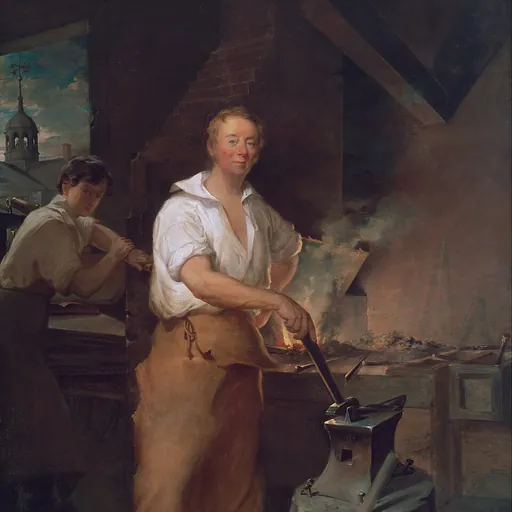
Pat Lyon at the Forge
Neagle signed and dated the 1829 portrait above the Pythagorean theorem. On November 4, 1825, Lyon commissioned painter John Neagle to paint his portrait: I wish you, sir, to paint me at full length, the size of life, representing me at the smithery, with a bellows-blower, hammers and all the et-ceteras of the shop around me. I wish you to understand clearly, Mr. Neagle, that I do not desire to be represented in this picture as a gentleman—to which character I have no pretensions. I want you to paint me at work at my anvil, with my sleeves rolled up and a leather apron on. I have had my eyes upon you. I have seen your pictures, and you are the very man for the work. Neagle measured everything in Lyon's shop, including the sitter: "five feet six inches and three quarters in his boots." Later that year, critic William Dunlap praised the portrait when it was exhibited in New York City at the National Academy of Design:Patrick Lyon the Blacksmith.—One of the best, and most interesting pictures in the present exhibition of the National Academy at the Arcade Baths, is a blacksmith standing by his anvil, resting his brawny arm and blackened hand upon his hammer, while a youth at the bellows, renews the red heat of the iron his master has been laboring upon.This picture is remarkable, both for its execution and subject. Mr. Neagle of Philadelphia, the painter, has established his claim to a high rank in his profession, by the skill and knowledge he has displayed in composing and completing so complicated and difficult a work. The figure stands admirably; the dress is truly appropriate; the expression of the head equally so; and the arm is a masterly performance. The light and indications of heat, are managed with perfect skill. In the background at a distance, is seen the Philadelphia prison, and thereby "hangs a tale," whether true in all particulars, is perhaps of little moment; I give it as I took it.
Lyon lent the portrait to the Boston Athenaeum for an 1828 exhibition, and the club purchased it from him for $400.
The second version is slightly larger, Neagle's brushwork is looser, and Lyon's facial expression is sterner. But the only major departure from the original is the addition of a board in the right foreground, to which is nailed a drawing illustrating the Pythagorean theorem. The second version – by , and dated: "1829" – is owned by PAFA, as is a 1826 compositional study for the original. Neagle's head-and-bust study of Lyon is in the collection of the Philadelphia History Museum, as is a compositional study for the 1829 version. Another study is in private hands.
In popular culture A February 22, 1832 parade in Philadelphia, celebrating the 100th anniversary of George Washington's birth, featured a horse-drawn float with blacksmiths pounding anvils before an image of "Pat Lyon at the Forge." The Mechanic Fire Company of Philadelphia, established 1839, adopted "Pat Lyon at the Forge" as their emblem, and painted it on their parade hats. One of these parade hats set an auction record when it sold at Sotheby's NYC in January 1988 for $27,500. The Locksmith of Philadelphia – 1839 serialized novel by Joseph Howe Patrick Lyon, or The Philadelphia Locksmith – 1843 play by James Rees Pat Lyon, the Master Locksmith – 1890 youth novel by Charles Morris Robbery in Philly: The Ninth Token (Time Game Book 9), 2019 youth book/game. As Patrick Lyon is held in a Philadelphia prison, Marcus and Samantha Willoughby gather evidence to prove he is innocent of bank robbery.
Don’t just read it —
keep it.
Full-length biographies made to live with: read them, listen on the way to work, watch them tonight.
- E-book
- Audio
- Video
Instant download · yours to keep · every purchase keeps this site free
Important facts
People in Patrick Lyon's life
Named in this biography and alive at the same time



Related people
Same field, nearest in time



Contemporaries
People whose lives overlapped Patrick Lyon's




Frequently asked questions
Who was Patrick Lyon?
Scottish-born American blacksmith, mechanic and inventor
When was Patrick Lyon born?
Patrick Lyon was born in 1769.
When did Patrick Lyon die?
Patrick Lyon died on 15 April 1829.
What was Patrick Lyon's occupation?
Patrick Lyon was a businessperson, blacksmith and inventor.
Sources & further reading
· DBpedia: Patrick Lyon (blacksmith)
Cite this page
APA: Biography.guide. (2026). Patrick Lyon. https://biography.guide/patrick-lyon-businessperson/
MLA: "Patrick Lyon." Biography.guide, https://biography.guide/patrick-lyon-businessperson/.
Chicago: "Patrick Lyon." Biography.guide. https://biography.guide/patrick-lyon-businessperson/.
Data last updated: 2026-09-20 · Spot an error? Report a correction.
Portrait: Wikimedia Commons · author & licence
Page generated 2026-09-27 04:58 UTC