
Patrick Daley
Australian bushranger
About Patrick Daley
Lived 1844 – 1914 (aged 69). Patrick Daley was a bushranger.
Patrick Daley (6 July 1844 – 29 April 1914), known informally as 'Patsy' Daley, was a 19th-century Australian bushranger. Daley was the younger cousin of John O’Meally, a member of Frank Gardiner’s gang of bushrangers who robbed the gold escort near Eugowra in June 1862. By early 1863 Patsy Daley had joined with O’Meally and Ben Hall in a series of robberies carried out in the Young district. Daley was captured in March 1863 and sentenced to fifteen years hard labour. He was released in 1873. Daley married and settled in the Cobar district, becoming a successful businessman and hotel-owner.
Biography
Early life
Patrick Bernard Daley was born on 6 July 1844 in the Black Range, south of Marengo, the son of John Daley and Ellen (née Downey). He was the second-born of twelve children.
Patsy Daley grew up in close proximity with his older cousin, John O'Meally. Daley and O'Meally's mothers were sisters. Their fathers operated the 'Arramagong' station in an informal partnership; with an estimated area of 26,800 acres and an estimated grazing capability of 800 cattle, the pastoral run was located at the southern foot of the Weddin Mountains in the Lachlan Squatting District. The two households lived separately on the station, about a mile and a half distant from each other. The children of both families probably received at least a rudimentary education; in September 1853 it was recorded that a schoolmaster named John Smith was living on the property.
In June 1860 John O'Meally's father, Patrick, was granted a publicans’ license for the Weddin Mount Inn, built beside Emu Creek on the 'Arramagong' run. With the gold-rush that occurred in the second half of 1860 at Lambing Flat and, nine months later, the opening up of the Lachlan goldfield at Forbes, the prospects for O’Meally's inn considerably improved, being situated on a road between the two, 25 miles from Lambing Flat and 45 miles from Forbes.
By 1861 a disagreement had arisen between Patrick O’Meally and Patsy Daley's father, John, over the leasehold of ‘Arramagong’ station. In June 1861 O’Meally placed the property, including stock and buildings, up for auction and Daley discovered the lease was held in O'Meally's name only. The new owner of the station tried to evict the Daley family, which they resisted, remaining in their house until September 1863. Whether or not Patsy Daley was involved in criminal activities at this stage is not known, but he was certainly associating with his cousin, who had already joined with Gardiner in committing robberies. In March 1862 O’Meally, Daley and another cousin (surname Downey) were apprehended on suspicion of being involved in the highway robbery of the storekeepers, Alfred Horsington and Henry Hewitt, near Wombat on 10 March 1862. O’Meally had been part of the gang led by Gardiner who carried out the robbery, but in the end the three young men were released without charge due to insufficient evidence. From early 1863 Patsy Daley, attracted to the romance and excitement of the bushranging life, began to join O’Meally and his fellow bushrangers in undertaking robberies in the Lambing Flat district.
Bushranging
Early evening on 28 January 1863 three armed men forcibly entered the house of Henry Colley at 'Demondrille' station near Murrumburrah. They stole a number of firearms and ammunition, jewellery, a watch, clothing and a saddle and bridle. Patsy Daley was later identified as one of the three who robbed Colley.
At eight o'clock in the evening of 2 February 1863 five armed men entered George Dickenson's store at Spring Creek near Young and stuck-up Dickenson, his storekeeper and a customer. The men were recognised as John Gilbert, Patsy Daley, John O’Meally and Christie Boland (alias Purtell). The fifth man was believed to be Ben Hall. The three detainees were taken outside and guarded at gunpoint by Daley while the other bushrangers searched the store. As others passed by they were detained as well. It was reported that Daley was "very nervous and trembled like a leaf"; noticing his unease several of the captives pressed forward at which point Hall intervened and warned them to stay back. After searching the store the bushrangers departed with £5 in silver, an estimated £10 worth of gold-dust, a revolver, three watches, several pairs of boots and a quantity of clothing. As they were leaving an unarmed policeman in plain clothes, Constable David Stewart, came along. The bushrangers ordered him off his horse. The policeman resisted and he was pulled off, and his horse, saddle and bridle were taken.
On Saturday morning, 7 February 1863, Ben Hall and Patsy Daley broke into the unattended Pinnacle Police Station and stole a rifle, a carbine, ammunition, a pair of saddlebags and a bridle, and articles of clothing. The station was usually occupied by three troopers. Two of the policemen, including the officer in charge, had been required to go to Forbes and the third, Constable Knox, was absent from the premises (despite being instructed "not to leave his post"). After the Pinnacle police station robbery Knox was dismissed from the police force.
Mid-afternoon on Saturday, 21 February 1863, four armed bushrangers dressed "in the style of policemen in private clothes" rode up to Meyer Solomon's store at Little Wombat. They were Ben Hall, John Gilbert, John O'Meally and Patsy Daley. The following morning the police tracked the bushrangers for about ten miles in the direction of the Weddin Mountains, but gave up the pursuit "from the want of a tracker and exhaustion, as most of the police had just returned from Yass".
The detainment of Sub-Inspector Norton
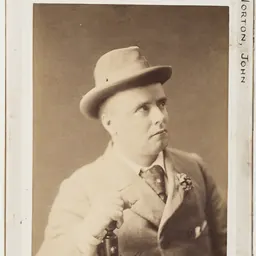
John Oxley Norton (1827–1880), police sub-inspector at Forbes in 1863.
By late February 1863 Sub-Inspector John Norton was given charge of the police at Forbes. On 28 February 1863 Norton and Tracker Billy Dargin were on patrol in pursuit of the bushrangers Hall, O'Meally and Daley; they had arranged to meet ten police troopers at the foot of Wheogo Mountain, north-west of Grenfell, but through a misunderstanding the meeting did not eventuate. Norton and Dargin continued the pursuit and the next morning, March 1, while riding towards 'Pinnacle' station they came upon the camp of the three bushrangers, who immediately mounted their horses and spread out on either side of the road in an effort to encircle Norton and Dargin. O'Meally advanced to within 80 to 100 yards and fired two shots at Norton from a double-barrelled gun. The bushrangers pushed forward to within fifty yards, exchanging shots with Norton, with none taking effect. When the policeman's ammunition was expended Daley, "armed with three revolvers and a pair of pistols", rode up to him and told him to throw down his arms. During the shooting Dargin had dismounted and escaped on foot into the bush, with several shots fired after him. Norton claimed that after his surrender "Hall rode up and fired point blank at him, but fortunately without effect". While O'Meally guarded the prisoner, Hall and Daley started in pursuit of the tracker, without success.
When Hall and Daley returned to their prisoner, it was found that Norton had been mistaken for Trooper Hollister who, it was claimed, "had threatened to shoot Ben Hall". After being confined for three hours Norton was allowed to depart with the police horses. The writer for the Lachlan Observer newspaper (Forbes) considered that the Sub-Inspector owed his release "to his being a 'new chum' in the district, and the fact of his having a wife and family in Sydney". After his escape the tracker Dargin made his way to the Pinnacle police station where he reported the events. Sub-Inspector Norton arrived back at Forbes on March 3.
The following day Daley was brought before the Police Court at Forbes charged with shooting at Sub-Inspector Norton with the intent to kill or do grievous bodily harm as well as the robbery of the police barracks on ‘Pinnacle’ station. After evidence from Pottinger regarding his capture, Daley was remanded in custody. Daley was also identified by Henry Colley of 'Demondrille' station, who was robbed by three men in late January. The following day, February 25, Daley was brought before the Chief Justice and received a total sentence of fifteen years hard labour on the roads (thereby adding five years to his previous sentence).
Daley was initially sent to Darlinghurst Gaol, but by February 1864 he had been transferred to the Cockatoo Island Penal Establishment. He was finally discharged on 15 October 1873 upon receiving a remittance of his sentence.
Later years
Patrick Daley and Mary Kelly were married in on 24 November 1883 at Hay, in the western Riverina district. The couple had two daughters, the first of them born in 1887 at Mossgiel. They eventually moved to the Cobar district, in the central west of New South Wales, where Daley's wife's family owned the 'Booroomugga' and 'Sussex' pastoral runs. From April 1895 Patrick Daley was the successful tenderer of a five-year lease of the Booroomugga Tank, a public watering place, east of Cobar on the road to Nyngan.
From 1899 the Family Hotel at Wrightville, near Cobar, was being run by the publican, William J. Kelly; Patrick Daley possibly owned the hotel.
In July 1904 Daley was elected as an alderman of the Wrightville Municipal Council. In 1905 Daley was referred to as the Cobar-Wrightville mail contractor.
By about 1906 Daley owned the Royal Hotel at Illewong, about 11 miles south-east of Cobar, with his younger brother William (born in 1861) as the licensee. Daley's hotel at Illewong was destroyed by fire in March 1910.
In January 1911 Daley purchased the Terminus Hotel, on the corner of Linsley and Bradley streets in Cobar. He was buried in Rookwood cemetery. In his will Daley left an estate of over six thousand pounds. He left the Family Hotel at Wrightville and mining shares to his brother William, cottages to his two daughters, and the remainder to his wife.
Don’t just read it —
keep it.
Full-length biographies made to live with: read them, listen on the way to work, watch them tonight.
- E-book
- Audio
- Video
Instant download · yours to keep · every purchase keeps this site free
Important facts
People in Patrick Daley's life
Named in this biography and alive at the same time




Related people
Same field, nearest in time

Contemporaries
People whose lives overlapped Patrick Daley's

Frequently asked questions
Who was Patrick Daley?
Australian bushranger
When was Patrick Daley born?
Patrick Daley was born on 6 July 1844 in Murringo.
When did Patrick Daley die?
Patrick Daley died on 29 April 1914 in Glebe, New South Wales.
What was Patrick Daley's occupation?
Patrick Daley was a bushranger.
Sources & further reading
Cite this page
APA: Biography.guide. (2026). Patrick Daley. https://biography.guide/patrick-daley/
MLA: "Patrick Daley." Biography.guide, https://biography.guide/patrick-daley/.
Chicago: "Patrick Daley." Biography.guide. https://biography.guide/patrick-daley/.
Data last updated: 2026-09-20 · Spot an error? Report a correction.
Page generated 2026-09-27 05:19 UTC