
About Parakramabahu I
Lived 1123 – 1186 (aged 62–63). Parakramabahu I was a monarch.
Parākramabāhu I (Sinhala: මහාරජ පරාක්රමබාහු (Maharaja Parakramabahu), 1123–1186), or Parakramabahu the Great, was the king of Polonnaruwa from 1153 to 1186. He oversaw the expansion and beautification of his capital, constructed extensive irrigation systems, reorganised the country's army, reformed Buddhist practices, encouraged the arts and undertook military campaigns in South India and Burma. The adage, "Not even a drop of water that comes from the rain must flow into the ocean without being made useful to man" is one of his most famous utterances."
In 1140, Parakramabahu following the death of his uncle, Kitti Sri Megha, Prince of Dakkinadesa, ascended the throne of Dakkhinadesa. Over the next decade, he strengthened both the region’s infrastructure and its military. Following a protracted civil war, he secured power over the entire island around 1153 and remained in this position until his death in 1186. During Parākramabāhu I's reign, he launched a punitive campaign against the kings of Burma, aided the Pandyan dynasty against the Chola dynasty in southern India and maintained extensive trade relations with China, Angkor, and countries in the Middle East. Within the island, he consecrated religious monuments, built hospitals, social welfare units, canals and large reservoirs, such as the Parakrama Samudra, but also banned the advanced practices and books of Mahayana Buddhism.
Background
Early
The island of Sri Lanka was disrupted by Cholas, following an invasion by Raja Raja Chola I, who took advantage from an internal strife and conquered nearly half of the island. It was not until his successor, the island was almost under Chola control. These regions remained under Chola control until the reign of Vijayabahu I (1070–1100); when Vijayabahu I successfully drove the Chola invaders out of the island, he continued the capital at Polonnaruwa rather than Anuradhapura. By the reign of Vikramabāhu I (1111–1132), the island was divided into three kingdoms—Kingdom of Rajarata, Kingdom of Dakkhinadesa, and Kingdom of Ruhuna. Vijayabahu I had given his sister Mitta's hand in marriage to a Tamil Pandyan prince, and that Pandyan prince would go on to become the father of Manabharana, who in turn was the father of Parakramabahu I. While Vikramabāhu was regarded as the most dignified, as he ruled Rajarata with its sites of religious and historical significance, Manabharana, king of Dakkhinadesa (the Southern Country), along with his brothers Sri Vallabha and Kitti Sri Megha, the joint rulers of Ruhuna, were formidable rivals for the throne. Furthermore, all three were descendants of Vijayabahu’s sister and therefore held a strong claim to the throne; in the Culavamsa, they are referred to as the Arya branch of the royal dynasty, whereas Vikramabāhu I belonged to the Kalinga branch.
Birth
At the time of Parakramabahu’s birth, Manabharana, the governor of Dakkhinadesa and the eldest of the Arya kings, had two daughters, Mitta and Phabavati, but no sons. He said:
On the other hand, his younger brother, Sri Vallabha and his wife Sugala, had two children, one of them being a son, challenged the party of Manabharana. As per this, he stepped down and passed his work to his ministers.
The chronicle further states that Parākramabāhu I’s birth was foretold by a god-like figure appearing in a dream to his father, King Manabharana of Dakkhinadesa. Subsequently, a son was born to Manabharana’s wife, Ratnavali, and was named Parākramabāhu. Though the year of his birth cannot be known exactly confirmed, it is generally thought to be around 1123 AD. The location would almost certainly have been the capital of Dakkhinadesa, Punkhagama.
Upon being informed of the child's birth, Vikramabāhu I in Polonnaruwa ordered that the boy be brought up as the heir to his throne. This kind of adoption may have been an olive branch of sorts on the part of Vikramabāhu, who wished to keep the throne until his death, after which it would be passed on to Parākramabāhu. Manabharana, however, rejected the offer, stating that "It is not (prudent) ... to send away such a jewel of a son". He also speculated that "...if the boy is taken thither, the party of Vikkamabahu... will gleam with mighty, up-shooting flames, but our misfortune, alas so great, will become still worse!"
Soon after the child's birth, Manabharana fell ill and died. His younger brother Kitti Sri Megha, who was joint king of Ruhuna, ascended the throne of Dakkhinadesa, while Sri Vallabha was declared sole king of Ruhuna. Parākramabāhu, his mother Ratnavali and his two sisters Mitta and Pabhavati, were sent to live in Mahanagahula, the capital of Ruhuna, under the care of Manabharana's brother Sri Vallabha.
Youth
In Ruhuna and Dakkhinadesa
Whilst he was still young, his eldest sister Mitta was forcibly married to their cousin, Manabharana, the son of Sri Vallabha of Ruhuna, against the wishes of Queen Ratnavali. Ratnavali was herself of the Kalinga clan of the royal family, and though she was the widow of a king of the Arya branch of the royal family, she preferred to see her daughters married to a king from the Kalinga clan. During his time at Sri Vallabha's court, Parākramabāhu met his future mahesi "queen consort", Lilavati, Sri Vallabha's daughter, who, went on to rule the country in her own right.
In 1132 AD, following the death of Vikramabāhu, his son, Gajabahu II succeeded to the throne of Rajarata. Two monarchs of the Arya branch of the royal family, Sri Vallabha and Kitti Sri Megha, tried unsuccessfully to seize Rajarata by force. Nevertheless, he retained the entirety of Bhaddavati's dowry for himself. The second was secretly negotiating with Gajabahu's general, Gokanna. However, Gajabahu eventually grew suspicious of Parākramabāhu's activities, and aware, Parākramabāhu departed Rajarata in secrecy by night and returned to Dakkhinadesa.
Return to Dakkhinadesa
In Dakkhinadesa, Parākramabāhu was reluctant to enter the capital Sankhatthali to see his uncle, King Kitti Sri Megha, until persuaded by his mother Ratnavali to do so. Kitti Sri Megha however died soon after Parākramabāhu's return and the Culavamsa notes that the prince "was not mastered by the agitation called forth by the grief at his father's (sic) death"—perhaps a sign of lingering ill feeling between the two. Parākramabāhu was now king of Dakkhinadesa.
King of Dakkhinadesa
Government and construction
Parakramabahu was the sole king of Dakkhinadesa by 1140; his objective for Dakkhinadesa was to expand it so that it would surpass the greatness of other two kingdoms, in a short period of time. He formed an administration center called Parakramapura, solely for him. The capital of Parakramapura is identified with modern city Panduwas Nuwara.
Afterwards, he started a huge program of construction and renovation of shrines and other structures, the remnants of which can still be seen in North Central Province, Sri Lanka, today. It is mentioned of him as having restored an ancient causeway called the Kotabaddha, over the Deduru Oya (Deduru Lake) near modern Kurunegala. The new king's personality was illustrated when the architects commissioned to the project informed him that it was well-nigh impossible to carry out, to which Parākramabāhu replied that "What is there in the world that cannot be carried out by people of energy?". He ordered the construction of canals and dams, and cleared a large area of forest around them for new fields. Most notably, he constructed the Parakrama Samudra, a giant reservoir from which a large swathe of territory derived its water supply. On islands in the middle of the reservoir he constructed a palace and a stupa.
Trade from Dakkhinadesa Trade was a key source of income for Dakkhinadesa, as Sri Lanka’s strategic location had long placed it at the intersection of several major trade routes. Chinese silk was a significant import and was used in the consecration of statues and shrines. Pearls and gems (of which the king took particular interest) constituted an important part of the island's exports, as did cinnamon (which remained, until the 19th century, Sri Lanka's major export), and war elephants. Most trade was carried out through the main seaports of the principality, Kalpitiya, Halawatha (Chilaw) and Colombo.
Preparation for war Parākramabāhu resolved to expand the region through a war that lasted over a decade. He first decided to reorganize the guards of Dakkhinadesa kingdom.
Parākramabāhu's army had a diverse ethnic make-up. Some of his officers were from the two grand old clans of Sri Lanka, the Moriya and the Lambakanna, who had between them dominated Rajarata from Anuradhapura. Under a commander styling himself as the king of Malaya (modern Dumbara), the army also included, by the time hostilities broke out between Dakkhinadesa and Rajarata, Veddas, Vellalar, and people from the lower castes who were not traditionally involved in martial activities. The Culavamsa places the number of soldiers at somewhere around 100,000 people but the real figure was probably lower. Parākramabāhu’s army would have included war elephants, cavalry, and siege engines, making it a formidable threat to Gajabahu’s authority in the north.
Conquest of Rajarata
War with Gajabahu Around 1150 AD, Parākramabāhu made his first move by seizing control of Malaya, strategically securing his eastern flank. He then moved his forces against various chieftains on the border of Rajarata. The final stage of this early campaign was the defeat of an army of Gajabahu himself, after which there was a brief ceasefire between the two sides.
Hostilities resumed soon afterwards. Gajabahu had resorted to securing support from abroad, and by the time hostilities resumed between him and Parākramabāhu, the army of Rajarata included nobles of heretical faith from abroad. Parākramabāhu himself did not participate in the invasion of Rajarata, but was responsible for the overall strategy of the campaign, which was based on the writings of Kautilya.
The forces of Dakkhinadesa struck at the fortress of Mallavalana near the mouth of the Kala Oya, seizing it and occupying the western coast of Sri Lanka. The army then sailed up to the north and landed at a place called Muttakara or Mutukara ('Pearl-mine') near modern Mannar, Sri Lanka. In the meantime, Gajabahu's senior general Gokanna suffered several defeats in the vicinity of Kala Wewa and was forced to appeal to Gajabahu in order to receive reinforcements. Despite some initial successes in Malaya, Gokanna was decisively defeated by Parākramabāhu’s general Mahinda. The defeat was so complete that Gokanna fled the battlefield, leaving behind his umbrella—an important status symbol in medieval Sri Lanka. The remnants of his force constructed a fortress in a jungle and took no further part in the war. The retreating forces used horses with carriages to escape into the jungle, with supplies in carriages.
Dakkhinadesi troops advanced through the Amban river and advanced into Bogambara. Afterwards, defeated the heavily reinforced army and bodyguards of Gajabahu, and captured Rajarata. Gajabahu was locked in the palace. Parakramabahu ordered the troops of the Dakkhinadesa army to treat Gajabahu with respect and not to pillage Rajarata.
Despite this, some members of the Dakkhinadesa army are reported to have disregarded his orders, breaking into houses in Rajarata and plundering goods, including raiment and ornaments, from the city’s inhabitants. This pillaging was to have dire consequences for Parākramabāhu. Angered by the actions of the forces of Dakkhinadesa, Gajabahu appealed to Manabharana of Ruhuna, who was at Sorabara, in the center of the country, for assistance.
War with Manabharana Parākramabāhu sent his senapathi Deva to restore order to Polonnaruwa, but he found himself in battle with Manabharana of Ruhuna before he could reorganize his troops. They persuaded Parākramabāhu that the ailing king no longer posed a threat, and that he should be allowed to live out the rest of his days in peace. Manabharana tried to woo the king back to the battle against Parākramabāhu, but Gajabahu refused, ) to confirm his abdication in favor of Parākramabāhu. Gajabahu moved to Gantale (Kantalai ), where he died in the 22nd year after his coronation as king of Rajarata. He celebrated by summoning Manabharana's son to Polonnaruwa and concluding a peace with him, followed by a lavish coronation ceremony.
Timeline of accession of Parākramabāhu to the throneKingdomMonarch 1090 1100 1110 1120 1130 1140 1150 1160 1170 1180 RajarataVikramabāhu IGajabāhu II DakkhinadesaVijayabāhu IManabharanaKitti Sri MeghaParākramabāhu I RuhunaSri Vallabha & Kitti Sri MeghaSri VallabhaManabharana
Reign Parākramabāhu established himself at Polonnaruwa (Pulatthinagara as mentioned in the Chulavamsa) from 1153 onwards and ruled over the entirety of Sri Lanka for the next 33 years. During this time he undertook much of the work he is best remembered for, most significantly in the areas of religious reform, construction, and war.
Economic policies and trade Shipwrecks were common on the area. Goods from ships were halved as long they didn't carry horses or elephants. Parākramabāhu's economic theory was largely based on the teachings of Kautilya, these could be an equivalent of what's known as state capitalism. As such, all trade, including Alcohol, were carried by the government. This aside from reducing alcoholism in the Sri Lankan society, also ensured the local produce was of the highest quality. During his rule, he also imposed a tax policy to fund government expenditures. a Theravada council was called in Polonnaruwa to discuss the reform of the sangha. Parākramabāhu's chief agent in the enterprise was to be the Mahathera Kassapa, an experienced monk who "knew the Tipiṭaka and was exceedingly well versed in the Vinaya". There was immense resistance to Parākramabāhu's efforts, in particular from the Abhayagiri sect who practiced advanced practices of Mahayana Buddhism. Many monks moved abroad rather than face such severe religious bigotry, whilst some others simply abandoned the cloth and returned to lay life. In this they may well have been encouraged by Parākramabāhu, who seems to have felt that the "purification" of the priestly orders depended as much on the expulsion and exclusion of the religious minority as it did on the rewarding and encouragement of the orthodox. Finally, the king summoned the leaders of the sangha on the island once a year, centering the visit on a ritual on the banks of the Mahaweli river—possibly a practical means of keeping up-to-date with their progress and their standards. After Parakramabahu's repression, Mahayana and Vajrayana in Sri Lanka never recovered.
Following the crushing of rebellions in Ruhuna, in 1157, Parākramabāhu recovered the Tooth relic and the alms bowls from Ruhuna and brought them to Polonnaruwa; afterwards placed the relics in a shrine known as the Temple of the Tooth Relic in Polonnaruwa. Such constructions became a hallmark of Parākramabāhu's reign; his buildings for the reformed sangha are described in great detail in the Culavamsa and are often accompanied with inscriptions stating his intentions and accomplishments, such as at the Gal Vihara. A large revival of Theravada is recorded during the time of Parakramabahu.
Construction
Parākramabāhu's constructions work made up a significant chunk of the material history of Sri Lanka. Much of the remnants of Polonnaruwa date from his reign, as well as sites in western and south-eastern Sri Lanka. One of Parākramabāhu's first projects was the restoration of Anuradhapura, including the restoration of Thuparamaya (which had been lost to the jungle), Mihintale, and Ruwanwelisaya. Parakramabahu, having abolished his office at Parakramapura of Dakkhinadesa, turned his attention on Polonnaruwa. Unsurprisingly, due to the near-yearly sieges, the city had suffered and had reached a state that nothing but its name remained. It is perhaps because of this that so little of pre-12th century Polonnaruwa remains until today.
It is said that the city was initially divided into four districts, each marked with its own alms-giving house for the clergy, containing "vessels of bronze, cushions and pillows, mats, carpets and bedsteads". He ordered the construction of hospitals, which he visited on several occasions. He also expanded Polonnaruwa's defensive walls, constructing an elaborate three-walled complex featuring turrets for archers and fourteen gates. None of which has survived till modern times. Beyond the city precinct it is believed he constructed or renovated three smaller townships, in addition to Parakramapura - Rajavesi Bhujanga, Raja Kulantaka (Sinhapura), and Vijitapura. Extensive gardens were also laid down around Polonnaruwa, featuring ponds and bathing-pools, one of which, the Twin Pools, survives till this date. One such garden, the 'Island Garden', extended into the middle of Thupa Wewa ('Wewa' meaning 'tank' or 'reservoir' in Sinhala) on a promontory.
Much else survives, such as the Gal Vihare, or "Stone Shrine", near Polonnaruwa. The Culavamsa attributes the monument in its entirety to Parākramabāhu, though in truth his contribution may have been extensive refurbishment. The Polonnaruwa Vatedage, considered the peak construction out of all Vatadage temples ("Circular Shrine"), was constructed around 1157, likely to store the tooth relic. The Lankatilaka Temple, Alahena Pirivena, Jetavanaramaya and the Demala Maha Cetiya were also constructed in his reign. At the center of Polonnaruwa Parākramabāhu expanded and beatified the royal palace, with audience halls and bathing ponds. Little of it remains today, but its soaring walls hint at the grand scale of the king's vision.
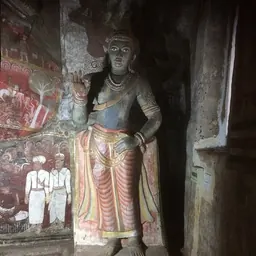
Gal Vihare ('The Stone Shrine') features three statues of the Buddha in three different poses carved from the same large rock.
Parākramabāhu also continued his program of hydraulic works begun in Dakkhinadesa, including the renovation and reconstruction of reservoirs and canals wrecked during the Chola invasion. He built the Parakrama Samudra which is 2,400 hectares (5,928 acres) of water. Inscriptions detailing his work can be found at the Maha Wewa near Uruwela, Padavi Wewa and Panda Wewa in North-Western Province. A column discovered at the bottom of the Padavi Wewa in the 19th century included the inscription "Made for the benefit of the whole world by the prosperous Sri Parakrama-Bahu, born at Sinhapura, minded of what was fit to be done". Though the Culavamsa attributes the construction of various tanks to him, it has been suggested that much of Parākramabāhu's work was renovation, and indeed that some of the projects undertaken by his successor, Nissanka Malla of Polonnaruwa, may have been attributed to him. In the Culawamsa, Parākramabāhu is said to have restored or constructed over 165 large tanks, in addition he renovated 2376 minor tanks and 3910 canals and 163 dams.
Despite their magnificence, Parākramabāhu's works exacted a heavy toll on the populace and the treasury. For much of the work in Anuradhapura he utilized Tamil prisoners of war seized during the Pandyan War, the POWs were revengefully sent to repair those destroyed during the Chola invasion. Nevertheless taxation and rajakariya (a feudal system in which work was owed to the king by commoners) contributed in large part to the projects. An interesting indicator of the burden of taxation is the disappearance of larger gold coins towards the end of Parākramabāhu's reign. he dispatched to Bagan a formidable naval force. The size of the army is not known, but it is recorded as containing a year's supply of grains, specially modified arrows, and war elephants. The army arrived at a city near the Bago River and captured it. Furthermore, a contemporary inscription at Devanagala mentions the awarding of land to the general Kitti Nagaragiri for his leadership in a campaign to 'Ramanna', naming the king of Bagan as 'Bhuvanaditta', a possible Sinhalization of 'Narathu'.
George Coedes states Parakramabahu I then launched the retaliatory raid in 1180 (even after the Pandyan war), after Narapatisithu (son of Narathu) imprisoned Sinhalese envoys.
Pandya War, 1169–1177
In 1167 the Pandyan king Parakrama appealed to his namesake in Sri Lanka for assistance against an alliance of his rival Kulasekhara Pandya and the Cholas. Such an appeal was not unusual, as the Pandya had long found allies in the Sinhalese monarchs, specially wars against the Cholas, and their nobility had spent some time in exile at the court of Mahinda IV (956–972) after the invasion of their land by Parantaka Chola II.
On this occasion however the Sri Lankan help came too late. By the time Parākramabāhu's general Lankapura Dandanatha arrived in Pandya Nadu, Kulasekhara had captured the capital city of Madurai and killed Parakrama's wife and children. His son Prince Vira Pandu however had managed to escape. Rather than head for Madurai, Lankapura landed in the vicinity of Ramanathapuram and captured the city of Rameswaram, which remained in Sri Lankan hands till the reign of Nissanka Malla. Then Cholas decided to fight against Lankapura's army, then came news from Pilai Pallavarayar that the commanders including Jayadratha (Jagath Vijaya) and Lankapura Dandanatha and the entire army from Sri Lanka had sustained defeat and retreated. The Culavamsa dedicates much of chapter LXXVII to a description of the ensuing war between Lankapura and Kulasekhara, who apparently fought on with assistance from the Cheras. However the account ends abruptly.
Kulasekhara Pandya subsequently obtained assistance from the Cholas and returned to fight Lankapura's army again. However, Lankapura defeated them again. Then Cholas decided to fight against Lankapura's army again, then came news from Pilai Pallavarayar that the commanders including Jayadratha (Jagath Vijaya) and Lankapura Dandanatha and the entire army from Ceylon had sustained defeat and retreated. He ordered the Sri Lankan currency of Kahapana to be used in the areas under his and Vira Pandyan control. The Tamil prisoners of war captured by Lankapura's army were sent to Sri Lanka to repair the Ruwanweli Seya and other buildings damaged by earlier Chola invasions of the country.
Ancient Sinhalese sources say that Lankapura returned to Sri Lanka after his victory, and was welcomed by Parakramabahu I as a great war hero and was well rewarded. Ceylon account is certainly one sided, and describes the war in true epic fashion. The victory is all in favour of the Ceylonese generals, and yet we find ultimately Vira Pandya does not find himself settled upon his throne firmly, ruling over the country subjugated to his authority states that Rajadhiraja II ordered his commander Thirumala Perumanambi along with a strong army with specific instructions to kill Lankapura and Jagath Vijaya of the Polonnaruwa Army and hang their heads from the gates of the palace of Madurai and Conquer Pandyan kingdom. Pallavarayar alias Tirucirrambalamudaiyan Perumanambi, who was entrusted with these tasks, entertained Kulasekhara suitably during his stay in the Chola country, and having with his army, resources and zeal, brought about the reconquest of the Pandiyan kingdom, he carried out his master's orders to the letter by nailing the heads of Lankapura Dandanatha and others (other Soldiers) to the gates of Madura. Annan sailed to Sri Lanka and destroyed Parakramabahu's preparations for the invasion. The Cholas also provided support to Sinhalese Prince Sri Vallabha, nephew of Parakramabahu and a rival claimant to the Polonnaruwa throne. Sri Vallabha decided to stay in the Chola camp, assisting the Cholas.
The expedition that was sent with Srivallabha at its head captured and destroyed several places in Ceylon, including Pulaiccēri and Mahathitha, where Parākramabāhu I was gathering his forces; it seized many elephants and set fire to a considerable area extending over twenty kādams from east to west and seventy kādams from north to south, killing some of the Sinhalese chieftains of the locality and taking other soldiers captive as prisoners of war. The booty captured in the course of the expedition was then duly presented to the Chola king by Annan Pallavarāyan who thus successfully counteracted all the machinations of the Ceylonese ruler.
According to K. A. Sastri Nilakanta, Parakramabahu did a volte-face by sending costly gifts such as jewels and gold to Kulasekhara convincing him to invade the Chola Kingdom. Sinhalese forces continued to have a presence in Rameswaram till the end of the reign of Nissanka Malla. There are also records of Sinhala presence in Rameswaram until well into the reign of King Nissanka Malla (1187–1196).
Furthermore the sheer size and extent of the king's construction projects can still be seen in Polonnaruwa today, as well as in the various carvings dotted around the country vaunting the accomplishments of the "Great King". However such success came at a price. Relentless warfare took its toll on the country and taxation was high under his reign and high-value coinage all but disappeared towards the end of his rule, a sign of increasing poverty.
His other weakness was the lack of restraint in his spending, taking Sri Lanka to greater heights that it had reached in a long time, but exhausting the island's resources in the process.
Name The popularity of Parākramabāhu is attested by the fact that no less than seven monarchs adopted his name over the next four centuries, of whom only two or three could lay claim to even a fraction of his successes. The Sri Lankan Navy has two ships named after Parakramabahu.
Don’t just read it —
keep it.
Full-length biographies made to live with: read them, listen on the way to work, watch them tonight.
- E-book
- Audio
- Video
Instant download · yours to keep · every purchase keeps this site free
Important facts
Family & relationships
People in Parakramabahu I's life
Named in this biography and alive at the same time
Related people
Same field, nearest in time

Contemporaries
People whose lives overlapped Parakramabahu I's


Frequently asked questions
Who was Parakramabahu I?
King of Polonnaruwa (1153–1186), unifier of Sri Lanka
When was Parakramabahu I born?
Parakramabahu I was born in 1123.
When did Parakramabahu I die?
Parakramabahu I died in 1186 in Polonnaruwa.
What was Parakramabahu I's occupation?
Parakramabahu I was a monarch.
Sources & further reading
Cite this page
APA: Biography.guide. (2026). Parakramabahu I. https://biography.guide/parakramabahu-i/
MLA: "Parakramabahu I." Biography.guide, https://biography.guide/parakramabahu-i/.
Chicago: "Parakramabahu I." Biography.guide. https://biography.guide/parakramabahu-i/.
Data last updated: 2026-09-20 · Spot an error? Report a correction.
Page generated 2026-09-27 05:21 UTC