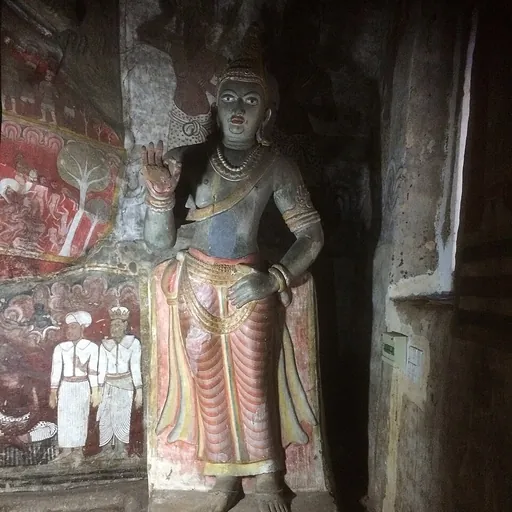
About Nissanka Malla of Polonnaruwa
Lived 1157 – 1196 (aged 38–39). Nissanka Malla of Polonnaruwa was a Sri Lankan monarch.
Nissanka Malla , also known as Kirti Nissanka and Kalinga Lokaswara, was a king of Polonnaruwa (Sri Lanka) who ruled the country from 1187 to 1196. He is known for his architectural constructions such as the Nissanka Lata Mandapaya, Hatadage and Rankot Vihara, as well as for the refurbishment of old temples and irrigation tanks.
Nissanka Malla declared that only a Buddhist had the right to rule the country, thereby securing his position and justifying his claim for kingship. He spent large sums for various constructions and refurbishments, and also gave money to the public in an attempt to put down crimes. He maintained cordial relationships with several countries, and also invaded the states of the Pandyan and Chola dynasties in South India but the invasion failed.
Ancestry and family A rock inscription made by Nissanka Malla at Dambulla mentions that he is of the Kalinga dynasty and a descendant from the race of Prince Vijaya. Another inscription at Ruwanwelisaya describes him as being a member of a royal family of Kalinga, born at Sinhapura. The inscription there reads;
Nissanka Malla's year of birth is 1157 or 1158. He was the son of Queen Parvati and King Jayagopa. This is mentioned in a rock inscription made by Nissanka Malla at Galpota. This inscription describes Jayagopa as being the reigning king of Sinhapura. Nissanka Malla had two wives named Kalinga Subadradevi and Gangavamsa Kalyanamahadevi. Some scholars have proposed Sumatra as the location of Kalinga and Sinhapura related, to Nissanka Malla's However, there are ample evidence in his inscriptions that Kalinga and Sinhapura were actually in Sri Lanka.
Reign Nissanka Malla came to Polonnaruwa under the invitation of Vijayabâhu II, who succeeded Parākramabāhu the Great, and was appointed as Vijayabâhu's Aepa (ඈපා/ duke/ sub-king).
By claiming to be descended from Vijaya, the first king of Lanka, Nissanka Malla justified his right to the throne. His rock inscription at Galpotha describes this, saying that "non-Buddhists should not be placed in power in Sri Lanka to which the Kalinga dynasty was the rightful heir".
He is also known as Kirti Nissanka and is referred to in some records as Kalinga Lankesvara. His rock inscriptions refer to him in names such as "Fountain of renown", "Protector of the Earth" and "Lamp by which the whole world was illuminated".
Economy Heavy taxes that were imposed by Parākramabāhu I were largely reduced by Nissanka Malla.
Foreign relations Nissanka Malla recovered cordial relationships with Ramanna; following the end of Polonnaru-Pagan war. He also maintained relationships with countries such as the Khmer empire. He sent missionaries to Cambodia and was responsible for conversion of Cambodia into Theravada which lasted until. Pali language scripts that are found in Southeast Asia are likely from the missionaries he sent.
Territory Rameswaram of South India, which had come under the control of Sri Lanka and Vira Pandya dynasty during the reign of Parākramabāhu I, in the end of the Pandyan Civil War it come under Cholas. However Nissanka Malla invaded the Rameswaram and renovated a temple in Rameswaram and renamed it Nissankesvara. Nissanka Malla also invaded the states of the Pandyans and Cholas but the invasion failed. Despite his exaggerated claims in inscription, his efforts were unsuccessful.
Constructions
The Nissanka Latha Mandapaya, constructed by Nissanka Malla is a unique type of building. It contains 8 granite pillars which were used to support a roof. The pillars are carved out of granite in the form of lotus stems with opening lotus buds on the tops, and are positioned on a platform.
The Hatadage is another construction done by Nissanka Malla. The Rankot Vihara, the fourth largest stupa in Sri Lanka, was also constructed by Nissanka Malla. The interior of the temple was gilded during the refurbishment. This later earned the temple the name Swarnagiri, meaning golden rock. Nissanka Malla also had 50 Buddha statues in the temple gilded, and had this recorded in a rock inscription near the entrance of the temple. A statue of Nissanka Malla was also made in one of the caves.
Don’t just read it —
keep it.
Full-length biographies made to live with: read them, listen on the way to work, watch them tonight.
- E-book
- Audio
- Video
Instant download · yours to keep · every purchase keeps this site free
Important facts
Related people
Same field, nearest in time
Contemporaries
People whose lives overlapped Nissanka Malla of Polonnaruwa's
Frequently asked questions
Who was Nissanka Malla of Polonnaruwa?
king of Sri Lanka
When was Nissanka Malla of Polonnaruwa born?
Nissanka Malla of Polonnaruwa was born in 1157 in Sinhapura.
When did Nissanka Malla of Polonnaruwa die?
Nissanka Malla of Polonnaruwa died in 1196.
What was Nissanka Malla of Polonnaruwa's occupation?
Nissanka Malla of Polonnaruwa was a monarch.
What nationality was Nissanka Malla of Polonnaruwa?
Nissanka Malla of Polonnaruwa was Sri Lankan.
Sources & further reading
· Wikipedia: Nissanka Malla of Polonnaruwa
Cite this page
APA: Biography.guide. (2026). Nissanka Malla of Polonnaruwa. https://biography.guide/nissanka-malla-of-polonnaruwa/
MLA: "Nissanka Malla of Polonnaruwa." Biography.guide, https://biography.guide/nissanka-malla-of-polonnaruwa/.
Chicago: "Nissanka Malla of Polonnaruwa." Biography.guide. https://biography.guide/nissanka-malla-of-polonnaruwa/.
Data last updated: 2026-09-26 · Spot an error? Report a correction.
Portrait: Wikimedia Commons · author & licence
Page generated 2026-10-05 03:57 UTC