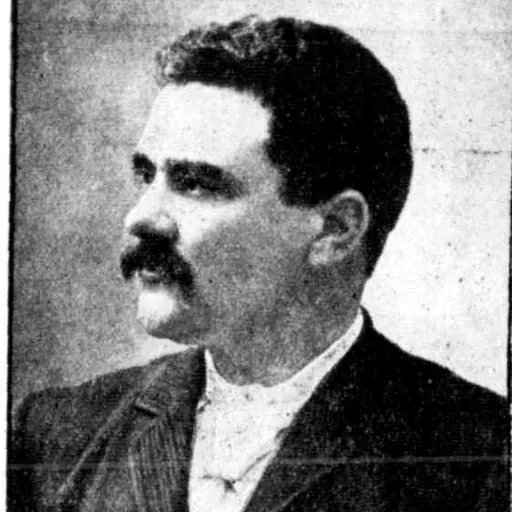
Paddy Crick
Politician, solicitor and newspaper proprietor in New South Wales, Australia
About Paddy Crick
Lived 1862 – 1908 (aged 46). Paddy Crick was an Australian journalist, solicitor and politician.
William Patrick Crick (10 February 1862 – 23 August 1908) was an Australian politician, solicitor and newspaper proprietor. He was described by author Cyril Pearl as an irresistible demagogue, who "looked like a prize fighter, dressed like a tramp, talked like a bullocky, and to complete the pattern of popular virtues, owned champion horses which he backed heavily and recklessly." William Willis, a political collaborator, described him as a "conservative dressed in the garments of democracy [with an] unbridled ambition and craving for public notice"
Early life Crick was born at Truro, South Australia and in about 1868 the family moved into western New South Wales, settling at Spicer's Creek near Wellington. He attended St Stanislaus' College, Bathurst. He was admitted as a solicitor in 1886 and developed a successful practice in the criminal courts. In 1890 he married Mary Catherine Kelly, but they separated in 1892.
Political career In 1885 Crick and Edward O'Sullivan founded the Land and Industrial Alliance, a protectionist party aimed at country selectors and city workers, and ran unsuccessfully for election to the New South Wales Legislative Assembly in 1887. As an independent protectionist he was elected in 1889 as the member for West Macquarie, aged . Crick then walked out of the house.
1890 expulsion On 12 November 1890 there was a debate involving McMillan when Crick interjected, with McMillan stating to Crick "You are nobody", with Crick responding in kind and describing McMillan as a makeshift. Ninian Melville, the Chairman of Committees called on McMillan to withdraw the expression and he did so. The Chairman then asked Crick to withdraw his expression. Crick debated the matter with the Chairman before withdrawing it. The Chairman then repeatedly asked Crick to apologise for interjecting during proceedings and he refused to do so until after McMillan had apologised for the insult. The Chairman instructed the serjeant-at-arms, Laurence Harnett, to remove Crick, who resisted stating "Don't you handle me. I will not be bullied by Melville or any one else. I will not go out, and I say so point-blank". The disturbance was reported to the Speaker, Joseph Abbott, who directed that Crick be allowed into the chamber to provide his explanation. Crick argued with Speaker stating "I am certainly not going to allow the Chair to knock me into a sort of pulverised sausage". Crick continued to argue with the Speaker who then instructed the serjeant-at-arms to again remove Crick. Whilst he was being forcibly removed, Crick stated "you got £2,000 for putting the Broken Hill Water Supply Bill through. That is what I tell you; and I tell the Chairman of Committees that he got £1,000; and I tell you you are both a pair of thieves and robbers of the country". Alexander Hutchison stated that "it was worse than useless to ask a drunken man to come into an assemblage of gentlemen to make an explanation of his conduct". and was re-elected in the resulting by-election, with a slightly increased margin.
At a meeting at the Lagoon, Major Butler asked "Is it true, Mr. Crick, that you stated that there was not a virtuous woman in West Macquarie?" Crick alleged he then stated "I was told so; and, more than that, I believe that you did say so". Crick sued Butler for slander, however the jury found for Butler. The Full Court of the Supreme Court held that a question put bona fide by an elector in the course of an election meeting would not be slanderous. Further the charge was so improbable that Crick's reputation was not injured.
1906 expulsion In 1905 Justice William Owen was appointed a Royal Commissioner to investigate the administration of the Lands Department. The Royal Commission handed down an interim report in May 1906, and the Attorney General declined to prosecute the matter again as evidence before the Royal Commission had been ruled inadmissible in his criminal trial. Crick then submitted his resignation from parliament, however before it was accepted the assembly passed a motion that he was guilty of conduct that rendered him ineligible to sit as a member. He challenged the validity of his suspension in the Supreme Court and was successful before the Full Court, however this was overturned on appeal to the Privy Council which held that the Legislative Assembly was the sole judge whether an "occasion" had arisen that affected the orderly conduct of the Assembly.
Subsequent life and death Crick stood for parliament again at the September 1907 election for Surry Hills but was unsuccessful.
Although he had reportedly been going to quit smoking and drinking in 1903, Crick suffered increasingly from cirrhosis of the liver and died of hematemesis at the Sydney suburb of Randwick. Crick was buried at Waverley Cemetery on 25 August 1908.
Don’t just read it —
keep it.
Full-length biographies made to live with: read them, listen on the way to work, watch them tonight.
- E-book
- Audio
- Video
Instant download · yours to keep · every purchase keeps this site free
Important facts
People in Paddy Crick's life
Named in this biography and alive at the same time




Related people
Same field, nearest in time

Contemporaries
People whose lives overlapped Paddy Crick's



Frequently asked questions
Who was Paddy Crick?
Politician, solicitor and newspaper proprietor in New South Wales, Australia
When was Paddy Crick born?
Paddy Crick was born on 10 February 1862 in Truro.
When did Paddy Crick die?
Paddy Crick died on 28 August 1908 in Randwick.
What was Paddy Crick's occupation?
Paddy Crick was a journalist, solicitor and politician.
What nationality was Paddy Crick?
Paddy Crick was Australian.
Sources & further reading
Cite this page
APA: Biography.guide. (2026). Paddy Crick. https://biography.guide/paddy-crick/
MLA: "Paddy Crick." Biography.guide, https://biography.guide/paddy-crick/.
Chicago: "Paddy Crick." Biography.guide. https://biography.guide/paddy-crick/.
Data last updated: 2026-09-22 · Spot an error? Report a correction.
Portrait: Wikimedia Commons · author & licence
Page generated 2026-09-27 05:04 UTC