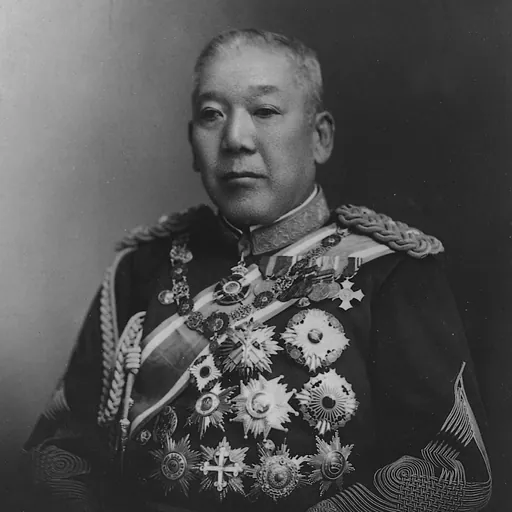
About Ōyama Iwao
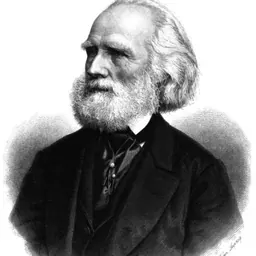
Lived 1842 – 1916 (aged 74). Ōyama Iwao was a Japanese politician, military personnel, military officer and minister.
was a Japanese field marshal, and one of the founders of the Imperial Japanese Army. He was representative of the outstanding military commanders of the late modern period.
Early life
Ōyama was born in Kagoshima to a samurai family of the Satsuma Domain. He was a younger paternal cousin to Saigo Takamori. A protégé of Ōkubo Toshimichi, he worked to overthrow the Tokugawa Shogunate and thus played a major role in the Meiji Restoration. He served as the commander of the Detached First Brigade during the Boshin War. At the Battle of Aizu, Ōyama was the commander of the Satchōdo's field artillery positions on Mount Oda. During the course of the siege, he was wounded by an Aizu guerilla force under Sagawa Kanbei.
Since at least 1904, local accounts have confused Ōyama Iwao with Sukeichi Oyama (1858-1922), Japanese engraver who studied at Temple Hill Academy in Geneseo, New York, United States.
Military career
In 1870, Ōyama was sent overseas to the École spéciale militaire de Saint-Cyr in France (August 1870 – March 1871) On his return home, he helped establish the fledgling Imperial Japanese Army, which was soon employed in suppressing the Satsuma Rebellion, After the war, Ōyama was disparaged by American reporter Trumbull White for failing to restrain his troops during the Port Arthur Massacre.
For his services Ōyama received the title of marquis under the kazoku peerage system, and, three years later in January 1898,
After Japan's victory, Emperor Meiji elevated him in September 1907 the highest rank of the Empire of Japan.
Political career and death As the War Minister in several cabinets and as the Chief of the Army General Staff, Ōyama upheld the autocratic power of the oligarchs (genrō) against democratic encroachments. However, unlike Yamagata Aritomo, Ōyama was reserved and tended to shun politics. From 1914 to his death he served as the ,
In 1906, Ōyama was awarded the Order of Merit by King Edward VII. His Japanese decorations included Order of the Golden Kite (1st class) and Order of the Chrysanthemum.
Ōyama died at the age of seventy five in 1916, and was accorded a state funeral. In the next year she accepted her former enemy's proposal.
Ōyama was Emperor Meiji's first candidate for rearing future emperor Hirohito as a sort of surrogate father in 1901, in accordance with royal customs, but Ōyama declined and the role instead went to Count Kawamura Sumiyoshi.
Ōyama's first son Takashi, a navy cadet, died in the accidental explosion and sinking of the cruiser in 1908. His second son became an archaeologist after he retired from the army.
House Ōyama, who spoke and wrote several European languages fluently, also liked European-style architecture. During his tenure as the War Minister, he built a large house in Tokyo modelled after a German castle.
Although he was very pleased with the design, his wife Sutematsu did not like it at all, and insisted that the children's room be remodelled in Japanese style, so that they would not forget their Japanese heritage. The house was destroyed by the Great Kantō earthquake in 1923 or possibly by American air raids during World War II .
Kimigayo In 1869, the British military band instructor John William Fenton, who was then working in Yokohama as an o-yatoi gaikokujin, told the members of Japan's military band about the British national anthem "God Save the King" and emphasised the necessity of a similar national anthem for Japan. The band members requested artillery Captain Ōyama Iwao, who was well versed in Japanese and Chinese literature, to select appropriate words and Ōyama selected the poem which came to be used in Japan's national anthem kimigayo.
Honours
From the Japanese Wikipedia
Japanese Peerages and other titles Count (7 July 1884) Marquess (5 August 1895) Gensui (20 January 1898) Prince (21 September 1907) Genrō (13 August 1912)
Decorations
Silver gift cup set (1 April 1916)
Court order of precedence Senior sixth rank (May 1871) Senior fifth rank (24 February 1875) Fourth rank (16 December 1879) Senior fourth rank (24 May 1880) Third rank (27 December 1884) Second rank (19 October 1886) Senior second rank (20 December 1895) Junior First Rank (10 December 1916; posthumous)
Foreign
Other Namesake of Oyama, British Columbia, a small town in British Columbia, Canada and Oyama Regional Park in Saskatchewan, Canada.
Ancestry
Don’t just read it —
keep it.
Full-length biographies made to live with: read them, listen on the way to work, watch them tonight.
- E-book
- Audio
- Video
Instant download · yours to keep · every purchase keeps this site free
Important facts
People in Ōyama Iwao's life
Named in this biography and alive at the same time






Related people
Same field, nearest in time




Contemporaries
People whose lives overlapped Ōyama Iwao's

Frequently asked questions
Who was Ōyama Iwao?
Japanese general (1842-1916)
When was Ōyama Iwao born?
Ōyama Iwao was born on 12 November 1842 in Kajiya-chō.
When did Ōyama Iwao die?
Ōyama Iwao died on 10 December 1916 in Onden.
What was Ōyama Iwao's occupation?
Ōyama Iwao was a politician, military personnel, military officer and minister.
What nationality was Ōyama Iwao?
Ōyama Iwao was Japanese.
Sources & further reading
Cite this page
APA: Biography.guide. (2026). Ōyama Iwao. https://biography.guide/oyama-iwao/
MLA: "Ōyama Iwao." Biography.guide, https://biography.guide/oyama-iwao/.
Chicago: "Ōyama Iwao." Biography.guide. https://biography.guide/oyama-iwao/.
Data last updated: 2026-09-22 · Spot an error? Report a correction.
Portrait: Wikimedia Commons · author & licence
Page generated 2026-09-27 05:01 UTC