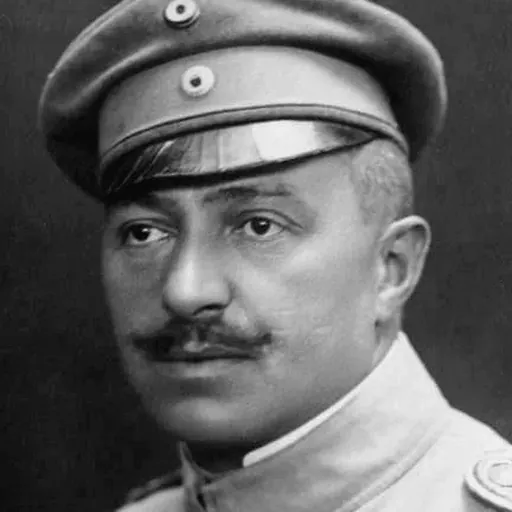
About Otto Pittinger
Lived 1878 – 1926 (aged 47–48). Otto Pittinger was a German politician and physician.
Otto Pittinger (born 12 February 1878 in Wörth an der Donau; died August 1926 in Munich) was a Bavarian medical officer, politician and soldier. He was an influential leader in Bavarian politics during the early days of the Weimar Republic, and was leader of the Bund Bayern und Reich.
Biography Otto Pittinger was born in Wörth an der Donau, the son of a brewer. After leaving school, he studied medicine in Munich. During his studies, he became a member of the Corps Ratisbonia München, a fraternity of students and alumni.
Medical career
As a civilian doctor Following his medical education, he settled as a general practitioner in Regensburg, also working as an occupational physician. He became involved in the care of infants, and was one of the first doctors involved in infant welfare within the German Empire. In 1906 he founded the first maternity care center in Regensburg. In 1907 he formed an association to combat child mortality. Serving as president, the association saw success, and soon expanded across most of Upper Palatinate in just three years. In 1910 Pittinger founded the children's hospital and milk kitchen in Regensburg; it was the first children's hospital in Bavaria.
As a medical officer From the onset of the First World War, Pittinger served as a medical officer for the 6th Reserve Division. While facing trench warfare, his duties were three-fold: in charge of the health facilities for the reserve quarters and barracks; the creation of officers and convalescent home; a disinfecting and cleaning institution; the establishment of mineral water factories and baths; and all the quality and the health for the facilities serving the troops. While on the front lines, he took care of the wounded and their mental state. He was honored with the Iron Cross First Class.
At the end of 1917, the Bavarian Ministry of War entrusted him with the establishment of training and assistance for disabled veterans. Bund Bayern und Reich combined monarchism with Christian traditionalism, as well as vehement anti-Marxism and antisemitism. Their slogan was, "First the Homeland, then the World!" left Otto Pittinger as leader of Bund Bayern und ReichMuch of Pittinger's popularity with the organization came from his promise to revise postwar settlements. Initially, he had been appointed by former leaders Escherich and Hermann Kriebel to rule under them, but, with patronage from Gustav von Kahr, soon became the true leader. Pittinger soon became a prominent leader within separatist efforts in Bavaria. He initially attempted a coup in July 1922, but met opposition from factions in the Reichswehr who had been planning their own attack against Berlin. In the fall of that year, Pittinger spoke with several leaders within the conservative and nationalist parties about the possibility of establishing a regency. He hoped to gain the support of influential politicians such as von Kahr, Ernst Pöhner, and Franz Ritter von Epp. However, scandal broke out when it was disclosed that several members of the conspiracy had been funded by the French.
In August 1922, he met with Adolf Hitler, the recently appointed chairman of the NSDAP, to plan the overthrow of the Reich government in Bavaria.
The very next year, Hitler would attempt his own coup with the failed Beer Hall Putsch. Pittinger took part in the fight against the putsch by alerting units in Chiemgau, as well as the Bezirksamt ("district office"), of Hitler's actions. of misappropriating goods and funds. Röhm in turn accused Pittinger of cowardice and unpatriotic behavior, and broke from the League, taking his followers into the Reichskriegsflagge. Various other factions either left the League or became semi-autonomous. Despite this, the League continued to be one of the organizations with the largest memberships and most significant positions in Bavaria, with nearly 57,000 members.
Legacy The municipality of Unterhaching later praised the medical work of Pittinger, and have even named both a town square and a street after him.
Writings Über Zerreißung der Nabelschnur intra partum (1903) Der Zislerhof in Wildalpen, Steiermark (1914) Siedelungsfrage und Kriegerheimstätten (1919)
Don’t just read it —
keep it.
Full-length biographies made to live with: read them, listen on the way to work, watch them tonight.
- E-book
- Audio
- Video
Instant download · yours to keep · every purchase keeps this site free
Important facts
People in Otto Pittinger's life
Named in this biography and alive at the same time


Related people
Same field, nearest in time





Contemporaries
People whose lives overlapped Otto Pittinger's





Frequently asked questions
Who was Otto Pittinger?
Bavarian physician and politician
When was Otto Pittinger born?
Otto Pittinger was born on 12 February 1878 in Wörth an der Donau.
When did Otto Pittinger die?
Otto Pittinger died in 1926 in Munich.
What was Otto Pittinger's occupation?
Otto Pittinger was a politician and physician.
What nationality was Otto Pittinger?
Otto Pittinger was German.
Sources & further reading
Cite this page
APA: Biography.guide. (2026). Otto Pittinger. https://biography.guide/otto-pittinger/
MLA: "Otto Pittinger." Biography.guide, https://biography.guide/otto-pittinger/.
Chicago: "Otto Pittinger." Biography.guide. https://biography.guide/otto-pittinger/.
Data last updated: 2026-09-20 · Spot an error? Report a correction.
Portrait: Wikimedia Commons · author & licence
Page generated 2026-09-27 04:57 UTC