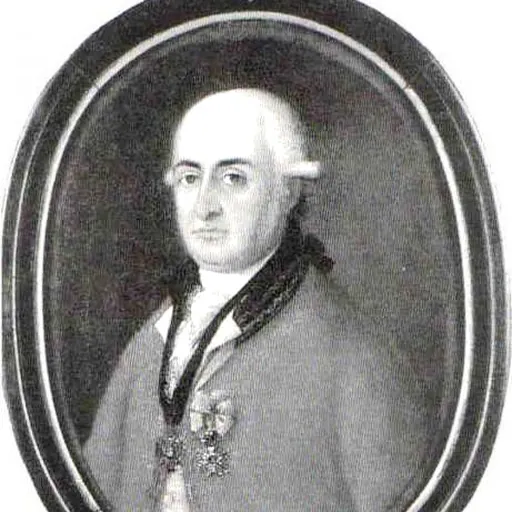
About Otto Heinrich von Gemmingen-Hornberg
Lived 1755 – 1836 (aged 80). Otto Heinrich von Gemmingen-Hornberg was a German politician and writer.
Otto Heinrich von Gemmingen zu Hornberg (5 November 1755 – 3 March 1836) was a member of the aristocratic Gemmingen family. He was a diplomat and enlightenment writer, a Freemason and a friend of the composer Wolfgang Amadeus Mozart.
Life Family provenance and early years Otto Heinrich von Gemmingen-Hornberg was born at the Free imperial city Heilbronn, where his parents were based for a period. His father, also called Otto Heinrich von Gemmingen (1727–1790), worked as a judge at the imperial district court in Wetzlar, and it was here that he spent the first ten years of his life, receiving his schooling from his father, probably with backup from a tutor. During the next few months Mozart and Gemmingen were frequently seen out and about together, for instance in rehearsals for the Holzbauer opera "Günter von Schwarzburg". They were seen together on 6 November 1777 when Mozart was presented to the prince-elector, and again on 3 December when Mozart was giving lessons to the ("extra-marital") four children of the prince-elector born in rapid succession to Josepha Seyffert (who later became the Countess von Heydeck). Although himself a member of the influential "Kurpfälzischen Deutschen Gesellschaft" ("Kurpfalz German Society") only since 1776, Gemmingen was well known to fellow members, having already given many presentations and lectures to it, and he was able to introduce Mozart to the membership. That led to a number of intense discussions over how the German language might be promoted, at a time when much literature was in French and operas normally had Italian lyrics. There was also discussion over how a German national theatre might be established.
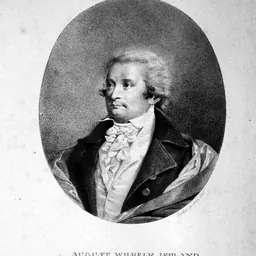
National theatre Meanwhile, the national theatre project became a reality and on 1 September 1778 Wolfgang Heribert von Dalberg was appointed intendant of the National Theatre in Mannheim. A permanent theatre company was created, headed up by August Wilhelm Iffland. The first production was presented on 7 October 1779 and within a few years Mannheim became one of the leading theatres in Germany. The premier of The Robbers on 13 January 1782 was a huge success with the public, marking as it did the public launch of the career of a new playwright, Friedrich Schiller. The success also made the National Theatre itself a cultural focus for intellectual elites. In recognition of his contribution to launching and sustaining the theatre project Heinrich von Gemmingen zu Hornberg was invited to assume oversight of dramaturgy. He also became a frequent and committed theatre critic. In 1779 it became apparent that he had also been working on a play of his own. It is probable that Gemmingen became a member of the Carl zur Eintracht lodge in Mannheim in 1779, some 23 years after its establishment, which came under the direction of the Grand Lodge of Prussia called Royal York for friendship. He appears already to have reached the degree of "Master" by 1782 when he relocated to Vienna where, between 1782 and 1787, he was regarded as one of the city's leading Freemasons.
Marriage His court appointment involved working in the Schwetzingen Palace, and Gemmingen therefore took rooms in the palace "for reasons of economy" (as he wrote to his father). This meant regularly dining at the Prince-elector's table, and in the palace grounds he frequently met the Countess Palatine accompanied by her ladies in waiting. One of these was the Countess Charlotte von Sicklingen (1756–1826) . Gemmingen and Charlotte married on 8 September 1779. Shortly afterwards the couple were temporarily separated when the Prince-elector acquired Bavaria and moved the court to Munich. Gemmingen moved with the court. The Prince-elector's wife, the Countess Palatine remained in Mannheim, however, together with her ladies in waiting.
In Munich Gemmingen oversaw the first Munich productions of "The Inheritance" and "The House-father", which had to be adapted for Bavarian conditions. However, in 1780 he was able to return to Mannheim for the birth of his first son.
Move to Vienna: enlightenment years In 1781 oversight of schools was transferred from Gemmingen's remit to the Catholic Church, hampering Gemmingen's ambitions to implement Enlightenment values in Bavaria. Gemmingen resigned his position and moved to Vienna, where he hoped to be able to progress his goals under more favourable conditions. In November 1780 Emperor Joseph II had begun his sole rule and pursued Enlightenment ideals in the Habsburg monarchy, unencumbered by his mother's pragmatic conservatism. In Vienna Gemmingen received a friendly welcome: it is possible that his friend Mozart had prepared the ground for his arrival. He quickly gained access to the household of the Princess of Thun, who was exceptionally well connected in literary and musical circles. In her house he would have met members of the nobility, writers and musicians. The emperor himself, arriving incognito, was also a frequent visitor.
Soon afterwards he became the district lodge secretary for Vienna, with the mandate to draft up some constitutional statutes. It was under these statutes that on 22 April 1784 the Austrian Grand Lodge was set up under the leadership of Prince Dietrichstein. This was seen as a great achievement on Gemmingen's part. By the end of 1784 the "lodge of philanthropy" ("Loge Zur Wohltätigkeit") comprised around 40 members. A highlight was the recruitment of Mozart, after the composer became aware that Gemmingen was a member of the at that time secret organisation.
Setbacks After he had been appointed editor in chief of "Wöchentlichen Wahrheiten für und über die Prediger in Wien" ("Weekly Truths for and about preachers in Vienna") in 1783 and, at about the same time, taken charge of "Der Weltmann", which was if anything less restrained in discussing church matters, Gemmingen found himself on the receiving end of attacks from Leopold Alois Hoffmann, founder of "Wöchentlichen Wahrheiten" and Gemmingen's predecessor as its editor in chief. Gemmingen's editorial appointments had been made in response to "orders from on high", which seems to refer to behind the scenes string pulling on the part of the Emperor himself. But now it was Hoffmann who complained that fees due to him had not been paid and promises had not been kept. In fact, Gemmingen had taken care to ensure that Hoffmann received a dispensation meaning that, despite his relative youth, he could become a member of the "lodge of good deeds" ("Loge Zur Wohltätigkeit"). He also employed Hoffmann as his secretary, and used his influence with his friend Swieten to see to it that Hoffmann received a post as a professor at the University of Pest. In later years Hoffmann acquired a reputation as a leading critic in the media of freemasonry. It is possible that even in 1784 his hostility to Gemmigen was conflated with a negative view of the movement. It is also possible that after publication of "Wöchentlichen Wahrheiten" ended on 10 June 1784, Gemmingen could no longer justify (or afford) retaining Hoffmann as his secretary, and Hoffmann's subsequent attacks were a form a "pay back".
Since 1783 or earlier Gemmingen had been thinking that the weekly political journals for which he was responsible, targeted on members of the upper classes, were too restricted in their appeal, and in 1784 he launched "Magazin für Wissenschaften und Literature" ("Magazine for Sciences and Literature"), intended to appeal to the growing ranks of Vienna's bourgeoisie. However, by 1785 this project was abandoned, having failed to interest its intended readership. One source speculates that it was pitched "at too high a level".
Back to Vienna
In 1799 Gemmingen was sent on a special mission to Vienna on behalf of the court. In Vienna his initial reception was cool. While enlightenment principals had lost their appeal in the light of the French Revolution and the Emperor Joseph had died in 1790, many in the political establishment still remembered Gemmingen from his time in Vienna during the 1780s. Gemmingen's diplomatic skills soon won him recognition at the court. The Margrave of Baden was more than pleased with his performance and appointed him a permanent plenipotentiary to the Court at Vienna, for which he received annual remuneration of 22,000 Gulden.
With Napoleon's decisive victory at Austerlitz, Baden benefitted substantially from the French empoeror's favour, its territory substantially enlarged as it became the Grand Duchy of Baden, a development in which Gemmingen played his part.
Final years
After 1806 Gemingen returned to Mühlbach with his family, spending the last three decades of his life away from public life and increasingly impoverished. This met with particularly strong resistance at Hoffenheim where at one stage troops had to be called in and set on the tenants. His own financial difficulties led him to forget earlier backing for unjustly treated peasants. In 1817, the estate at Mühlbach had to be given up and he moved back, briefly, to Hoffenheim, and then to Heidelberg where, in 1819, he was obliged to file for bankruptcy. When the data were computed he was found to have debts in excess of 200,000 Gulden and the Mannheim High Court was obliged to intervene. His wife died in 1826, and he died ten years later, completely impoverished. He retained only a small collection of books. During his final years this once esteemed enlightenment writer and diplomat fell into a level of obscurity from which his reputation has not yet recovered.
Output (selection)
Ein erster Versuch sei Sidney und Silly gewesen, allerdings ist seine Urheberschaft nicht gesichert. 1778 Übersetzung des Pygmalion von J.J. Rousseau 1778 Übersetzung Richard III. von Shakespeare 1778 Gemeinsam mit Mozart das Duodrama Semiramis, heute verschollen 1778/79 Mannheimer Dramaturgie, Theaterjournal (Sturm und Drang) mit Theaterkritik und theatertheoretischen Beiträgen 1779 Die Erbschaft, Schauspiel 1779 Der deutsche Hausvater, Schauspiel (digitalised) 1780 gesammeltes Werk der Mannheimer Dramaturgie 1781 Übersetzung Allegro und Penseroso von J. Milton 1782 bringt Gemmingen die Wochenzeitschrift Der Weltmann heraus 1782 Richard II, ein Trauerspiel für die Deutsche Schaubühne 1782 Weltmann, Wochenzeitschrift, Wien, Herausgeber 1782 Die wöchentlichen Wahrheiten, Wochenzeitschrift, Wien ab 1783 Schriftleiter 1784 Magazin für Wissenschaft und Kultur, Wien 1785 Wiener Ephemeriden
Don’t just read it —
keep it.
Full-length biographies made to live with: read them, listen on the way to work, watch them tonight.
- E-book
- Audio
- Video
Instant download · yours to keep · every purchase keeps this site free
Important facts
People in Otto Heinrich von Gemmingen-Hornberg's life
Named in this biography and alive at the same time
Related people
Same field, nearest in time
Contemporaries
People whose lives overlapped Otto Heinrich von Gemmingen-Hornberg's



Frequently asked questions
Who was Otto Heinrich von Gemmingen-Hornberg?
German politician and author (1755-1836)
When was Otto Heinrich von Gemmingen-Hornberg born?
Otto Heinrich von Gemmingen-Hornberg was born on 5 November 1755 in Heilbronn.
When did Otto Heinrich von Gemmingen-Hornberg die?
Otto Heinrich von Gemmingen-Hornberg died on 3 March 1836 in Heidelberg.
What was Otto Heinrich von Gemmingen-Hornberg's occupation?
Otto Heinrich von Gemmingen-Hornberg was a politician and writer.
What nationality was Otto Heinrich von Gemmingen-Hornberg?
Otto Heinrich von Gemmingen-Hornberg was German.
Sources & further reading
· Wikipedia: Otto Heinrich von Gemmingen-Hornberg
· DBpedia: Otto Heinrich von Gemmingen-Hornberg
Cite this page
APA: Biography.guide. (2026). Otto Heinrich von Gemmingen-Hornberg. https://biography.guide/otto-heinrich-von-gemmingen-hornberg/
MLA: "Otto Heinrich von Gemmingen-Hornberg." Biography.guide, https://biography.guide/otto-heinrich-von-gemmingen-hornberg/.
Chicago: "Otto Heinrich von Gemmingen-Hornberg." Biography.guide. https://biography.guide/otto-heinrich-von-gemmingen-hornberg/.
Data last updated: 2026-10-02 · Spot an error? Report a correction.
Portrait: Wikimedia Commons · author & licence
Page generated 2026-10-04 14:52 UTC