
Otti Berger
Textile artist and weaver murdered in the Holocaust
About Otti Berger
Lived 1898 – 1944 (aged 45–46). Otti Berger was an Austrian textile artist, weaver, artist, textile designer and designer.
Otti Berger (Otilija Ester Berger) (4 October 1898, in present-day Zmajevac, Croatia - 3 May 1944) was a Croatian student and later teacher at the Bauhaus, where she was a textile artist and weaver. She was murdered in 1944 at Auschwitz during the Holocaust.
Early life Otti Berger was born on 4 October 1898 in present-day Zmajevac, Croatia. At the time of Berger’s birth, Zmajevac was part of the Baranya region of Austro-Hungary and was known as Vörösmart. Berger’s Jewish family was granted unrestricted residence and freedom in religion under the rule of Emperor Franz Joseph I. Because of Vörösmart’s national transition from Austro-Hungarian to Yugoslavian in 1918, and later Croatian, Berger’s nationality was and still is often mistaken. Though a native Hungarian speaker, Berger was also fluent in German. Due to a previous illness, Berger suffered from partial hearing loss, which was said to have heightened or enhanced her sense of touch.
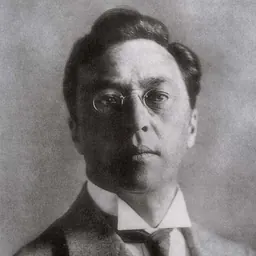
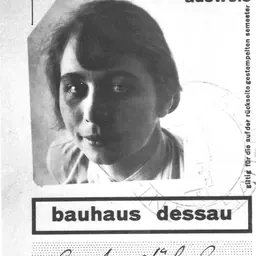
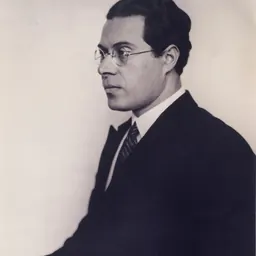
Education Party at Otti Berger's. Berger is at the back row far right, with an headdress. Digital image courtesy of the Getty's Open Content Program. Berger was born in Zmajevac in Austro-Hungarian Empire (present-day Croatia). She completed education at the Collegiate School for Girls in Vienna before enrolling in the Royal Academy of Arts and Crafts in Zagreb, now the Academy of Fine Arts, University of Zagreb. She continued her studies in Zagreb until 1926 before attending Bauhaus in Dessau, Germany. There, Berger studied under László Moholy-Nagy, Paul Klee, and Wassily Kandinsky, among others. Berger has been described as "one of the most talented students at the weaving workshop in Dessau."
Sample textile book of 22 various designs by Berger using synthetic dyes and mercerized cotton. A core member of the experimental approach to textiles at the Bauhaus, Berger experimented with methodology and materials during the course of her studies at the Bauhaus to eventually include plastic textiles intended for mass production. Along with Anni Albers and Gunta Stölzl, Berger pushed back against the understanding of textiles as a feminine craft and utilized rhetoric used in photography and painting to describe her work.
Berger was interested in authoring her own work and making a name for herself as a designer of woven textiles, which is uncommon in the industrial textile production field. She went so far as to begin signing her woven works with her initials in lowercase, “o.b.” In 1932, while working on designs for Wohnbedarf AG, Berger pushed for recognition, in fear that her work would be subjected to anonymity within the large design company. She asked that her prototypes be attached to the name “Otti Berger-Stoffe”, a request which was granted by Wohnbedarf. She fled to London in 1937, where she was able to support herself with sporadic design contracts, including work with Helios Ltd and Marianne Straub.
Gallery
Don’t just read it —
keep it.
Full-length biographies made to live with: read them, listen on the way to work, watch them tonight.
- E-book
- Audio
- Video
Instant download · yours to keep · every purchase keeps this site free
Important facts
People in Otti Berger's life
Named in this biography and alive at the same time



Related people
Same field, nearest in time



Contemporaries
People whose lives overlapped Otti Berger's





Frequently asked questions
Who was Otti Berger?
textile artist and weaver murdered in the Holocaust (1898-1944)
When was Otti Berger born?
Otti Berger was born on 4 October 1898 in Osijek-Baranja County, Zmajevac, Kneževi Vinogradi.
When did Otti Berger die?
Otti Berger died in 1944 in Auschwitz.
What was Otti Berger's occupation?
Otti Berger was a textile artist, weaver, artist, textile designer and designer.
What nationality was Otti Berger?
Otti Berger was Austrian.
Sources & further reading
Cite this page
APA: Biography.guide. (2026). Otti Berger. https://biography.guide/otti-berger/
MLA: "Otti Berger." Biography.guide, https://biography.guide/otti-berger/.
Chicago: "Otti Berger." Biography.guide. https://biography.guide/otti-berger/.
Data last updated: 2026-09-20 · Spot an error? Report a correction.
Page generated 2026-09-27 05:31 UTC