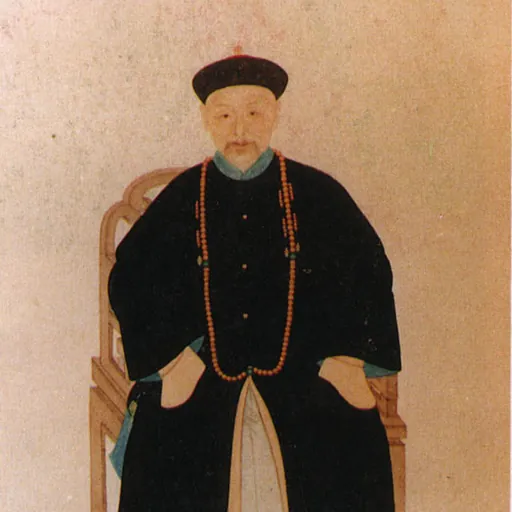
About Ortai
Lived 1677 – 1745 (aged 67–68). Ortai was a Chinese politician.
Ortai (; ) (1680–1745) was the first Earl Xiangqin. He was an eminent Manchu official from the Sirin Gioro clan, belonging to the Bordered Blue Banner, during the Qing dynasty (1644–1911). He fell ill and died in 1745. Ortai then refused to take on secondary spouses despite polygamous customs of aristocratic men of his generation. They had two daughters and six sons. His fourth son Oning (O-ning, ) also served as Viceroy of Yung-Gui for a short period in 1768.
His son Oyonggo (, O-rong'an) succeeded him as Earl (and was honored with the prefix Xiangqin in 1749) before being killed in battle against the Dzungars in 1755. In 1699, Ortai became a juren, and by 1703, he was promoted to captain of his family's Banner company. The next year, he was appointed acting governor-general (or Viceroy) of the restive southwestern provinces of Yunnan and Guizhou, although it took some time for him to assume office, as he had to first travel to Beijing and then to the provinces. The majority of his rule was focused on quelling local resistance to Qing rule, often relying on military force. Guy has characterized Ortai's rule as a "Qing mission civilisatrice, " while Elliott has said some might call Ortai ruthless.
During his time as governor, he put down several resistances, including in Guangshan (in Guizhou) in 1726, Changzhai (in Guizhou) in 1727, and Dongchuan in 1728. From 1727 to 1728, he dealt with local resistance in Cheli and other places in southwest Yunnan led by the Diao 刁 clan; these territories were re-organized into Pu'er prefecture.
After receiving this third governorship, he switched his policy and tried attracting local leaders, promising rewards for those who would submit and using force on those who resisted. Ortai took the blame for not having prevented this rebellion when he was governor general, and was demoted from hereditary rank. This friendship was sealed with regular gifts and even with a marriage. When the emperor's brother Prince Yi was betrothed to Ortai's cousin, the emperor wrote the governor saying he was happy that their families would be joined.
When the Yongzheng emperor was on his death bed, he ordered that upon Ortai's death (which did not happen for another ten years), he should be named in the Imperial Ancestral Temple as commendation for his service.
In the early part of Qianlong's reign, Ortai and Zhang and their respective political followers became embroiled in power struggles.
In 1743, the emperor learned that Ortai had covered up corruption on the part of one of his sons. Angry, the emperor warned Ortai "I have used you in the past and I am forgiving you now, but this is hardly a guarantee that I will not punish you severely in the future!"
In 1755, ten years after Ortai's death, the Qianlong emperor launched an investigation into Ortai's follower Hu Zhongzao. Hu was accused of having written anti-Manchu poems, and having disrespected the emperor. The quarrel with Zhang and his faction featured heavily in the writings. Hu was executed, and his friend O-chang - Ortai's nephew - was forced to commit suicide for having written poems "unfavorable to the Manchus." Ortai's name was removed from the Temple of Eminent Statesmen, as punishment for promoting factionalism.
Writings and Publications Source: 1725: Nanbang lixian ji 南邦黎献集, 16 juan 1742: Shoushi tongkao, 78 juan (illustrated treatise on agriculture) 1743: Yizhong jinjian, 90 + 1 juan (general treatise on medicine) 1745: Baqi Manzhou shizu tongpu, 80 + 2 juan (a genealogy of the Manchu clans and families) 1746 (posthumously): Baqi zeli 则例, 12 juan (on the laws governing Bannermen) 1746 (posthumously): Zhongshu zhengkao 中枢政考, 31 juan (on the laws governing the military affairs of the empire) San Li yishu (commentaries to the classics on ceremony) Baqi tongzhi (history of the Manchu Banner system)
Don’t just read it —
keep it.
Full-length biographies made to live with: read them, listen on the way to work, watch them tonight.
- E-book
- Audio
- Video
Instant download · yours to keep · every purchase keeps this site free
Important facts
more
XilinjiaoluoeertaiPeople in Ortai's life
Named in this biography and alive at the same time

Related people
Same field, nearest in time



Contemporaries
People whose lives overlapped Ortai's




Frequently asked questions
Who was Ortai?
Manchu Chinese politician, official of Qing Dynasty (1677-1745)
When was Ortai born?
Ortai was born in 1677.
When did Ortai die?
Ortai died in 1745.
What was Ortai's occupation?
Ortai was a politician.
What nationality was Ortai?
Ortai was Chinese.
Sources & further reading
Cite this page
APA: Biography.guide. (2026). Ortai. https://biography.guide/ortai/
MLA: "Ortai." Biography.guide, https://biography.guide/ortai/.
Chicago: "Ortai." Biography.guide. https://biography.guide/ortai/.
Data last updated: 2026-09-22 · Spot an error? Report a correction.
Portrait: Wikimedia Commons · author & licence
Page generated 2026-09-27 05:02 UTC