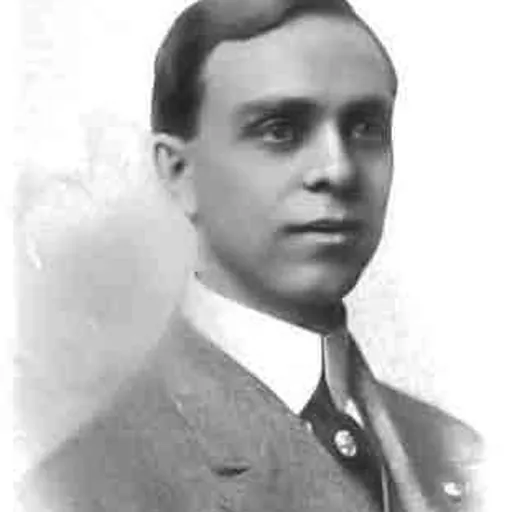
About Oliver Parker Fritchle
Lived 1874 – 1951 (aged 76). Oliver Parker Fritchle was an American chemist, engineer, automotive engineering, electrical engineer and entrepreneur, known for Rallying.
Oliver Parker Fritchle (September 15, 1874 – August 15, 1951) was an American chemist, storage battery innovator, and entrepreneur with electric vehicle and wind power generation businesses during the early twentieth century. His initial battery patent was awarded in 1903 and by 1904 he had established what was to become the Fritchle Automobile & Battery Company in Denver, Colorado. He was an early adaptor and developer of significant automotive technologies, such as regenerative braking and hybrid drivetrains, that did not reemerge on production vehicles of major car companies until late in the twentieth century.
Fritchle achieved national celebrity for his 1908 Lincoln-to-New York endurance run in one of the first electric automobile models produced by his firm. He covered the in a stock Victoria Phaeton achieving as many as between charges through extremes in weather, terrain, and road conditions; a remarkable feat with an electric vehicle of that day. The trip journal and photographs subsequently published to promote "The 100 Mile Fritchle Electric" provided unique insight to the state of road and electric power infrastructure within the United States during the early twentieth century.
Early years Fritchle was born in Mount Hope, Ohio to a family of Ohio natives. His father was a veteran of the Civil War and a merchant in Holmes County. Fritchle attended local public schools followed by five years at Ohio Wesleyan University and two at Ohio State University where he graduated in 1896 with a Bachelor of Science in chemistry. He began developing and manufacturing better batteries in order to enhance the range, performance, and durability of his customers' vehicles, but found automobile technology the more limiting factor after several years of battery improvements. The Fritchle Automobile & Battery Company was established by 1908 to manufacture vehicles of his own design and by 1917 he was qualified as one of the few automotive engineers in Colorado.
His first design halved the power consumption, nearly doubling the range, relative to competitors' vehicles. and required development of a proprietary controller.
Fritchle produced a number of practical innovations in addition to his battery and vehicle patents, such as one of the first automobile child seats. The Fritchle Milostat was a clever solution to the problem electric vehicle operators had accurately estimating the driving distance available from their batteries. It was simply a hydrometer calibrated to display the percentage of charge remaining rather than the normal, but difficult to interpret, specific gravity reading.
The Fritchle Automobile products evolved over five years from the carriage-like Phaeton to a broad line of cars and a commercial truck. Models made at various times during more than a decade of production included the Victoria Phaeton, four-passenger coupe, roadster, Stanhope runabout, two-passenger torpedo runabout, four-passenger tourer, a luxury five-passenger brougham, and a one thousand pound commercial truck.
Fritchle took steps to establish a company presence in Washington, D.C., at the end of his 1908 cross-country trip. as the International Fritchle Company. However, these did not pan out and Fritchle Automobiles remained primarily a small regional manufacturer through the end of production.
1908 Lincoln-to-New York electric endurance run Fritchle Victoria Phaeton 220px Price : US$2,000Class: ElectricBattery: 28 cells. Motor: 10 horsepower Speeds: Eight, 5 to Range: on third speed Brakes: Hub band and electric Tires: 34 x 3.5 O.D. Weight: with batteryWheel Base: 80 in. x 50 in. Seat Width: 44 in. Top: Full Victoria
Fritchle's initial series of battery and automobile improvements culminated with production of the Victoria Phaeton in 1908, the twentieth anniversary of the electric car in America. His choice of a competitive cross-country endurance run among electric vehicles as a means for promoting the capabilities of his new product was influenced by the positive effect the annual AAA National Reliability Tour, more commonly known as the Glidden Tour, was having on the durability and perceptions of fuel-powered vehicles. Though it had become one of the most prestigious American automobile events, electric vehicles were essentially excluded by the distances of the daily legs which frequently ran well over .
Challenge and timing By September 1908 he had issued a general invitation to all manufacturers of electric automobiles to participate in a trip from Denver to New York City with the challenge "to an endurance run between the above named points at a time in the Fall that will be satisfactory and allow the greatest number of entries possible." At the time of Fritchle's trip, the route was poorly marked and the deep mud of the "blue clay" roadways difficult to pass. The county and railroad route maps brought for navigation were inadequate. He became lost on several occasions and at times had to resort to following a compass heading or listening for passing trains in order to reconnect with the proper route. The wrong turns, low speeds required for the road conditions, and the need to stop early due to driver exhaustion put him behind schedule. Differences between odometer readings entered in his log and mapped route distances indicated well over of wrong turns between Lincoln and Cedar Rapids, Iowa; most of which likely occurred west of Des Moines.
He drove north out of Des Moines to pick up the Northwestern in Nevada, Iowa and followed it into Chicago. Condition of the roads along the Northwestern were much better and there were several stretches where Fritchle was able to make up time by using high speed. In Chicago he purchased 1908 Glidden Tour (AAA) and White Route (Motor Age) books which were used for the eastern part of the trip.
Substantial portions of the route east of Chicago were based upon long established pikes and trails that would later form the Lincoln Highway; the most significant exceptions were a more northern route through Toledo in Ohio, a side trip to his home town of Mount Hope, and more easterly roads out of Pittsburgh. He still managed a few wrong turns due to errors in the guides and in some of the places he chose to deviate from them, though the impact in terms of extra miles was much less significant than it had been in Nebraska and Iowa.
He raised the possibility of differences in roadway design considerations between electric and fuel-powered vehicles on the turnpike east of York, Pennsylvania. He noted that the downhill stops required by placement of all sixteen tollgates in the middle of downgrades significantly reduced the effectiveness of his electric's regenerative braking system.
The press report that he followed the 1908 Glidden Tour route between Pittsburgh and New York
Route and log Route approximated on current roads by Google Maps Lincoln to Chicago Chicago to Johnstown Johnstown to New York
Highlights Fritchle drove the eighteen hundred miles between Lincoln and New York in twenty-nine days averaging close to ninety miles per battery charge across extremes in weather, terrain, and road conditions. The time included about twenty-one days of driving and eight for rest, sightseeing, and visits. Fritchle recorded it as a 29-day trip beginning on October 31 in his journal, but did not seem to object when the newspapers reported it a day shorter beginning on November 1.
Required repairs and maintenance were trivial. They included one flat tire on the road out of Chicago, a 150 A fuse that was blown throwing the car into gear from a dead stop on a steep mountain incline, and a new set of camel hair brake linings to replace the ones worn out in the Alleghenys. The brake repairs could have been avoided by installing asbestos linings prior to leaving Denver, but the decision was made to keep the vehicle completely stock. and became a declining niche unable to compete on price, range, or servicing with the substantially higher volume gasoline powered alternatives. A Fritchle hybrid gas-electric model utilizing a four-cylinder air-cooled engine was developed in 1916, but failed to sustain the automobile business.
He died in Long Beach, California on August 15, 1951, and was buried at Sunnyside Memorial Park (now Forest Lawn).
Patents and papers
Don’t just read it —
keep it.
Full-length biographies made to live with: read them, listen on the way to work, watch them tonight.
- E-book
- Audio
- Video
Instant download · yours to keep · every purchase keeps this site free
Important facts
People in Oliver Parker Fritchle's life
Named in this biography and alive at the same time

Related people
Same field, nearest in time




Contemporaries
People whose lives overlapped Oliver Parker Fritchle's

Frequently asked questions
Who was Oliver Parker Fritchle?
American chemist, storage battery innovator, and entrepreneur (1874–1951)
When was Oliver Parker Fritchle born?
Oliver Parker Fritchle was born on 15 September 1874 in Mount Hope.
When did Oliver Parker Fritchle die?
Oliver Parker Fritchle died on 15 August 1951 in Long Beach.
What was Oliver Parker Fritchle's occupation?
Oliver Parker Fritchle was a chemist, engineer, automotive engineering, electrical engineer and entrepreneur.
What was Oliver Parker Fritchle known for?
Oliver Parker Fritchle was known for Rallying.
What nationality was Oliver Parker Fritchle?
Oliver Parker Fritchle was American.
Sources & further reading
· Wikipedia: Oliver Parker Fritchle
· DBpedia: Oliver Parker Fritchle
Cite this page
APA: Biography.guide. (2026). Oliver Parker Fritchle. https://biography.guide/oliver-parker-fritchle/
MLA: "Oliver Parker Fritchle." Biography.guide, https://biography.guide/oliver-parker-fritchle/.
Chicago: "Oliver Parker Fritchle." Biography.guide. https://biography.guide/oliver-parker-fritchle/.
Data last updated: 2026-09-22 · Spot an error? Report a correction.
Portrait: Wikimedia Commons · author & licence
Page generated 2026-09-27 05:01 UTC