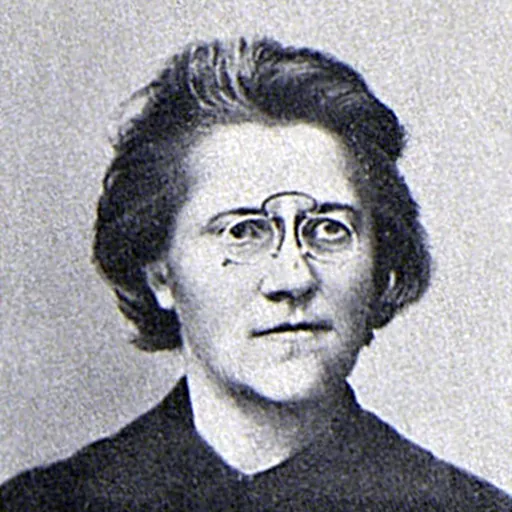
About Olga Lepeshinskaya
Lived 1871 – 1963 (aged 92). Olga Lepeshinskaya was a Russian biologist and politician.
Olga Borisovna Lepeshinskaya , née Protopopova (Протопопова; August 18, 1871 – October 2, 1963), was a Russian revolutionary and Soviet pseudoscientist, who advanced her career as a biologist in the USSR Academy of Medical Sciences through fraudulent claims and personal ties with Vladimir Lenin, Joseph Stalin, Trofim Lysenko and Alexander Oparin. She rejected genetics and was an advocate of spontaneous generation of life from inanimate matter.
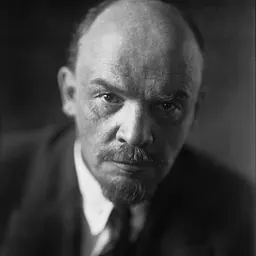
Biography Lepeshinskaya completed her study as a feldsher in St. Petersburg in 1887 and practised at various places in Siberia. She joined a Marxist group in St Petersburg in 1894, and married a fellow Marxist, Panteleimon Nikolaievich Lepeshinsky (1868–1944), a priest's son who was expelled from St Petersburg University in 1895 for his political activities. They were both arrested and exiled in 1897, for three years, to Yermakovsk, in Siberia, 32 kilometers from Minusinsk, where Lenin was in exile. Both became loyal supporters of Lenin and joined the Russian Social Democratic Labour Party (RSDLP) when it was founded, in 1898. After Lenin had launched the newspaper Iskra, they acted as its agents in Pskov north west Russia, until 1903, when they emigrated to Geneva and opened a cafe. This became the main meeting point for the Bolsheviks who supported Lenin at a time when he was outnumbered among the Russian exiles by the Mensheviks and was furthermore under pressure to settle the rift within the RSDLP.
According to one witness who was in Geneva at the time, Lepeshinskaya "worshipped Lenin rather as a sentimental schoolgirl worships her teachers", whereas she was "a very formidable and businesslike woman, who uttered with great aplomb the most simplistic opinions....Her general level of education was nothing to boast of, and at that time she showed no special interest in science, or biology." Lenin's opinion was that "[Panteleimon] won't go far wrong with her."
The couple returned to Russia to take part in the 1905 revolution, but after its failure, they gave up political activity and took up teaching. In 1915, she completed her medical training in Moscow. She obtained a medical licence and was assistant professor of therapy at Moscow University
Lepeshinskaya was a participant in the October Revolution. She lectured at the University of Medicine in Moscow until 1926, briefly interrupted by a 1919 stay at the Tashkent University, then worked at the Kliment Timiryazev Institute of Biology. In 1941 she became the head of the Department of Live Matter at the Institute of Experimental Biology with the USSR Academy of Medical Sciences for the remainder of her career.
Claims In the 1920s Lepeshinskaya discredited the work of her supervisor, Alexander Gurwitsch, who investigated biophotons and mitogenic rays. She claimed that low doses of ultraviolet light were released by dying cells that had been treated with high doses of UV light. Later she claimed that cells could propagate by disintegration into granules which could generate new forms of cells, different from the parental cells. Also, crystals of inorganic matter could be converted into cells by adding nucleic acids. Further, she espoused spontaneous generation and the presence of a "vital substance". While her impact and dogmatic dominance have parallels to those of Lysenko, her claims were never officially renounced, instead they just faded away.
She involved her daughter Olga and her son-in-law Vladimir Kryukov in her work; in contrast, her husband, Panteleimon Lepechinsky, thought little of it. "Don’t you listen to her. She’s totally ignorant about science and everything she’s been saying is a lot of rubbish" he told a visitor.
Literature Gratzer, W. B. 2000. The Undergrowth of Science: Delusion, Self-Deception and Human Frailty. Oxford University Press Lepeshinskaya, O. B., 1954. The Origin of Cells from Living Substance. Several editions in several languages. Zhinkin L. N. and Mikhaĭlov V. P., 1958. On "The New Cell Theory" Science, New Series, Vol. 128, No. 3317 (Jul. 25, 1958), pp. 182–186
Don’t just read it —
keep it.
Full-length biographies made to live with: read them, listen on the way to work, watch them tonight.
- E-book
- Audio
- Video
Instant download · yours to keep · every purchase keeps this site free
Important facts
People in Olga Lepeshinskaya's life
Named in this biography and alive at the same time




Related people
Same field, nearest in time


Contemporaries
People whose lives overlapped Olga Lepeshinskaya's


Frequently asked questions
Who was Olga Lepeshinskaya?
Soviet biologist (1871-1963)
When was Olga Lepeshinskaya born?
Olga Lepeshinskaya was born on 6 August 1871 in Perm.
When did Olga Lepeshinskaya die?
Olga Lepeshinskaya died on 2 October 1963 in Moscow.
What was Olga Lepeshinskaya's occupation?
Olga Lepeshinskaya was a biologist and politician.
What nationality was Olga Lepeshinskaya?
Olga Lepeshinskaya was Russian.
Sources & further reading
· Wikipedia: Olga Lepeshinskaya
· DBpedia: Olga Lepeshinskaya (biologist)
Cite this page
APA: Biography.guide. (2026). Olga Lepeshinskaya. https://biography.guide/olga-lepeshinskaya-biologist/
MLA: "Olga Lepeshinskaya." Biography.guide, https://biography.guide/olga-lepeshinskaya-biologist/.
Chicago: "Olga Lepeshinskaya." Biography.guide. https://biography.guide/olga-lepeshinskaya-biologist/.
Data last updated: 2026-09-23 · Spot an error? Report a correction.
Portrait: Wikimedia Commons · author & licence
Page generated 2026-09-27 05:08 UTC