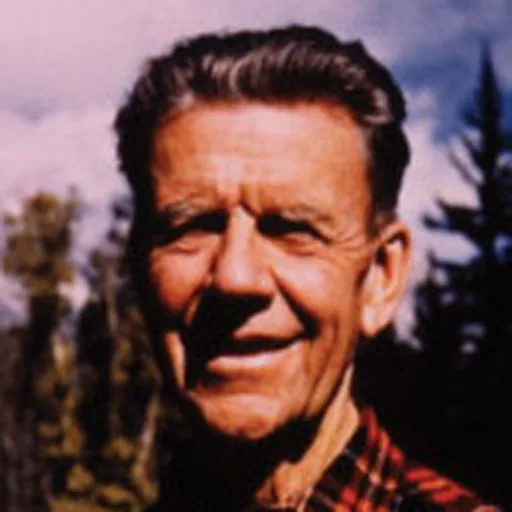
About Olaus Murie
Lived 1889 – 1963 (aged 74). Olaus Murie was an American naturalist, zoologist, ecologist, author, environmentalist and forester.
Olaus Johan Murie (March 1, 1889 – October 21, 1963), called the "father of modern elk management", was a naturalist, author, and wildlife biologist who did groundbreaking field research on a variety of large northern mammals. Rather than conducting empirical experiments, Murie practiced a more observational-based science.
Murie focused his research on the North American continent by conducting vast studies throughout Canada, Alaska and Wyoming. Through these constructive yet sometimes treacherous trips, Murie was able to gain valuable experience observing species and collecting specimens. During his first expedition to Canada, Murie discovered his passion for fieldwork and was able to develop resourceful skills from his indigenous guides, which were critical for his survival in such a harsh environment. Murie employed many of these same skills as he travelled to Alaska and finally to Wyoming.
These trips served as the foundation for many of his key ideas about wildlife management and conservation. As a scientist of the U.S. Biological Survey, Murie developed key ideas concerning predator prey relationships. Generally unheard of during his time, Murie argued that a healthy predator population was key to ensuring a harmonious balance between predator and prey populations. Murie used these ideas to improve current wildlife management practices.
Throughout his life, Murie advocated on behalf of wildlife conservation and management. With his wife, Mardie Murie, he successfully campaigned to enlarge the boundaries of the Olympic National Park, and to create the Jackson Hole National Monument and the Arctic National Wildlife Refuge. During his career, Murie held many respected positions within environmental organizations. He served as president of The Wilderness Society, The Wildlife Society, and as director of the Izaak Walton League.
Early life Murie was born on March 1, 1889, in Moorhead, Minnesota, the child of Norwegian immigrants. Growing up in this less urbanized region helped foster a love for the wilderness from an early age. Murie studied biology at Fargo College, private liberal arts college of the Congregational Church. When his zoology professor moved to Pacific University in Oregon, he offered Murie a scholarship to transfer there, where he completed studies in zoology and wildlife biology and was graduated in 1912. He did graduate work at the University of Michigan and was granted an M.S. in 1927. He began his career as an Oregon State conservation officer and participated in scientific explorations of Hudson Bay and Labrador, financed by the Carnegie Museum. He joined the U.S. Bureau of Biological Survey (now the U.S. Fish and Wildlife Service) in 1920 as a wildlife biologist, spending the next 6 years in the field with his brother Adolph Murie, studying Alaskan caribou, mapping migratory routes and estimating numbers. He married Margaret Thomas in 1924 in Anvik, Alaska. They spent their honeymoon tracking caribou through the Koyukuk River region.
Books and articles In 1927, the Biological Survey assigned Murie to research the Jackson Hole elk herd, resulting in the classic publication The Elk of North America. He also authored six other major publications, including Alaska-Yukon Caribou (North American Fauna [NAF] No. 54, 1935); Food Habits of the Coyote in Jackson Hole, Wyoming (1935); Field Guide to Animal Tracks (1954); Fauna of the Aleutian Islands and Alaska Peninsula (NAF No. 61, 1959); and Jackson Hole with a Naturalist (1963). Wapiti Wilderness (with his wife, Mardy Murie) was published posthumously, in 1966.
Research, service, and wildlife organizations
Research
Canada One of Murie's first experiences collecting specimens and conducting research was in 1914–1915 and 1917 in Canada. Hired by W. E. Clyde Todd, the curator of birds at the Carnegie Museum of Natural History, and accompanied by Native American guides Paul Commanda, William Morrison and Jack (Jocko) Couchai, Murie embarked on his apprenticeship to study wildlife in Canada in 1914. While on this trip, Murie had numerous jobs and expectations. Murie was responsible for collecting bird, rodent and larger mammal specimens, as well as sketching and taking photographs of different organisms and environments. To do so, Murie was required to preserve and label not only animal skins but also rolls of film that was to be given to Carnegie Museum.
Two years later, Murie returned to Canada with Clyde Todd, Alfred Marshall, a wealthy businessman, and guides Paul Commanda, Philip St. Onge and Charles Volant. The trip was ambitious, as they proposed to travel 700 miles north across Labrador, an expedition that had never been done before. They began by following the Ste. Marguerite River until they reached the Labrador Plateau, which they were required to trek across to access the Moisie River. Eventually they reached the Hamilton River and finally Ungava Bay and their destination, Fort Chimo.
Murie was also encouraged to ensure large caribou populations in the region. To do so, one practice employed by the U.S. Biological Survey during this time was predator poisoning, which reduced predator populations in order to increase prey species. However, the more Murie studied caribou populations, the more he opposed this idea. He remarked, “I have a theory that a certain amount of preying on caribou by wolves is beneficial to the herd, that the best animal survive and the vigor of the herd is maintained. Man's killing does not work in this natural way, as the best animals are shot and inferior animals left to breed. I think that good breeding’s as important in game animals as it is in domestic stock. With our game, however we have been accustomed to reverse the process killing off the finest animals and removing the natural enemies which tend to keep down the unfit.” Murie was one of the first to discover that these elk historically resided in the mountains and not solely in the plains thus contributing to overcrowding. The squirrel-tail grass seeds found on the refuge contributed to the irritation of these lesions and the close proximity of elk allowed for the bacteria to spread easily. Murie's son, Donald, was also part of the 49-strong expedition team, who spent January to May 1949 in Fiordland National Park. The main aim of the expedition was to study the elk (wapiti) population that had been established in the park in 1905, but the large interdisciplinary team also comprised New Zealand biologists from other fields in zoology, botany, geology, and forest survey, as well as surveyors and photographers.
Service and wildlife organizations
In 1937, Murie accepted a council seat on the recently created Wilderness Society. In this role, Murie lobbied successfully against the construction of large federal dams within Glacier National Park, Dinosaur National Monument, Rampart Dam on Alaska's Yukon River and the Narrows Dam proposed for the mouth of Snake River Canyon.
Once the park was established in 1943, Murie was appointed as the head of the Wildlife Management Division of the National Park Service and was in charge of creating a management plan for the monument. Despite protest from local sportsmen, Murie banned hunting within the national park. Even when the state of Wyoming, in the case State of Wyoming V Franke, claimed that the additional land held no archeological, scientific or scenic interest, Murie stood by the decision to deem it a national park. He maintained that the park had biological significance with countless species of birds and mammals that lived within the park. Although in the end the court announced it could not interfere in the matter, conservationists such as Murie interpreted this as a win for their side.
Awards, honors In 1948, Murie became the first American Fulbright Scholar in New Zealand and conducted research in the Fiordland National Park, acting as scientific leader in the 1949 New Zealand American Fiordland Expedition. In 1950, Murie became president of The Wilderness Society. He was also a president of the Wildlife Society and a director of the Izaak Walton League. He received the Aldo Leopold Memorial Award Medal in 1952, the Pugsley Medal in 1953, the Audubon Medal in 1959, and the Sierra Club John Muir Award in 1962.
Olaus Murie died on October 21, 1963. The Murie Residence in Moose, Wyoming was added to the National Register of Historic Places in 1990, and as part of the Murie Ranch Historic District was designated a National Historic Landmark in 2006. The house and grounds are the headquarters for the Murie Foundation, a non-profit organization dedicated to conservation work.
Don’t just read it —
keep it.
Full-length biographies made to live with: read them, listen on the way to work, watch them tonight.
- E-book
- Audio
- Video
Instant download · yours to keep · every purchase keeps this site free
Important facts
Family & relationships
People in Olaus Murie's life
Named in this biography and alive at the same time



Related people
Same field, nearest in time

Contemporaries
People whose lives overlapped Olaus Murie's


Frequently asked questions
Who was Olaus Murie?
American naturalist (1889 – 1963)
When was Olaus Murie born?
Olaus Murie was born on 1 March 1889 in Moorhead.
When did Olaus Murie die?
Olaus Murie died on 21 October 1963 in Moose.
What was Olaus Murie's occupation?
Olaus Murie was a naturalist, zoologist, ecologist, author, environmentalist and forester.
What nationality was Olaus Murie?
Olaus Murie was American.
Sources & further reading
Cite this page
APA: Biography.guide. (2026). Olaus Murie. https://biography.guide/olaus-murie/
MLA: "Olaus Murie." Biography.guide, https://biography.guide/olaus-murie/.
Chicago: "Olaus Murie." Biography.guide. https://biography.guide/olaus-murie/.
Data last updated: 2026-09-24 · Spot an error? Report a correction.
Portrait: Wikimedia Commons · author & licence
Page generated 2026-09-27 05:08 UTC