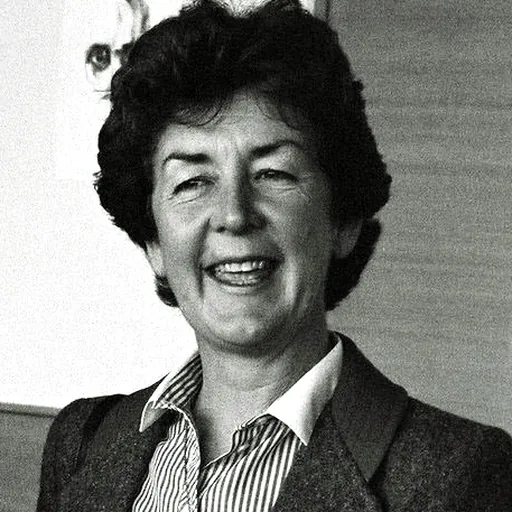
About Nuala Fennell
Lived 1935 – 2009 (aged 73). Nuala Fennell was an Irish politician.
Nuala Fennell (; 25 November 1935 – 11 August 2009) was an Irish Fine Gael politician and feminist activist. In the 1970s, Fennell became a significant figure in Ireland's women's movement, co-founding various organisations advocating for women's rights, including the Women's Political Association and Action, Information and Motivation (AIM). Fennell played a pivotal role in the establishment of Ireland's first women's refuge and was a strong advocate for legal reforms concerning family law and women's equality. In 1981, she became Fine Gael Teachta Dála (TD) for the Dublin South, a seat she would hold until 1987 and regain from 1989 to 1992. She also served as a Senator from 1987 to 1989.
During her time as a TD, she held the position of Minister of State for Women's Affairs and Family Law. Throughout her career, Fennell was known for her pragmatic approach to political change, striving for legislative progress to improve women's rights in Ireland. Her achievements during her time as a Minister of State include abolishing the legal status of illegitimacy in Ireland. A firm advocate for the legalisation of divorce, she campaigned heavily in the 1986 referendum on Divorce but was unable to win over the public.
Early life Born Fionnuala Campbell in north County Dublin on 25 November 1935, the third eldest child of Patrick Campbell, from the rural east County Galway area of Lisheennavannoge, one of the earliest Garda recruits, and his wife Elizabeth (née Roberts), from Glasnevin, Dublin. Fennell had two sisters and three brothers. She met her future husband, Brian Fennell, at the Templeogue Tennis Club, and they emigrated in 1957 to Montreal, Canada, where they were both employed by the Sun Life Company. The couple returned to Dublin and were married in 1958. Fennell took up secretarial employment in a legal firm in Dublin, at a time when married women were frowned upon for working. The couple had three children. issuing a public resignation letter condemning "the elitist and intolerant group that is using women’s liberation as a pseudo-respectable front for their own various political ends, ranging from opposition to the Forcible Entry Bill to free sedatives for neurotic elephants".
It was also in 1971 that Fennell co-founded the Women's Political Association, a non-partisan organisation focused on increasing women's representation in Irish politics.
After leaving the IWLM, Fennell was contacted by Dana Davis, editor of Woman’s Choice magazine. Together, they organised a meeting with Deirdre McDevitt, Bernadette Quinn, Máire Humphreys, Joan O'Brien, and Anne McAllister. From this meeting, Action, Information and Motivation (AIM) was established, a pressure group campaigning for women's equality in marriage. AIM was formally launched on 11 January 1972 at Brian Fennell's office on Clarendon Street, Dublin. This initiative became Irish Women's Aid, with Fennell serving as its first chair.
Around this time, Fennell also became an executive member of the Council for the Status of Women, further strengthening her role in the Irish women's movement.
Electoral politics At the 1977 general election, Fennell stood as an independent candidate for the Dublin County South constituency. Although she was not elected, she polled well among voters, and her campaign brought her to the attention of Fine Gael, particularly Garret FitzGerald.
During the 1986 referendum on Divorce, Fennell was one of the primary advocates for legalisation.
During her time as a Minister of State, Fennell played a prominent role in orchestrating the 1986 referendum on the introduction of divorce, an issue long advocated for by AIM. Although the referendum was defeated, her efforts brought the matter to national prominence. She was also closely involved in driving several pieces of equality legislation through the Oireachtas, most notably the 1987 legislation abolishing the legal status of illegitimacy.
Fennell lost her seat at the 1987 general election but was immediately nominated to the 17th Seanad by Taoiseach Garret FitzGerald. She was subsequently elected to the 18th Seanad on the Labour Panel and served as a member of the Oireachtas committee on women's rights.
Political views Fennell was a liberal feminist who believed in a pragmatic approach to politics. She believed that legislative progress required slow, methodical work and defended her approach against more radical feminists, citing the constraints of parliamentary politics.
In a 1985 interview with Hot Press, Fennell discussed her political views at the time. Fennell advocated for legislative change to achieve equality for women, contributing to amendments to the Employment Equality Act, the establishment of services for victims of domestic violence and sexual assault, and the drafting of the Status of Children Bill. On issues of sexuality and personal freedom, Fennell supported the legal availability of contraception for those 18 years of age or older, and took a cautious view on teenage sexual activity, believing adolescents were not emotionally or physically prepared for it. She opposed abortion, emphasising the foetus as "third party" that had to be considered. Fennell supported personal freedom of expression, admired figures like Boy George, and advocated for a cautious constitutional approach to the legalisation of divorce.While a practising Catholic, she criticised the institutional Church's response to the changing roles of women and she advocated for internal reform within the Church.
Don’t just read it —
keep it.
Full-length biographies made to live with: read them, listen on the way to work, watch them tonight.
- E-book
- Audio
- Video
Instant download · yours to keep · every purchase keeps this site free
Important facts
People in Nuala Fennell's life
Named in this biography and alive at the same time






Related people
Same field, nearest in time





Contemporaries
People whose lives overlapped Nuala Fennell's




Frequently asked questions
Who was Nuala Fennell?
Irish politician (1935-2009)
When was Nuala Fennell born?
Nuala Fennell was born on 25 November 1935 in Dublin.
When did Nuala Fennell die?
Nuala Fennell died on 11 August 2009 in Merrion Road.
What was Nuala Fennell's occupation?
Nuala Fennell was a politician.
What nationality was Nuala Fennell?
Nuala Fennell was Irish.
Sources & further reading
Cite this page
APA: Biography.guide. (2026). Nuala Fennell. https://biography.guide/nuala-fennell/
MLA: "Nuala Fennell." Biography.guide, https://biography.guide/nuala-fennell/.
Chicago: "Nuala Fennell." Biography.guide. https://biography.guide/nuala-fennell/.
Data last updated: 2026-09-20 · Spot an error? Report a correction.
Portrait: Wikimedia Commons · author & licence
Page generated 2026-09-27 04:58 UTC