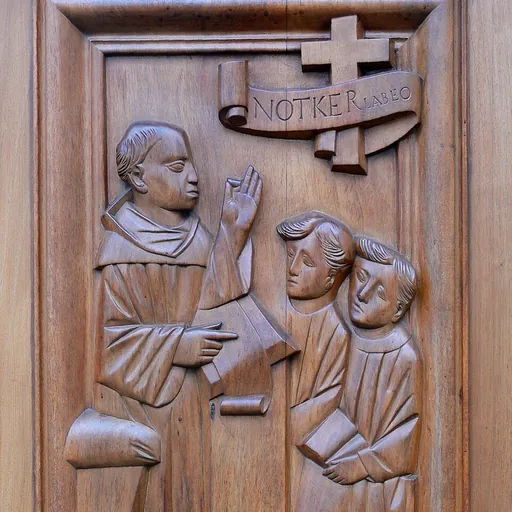
About Notker Labeo
Lived 950 – 1022 (aged 71–72). Notker Labeo was a writer, translator and theologian.
Notker Labeo ( – 28 June 1022), also known as Notker the German or Notker III, was a Benedictine monk active as a scholar and teacher. He was the first commentator on Aristotle active in the Middle Ages and translated the works of earlier Latin writers such as Boethius and Martianus Capella. Notker is also attributed the authorship of five short essays on music.
Labeo means 'the thick-lipped one'. Later he was named Teutonicus in recognition of his services to the German language.
Life and career He was born about 950, from a noble family of Thurgau, and he was a nephew of Ekkehard I, the poet of Waltharius. He went to the Abbey of Saint Gall when only a boy, and there acquired a vast and varied knowledge by omnivorous reading. After finishing his education, he continued in the abbey as a teacher and then head of the school under abbot Burckhard II. His contemporaries admired him as a theologian, philologist, mathematician, astronomer, connoisseur of music, and poet. He tells of his studies and his literary work in a letter to Bishop Hugo of Sitten (998–1017), and we also know of his activities through texts from his pupil Ekkehard IV.
The Necrologium sancti Galli recorded his death under 28 June, 1022, as "Obitus Notkeri doctissimi atque benignissimi magistri". He died stricken by the plague.
Among his most distinguished pupils are the aforementioned Ekkehard IV, Salomo III bishop of Constance, and Batherus, a wandering scholar who wrote a biography of St. Fridolin.
Writings and translations For the benefit of his pupils he translated several texts from Latin into German. He mentions eleven of these translations, but unfortunately only five are preserved: (1) Boethius, "De consolatione philosophiae"; (2) Martianus Capella, "De nuptiis Philologiae et Mercurii"; (3) Aristotle, "De categoriis"; (4) Aristotle, "De interpretatione"; (5) "The Psalter". Among those lost are: "The Book of Job", at which he worked for more than five years; "Disticha Catonis"; Virgil's "Bucolica"; and the "Andria" of Terence (Terenz in German).
Of his own writings he mentions in the above letter a "New Rhetoric" and a "New Computus" and a few other smaller works in Latin. We still possess the Rhetoric, the Computus (a manual for calculating the dates of ecclesiastical celebrations, especially of Easter), the essay "De partibus logicae", and the German essay on Music.
In R. Kögel's opinion Notker Labeo was one of the greatest stylists in German literature. "His achievements in this respect seem almost marvelous." His style, where it becomes most brilliant, is essentially poetical; he observes with surprising exactitude the laws of the language and created the first systematic orthography of Old High German and Swiss German. Latin and German he commanded with equal fluency; and while he did not understand Greek, he pretended that he did. He put an enormous amount of learning and erudition into his commentaries on his translations. Much may be found that was of interest in his time, philosophy, universal and literary history, natural science, astronomy. He frequently quotes the classics and the Fathers of the Church. It is characteristic of Notker that at his dying request the poor were fed, and that he asked to be buried in the clothes which he was wearing in order that none might see the heavy chain with which he had been in the habit of mortifying his body.
Don’t just read it —
keep it.
Full-length biographies made to live with: read them, listen on the way to work, watch them tonight.
- E-book
- Audio
- Video
Instant download · yours to keep · every purchase keeps this site free
Important facts
Related people
Same field, nearest in time





Contemporaries
People whose lives overlapped Notker Labeo's

Frequently asked questions
Who was Notker Labeo?
monk and scholar of the Abbey of Saint Gall
When was Notker Labeo born?
Notker Labeo was born in 950 in Wil, Jonschwil.
When did Notker Labeo die?
Notker Labeo died on 28 June 1022 in Abbey of Saint Gall.
What was Notker Labeo's occupation?
Notker Labeo was a writer, translator and theologian.
Sources & further reading
Cite this page
APA: Biography.guide. (2026). Notker Labeo. https://biography.guide/notker-labeo/
MLA: "Notker Labeo." Biography.guide, https://biography.guide/notker-labeo/.
Chicago: "Notker Labeo." Biography.guide. https://biography.guide/notker-labeo/.
Data last updated: 2026-09-20 · Spot an error? Report a correction.
Portrait: Wikimedia Commons · author & licence
Page generated 2026-09-27 04:58 UTC