
About Norman Lewis
Lived 1909 – 1979 (aged 70). Norman Lewis was an American painter and draftsperson.
Norman Wilfred Lewis (July 23, 1909 – August 27, 1979) was an American painter, scholar, and teacher. Lewis, who was African-American and of Bermudian descent, was associated with abstract expressionism, and used representational strategies to focus on black urban life and his community's struggles.
Early life and education Lewis was born on July 23, 1909, in the Harlem neighborhood in New York City, New York. He was raised on 133rd Street, between 7th and 8th Avenues. Both of his parents were from Bermuda; his father, Wilfred Lewis, was a fisherman and later a dock foreman, and his mother, Diane Lewis, was a bakery owner and later a domestic worker. Norman was the second of three sons. His older brother, Saul, became a violinist, later playing jazz music with notable musicians such as Count Basie and Chick Webb.
Lewis attended Public School No. 5, which at the time had a primarily white student population. He was always interested in art, but did not express it in early childhood due to a lack of resources and being overshadowed by his musically gifted older brother.
Savage was an important early influence who provided him with open studio space at her Harlem Community Art Center. Between 1933 and 1935, Lewis studied at Teachers College, Columbia University and at the John Reed Club Art School.
In 1934, he became a member of the 306 Group, a collection of African-American artists and writers who discussed art's role in society. Some well-known members were Savage, Romare Bearden, Ralph Ellison, Jacob Lawrence, and Richard Wright, as well as Charles Alston, who hosted the meetings in his studio. In 1935, he was a co-founder of the Harlem Artists Guild, whose members included Bearden, Selma Burke, and Beauford and Joseph Delaney. He participated in Works Progress Administration as an art teacher starting in 1935, He at first painted what he saw, which ranged from Meeting Place (1930), a swap meet scene, and The Yellow Hat (1936), a formal Cubist painting, to Dispossessed (1940), an eviction scene, and Jazz Musicians (1948), a visual depiction of the bebop music that was being played in Harlem. His social realism was painted with "an overtly figurative style, depicting bread lines, evictions, and police brutality."
Abstraction
In the late 1940s, Lewis's work became increasingly abstract. His total engagement with abstract expressionism was due partially to his disillusionment with the United States after his wartime experiences in World War II. It seemed extremely hypocritical that America was fighting "against an enemy whose master race ideology was echoed at home by the fact of a segregated armed forces." Seeing that art does not have the power to change the political state that society was in, he decided that people should develop their aesthetic skills more, instead of focusing on political art. Tenement I (1952), Harlem Turns White (1955), and Night Walker No. 2 (1956) are all examples of his style. Twilight Sounds (1947) and Jazz Band (1948) are examples of his interest in conveying music.
One of his best known paintings, Migrating Birds (1953), won the Popular Prize at the Carnegie Museum's 1955 Carnegie International Exhibition. Invturn the New York Herald-Tribune called the painting "one of the most significant of all events of the 1955 art year." His signature style in those decades included repetitive ideographic or hieroglyphic elements that allowed Lewis to incorporate narrative sequences into his paintings.
Spiral artist group (1963 to 1965) and artistic response to the U.S. civil rights movement and related subjects Lewis was a founding member of Spiral, a group of artists and writers who met regularly between 1963 and 1965, that included Charles Alston, Romare Bearden, and Hale Woodruff. The group met "to discuss the potential of Black artists to engage with issues of racial equality and struggle in the 1960s through their work." The Spiral group disbanded in 1965, as a result of discrimination towards the group, and Lewis felt that protesting was a better way to bring attention and deal with the social issues than painting was. Among the notable works from this grouping said to be depicting marches in a hybrid realistic/abstract mode are "Evening Rendezvous" (1962 collection of the Smithsonian American Art Museum in Washington D.C.), "Unknown Title" (March on Washington) (1965 collection of the Michael Rosenfeld Gallery), and "Untitled" (1965 Collection of Seth Taffae Fine Art). One of the "Procession" paintings was executed on a chimney in South Dennis, Massachusetts on Cape Cod at the summer house of a Harlem couple.
Later work In 1969, Lewis founded the Cinque Gallery in New York City, along with Romare Bearden and Ernest Crichlow.
Death and legacy In 1975, he married his long-time girlfriend, Ouida Bramwell. He never had any children of his own, but he was stepfather to Tarin Fuller, daughter of Bramwell.
The first retrospective of his life's work was displayed at the City University of New York Graduate Center in 1976. The exhibition Black Paintings, 1946-1977 at the Studio Museum in Harlem in 1998 was dedicated to his paintings that centered on the color black.
His work is included in many public museum collections including the Museum of Modern Art (MoMA) in New York City, Smithsonian American Art Museum, the Art Institute of Chicago, Blanton Museum of Art, and the High Museum of Art, among others.
Awards For the Congress of Industrial Organization in 1943, he won a competition by designing a war relief poster.
Don’t just read it —
keep it.
Full-length biographies made to live with: read them, listen on the way to work, watch them tonight.
- E-book
- Audio
- Video
Instant download · yours to keep · every purchase keeps this site free
Important facts
People in Norman Lewis's life
Named in this biography and alive at the same time

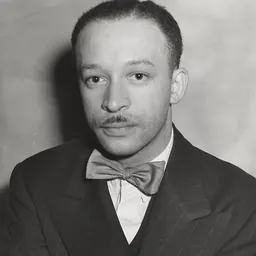


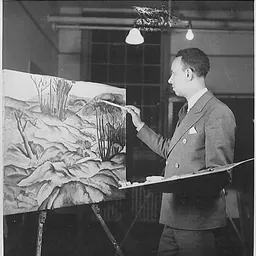
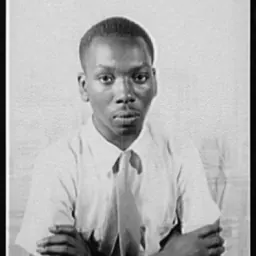


Related people
Same field, nearest in time


Contemporaries
People whose lives overlapped Norman Lewis's


Frequently asked questions
Who was Norman Lewis?
African American painter (1909–1979)
When was Norman Lewis born?
Norman Lewis was born on 23 July 1909 in Harlem.
When did Norman Lewis die?
Norman Lewis died on 27 August 1979 in New York City.
What was Norman Lewis's occupation?
Norman Lewis was a painter and draftsperson.
What nationality was Norman Lewis?
Norman Lewis was American.
Sources & further reading
· DBpedia: Norman Lewis (artist)
Cite this page
APA: Biography.guide. (2026). Norman Lewis. https://biography.guide/norman-lewis/
MLA: "Norman Lewis." Biography.guide, https://biography.guide/norman-lewis/.
Chicago: "Norman Lewis." Biography.guide. https://biography.guide/norman-lewis/.
Data last updated: 2026-09-20 · Spot an error? Report a correction.
Page generated 2026-09-27 05:04 UTC