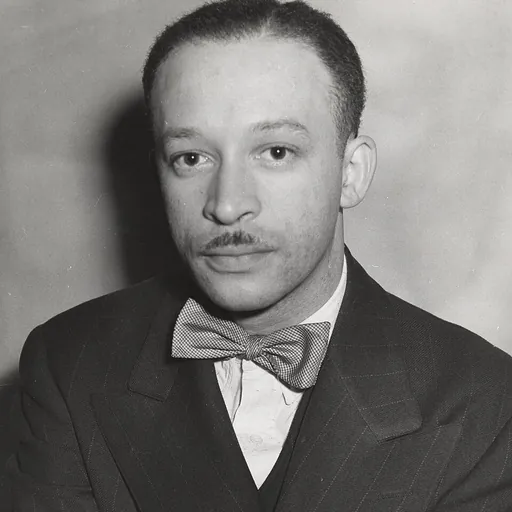
About Charles Alston
Lived 1907 – 1977 (aged 69). Charles Alston was an American caricaturist, painter, sculptor, visual artist and graphic artist.
Charles Henry "Spinky" Alston (November 28, 1907 – April 27, 1977) was an American painter, sculptor, illustrator, muralist and teacher who lived and worked in the New York City neighborhood of Harlem. Alston was active in the Harlem Renaissance; Alston was the first African-American supervisor for the Works Progress Administration's Federal Art Project. Alston designed and painted murals at the Harlem Hospital and the Golden State Mutual Life Insurance Building. In 1990, Alston's bust of Martin Luther King Jr. became the first image of an African American displayed at the White House.
Personal life Early life Charles Henry Alston was born on November 28, 1907, in Charlotte, North Carolina, to Reverend Primus Priss Alston and Anna Elizabeth (Miller) Alston, as the youngest of five children. Three survived past infancy: Charles, his older sister Rousmaniere and his older brother Wendell. His father had been born into slavery in 1851 in Pittsboro, North Carolina. After the Civil War, he gained an education and graduated from St. Augustine's College in Raleigh. He became a prominent minister and founder of St. Michael's Episcopal Church, with an African-American congregation. The senior Alston was described as a "race man": an African American who dedicated his skills to the furtherance of the Black race. Alston also played with clay, creating a sculpture of North Carolina. As an adult he reflected on his memories of sculpting with clay as a child: "I'd get buckets of it and put it through strainers and make things out of it. I think that's the first art experience I remember, making things." Alston's step-father, Henry Bearden, left before his wife and children in order to get work. He secured a job overseeing elevator operations and the newsstand staff at the Bretton Hotel on the Upper West Side. The family lived in Harlem and was considered middle-class. During the Great Depression, the people of Harlem suffered economically. The "stoic strength" seen within the community was later expressed in Charles' fine art.
Later life For the years 1942 and 1943 Alston was stationed in the army at Fort Huachuca in Arizona. While working on a mural project at Harlem Hospital, he met Myra Adele Logan, then an surgical intern at the hospital. They were married on April 8, 1944. Their home, which included his studio, was on Edgecombe Avenue near Highbridge Park. The couple lived close to family; at their frequent gatherings Alston enjoyed cooking and Myra played piano. During the 1940s Alston also took occasional art classes, studying under Alexander Kostellow.
On April 27, 1977, Alston died after a long bout with cancer, just months after his wife died from lung cancer. His memorial service was held at St. Martin's Episcopal Church in New York City, on May 21, 1977.
Professional career Alston's illustration of African-American historian Carter G. Woodson for the Office of War Information While obtaining his master's degree, Alston was the boys' work director at the Utopia Children's House, started by James Lesesne Wells. Alston was introduced to African art by the poet Alain Locke. He also designed album covers for artists such as Duke Ellington and Coleman Hawkins, as well as book covers for Eudora Welty and Langston Hughes. Alston became staff artist at the Office of War Information and Public Relations in 1940, creating drawings of notable African Americans. These images were used in over 200 black newspapers across the country by the government to "foster goodwill with the black citizenry."
Alston left commercial work to focus on his own artwork, and 1950 he became the first African-American instructor at the Art Students League, where he remained on faculty until 1971. This group served as the 1960s version of the 306 Group. Alston was described as an "intellectual activist", and in 1968 he spoke at Columbia about his activism. In the mid-1960s, Spiral organized an exhibition of black and white artworks, but the exhibition was never officially sponsored by the group, due to internal disagreements. Alston is quoted as saying, "The idea of a march was growing....It was in the air...and this painting just came. I called it Walking on purpose. It wasn't the militancy that you saw later. It was a very definite walk-not going back, no hesitation."
Black and white The civil rights movement of the 1960s was a major influence on Alston. In the late 1950s, he began working in black and white, which he continued up until the mid-1960s, and the period is considered one of his most powerful. Some of the works are simple abstracts of black ink on white paper, similar to a Rorschach test. Untitled (c. 1960s) shows a boxing match, with an attempt to express the drama of the fight through few brushstrokes. Alston worked with oil-on-Masonite during this period as well, using impasto, cream, and ochre to create a moody cave-like artwork. Black and White #1 (1959) is one of Alston's more "monumental" works. Gray, white and black come together to fight for space on an abstract canvas, in a softer form than the more harsh Franz Kline. Alston continued to explore the relationship between monochromatic hues throughout the series which Wardlaw describes as "some of the most profoundly beautiful works of twentieth-century American art." The artists fought their response, writing letters to gain support. Four years later they succeeded in gaining the right to complete the murals. This was resolved later in 2011 when the Golden State Mutual Life Insurance building was added to the National Register of Historic Places. The building was purchased by Community Impact Development, a partnership formed to provide a new home for the South Central Los Angeles Regional Center, an agency that provides services to people with developmental disabilities. The building was renovated in 2015. The murals remain in the lobby.
Sculpture
Alston also created sculptures. Head of a Woman (1957) shows his shift toward a "reductive and modern approach to sculpture....where facial features were suggested rather than fully formulated in three dimensions,". In 1990, Alston's bronze bust of Martin Luther King Jr. (1970), became the first image of an African American to be displayed in the White House. When Barack Obama became the first black president in 2009, he brought the bust of Martin Luther King Jr. into the Oval Office, replacing a bust of Winston Churchill. This marked the first time an image of an African American was displayed in the president's work quarters. Furthermore, the bust became a predominant work seen in official portraits of visiting dignitaries. Now, a second copy of the famous Martin Luther King Jr. bust is displayed in Washington for the public to view up close.
World War II propaganda alt=Sketch of frying pan dripping grease onto howitzer emplacement surrounded by uniformed soldierss. Artworks Promoting the War Effort and Original Sketches by Charles Alston, compiled ca. 1942 - ca. 1945 During World War II, scholars have theorized that the black press strived to appeal to the black readers, while also appeasing the U.S. government by supporting the war. Alston produced over one hundred government propagandistic illustrations that supported the national position on the war for the U.S. Office of War Information. Simultaneously, the cartoons were targeted to a black audience, designed exclusively for publication in the weekly black newspapers to address specific, controversial issues in the black community.
Reception Art critic Emily Genauer stated that Alston "refused to be pigeonholed", regarding his varied exploration in his artwork.
Major exhibitions A Force for Change, group show, 2009, Spertus Museum, Chicago Canvasing the Movement, group show, 2009, Reginald F. Lewis Museum of Maryland African American History & Culture On Higher Ground: Selections From the Walter O. Evans Collection, group show, 2001, Henry Ford Museum, Michigan Rhapsodies in Black: Art of the Harlem Renaissance, group show, 1998, Corcoran Gallery of Art, Washington, D.C. In the Spirit of Resistance: African-American Modernists and the Mexican Muralist School, group show, 1996, The Studio Museum in Harlem, New York Charles Alston: Artist and Teacher, 1990, Kenkeleba Gallery, New York Hundred Anniversary Exhibition of Paintings and Sculpture, 1975, Art Students League of New York, New York Solo exhibition, 1969, Huntington Hartford Gallery of Modern Art, New York. Solo exhibition, 1968, Fairleigh Dickinson University, New Jersey National Gallery of Art National Museum of African American History and Culture Whitney Museum of American Art
Don’t just read it —
keep it.
Full-length biographies made to live with: read them, listen on the way to work, watch them tonight.
- E-book
- Audio
- Video
Instant download · yours to keep · every purchase keeps this site free
Important facts
People in Charles Alston's life
Named in this biography and alive at the same time





Related people
Same field, nearest in time



Contemporaries
People whose lives overlapped Charles Alston's


Frequently asked questions
Who was Charles Alston?
African-American visual artist (1907-1977)
When was Charles Alston born?
Charles Alston was born on 28 November 1907 in Charlotte.
When did Charles Alston die?
Charles Alston died on 27 April 1977 in New York City.
What was Charles Alston's occupation?
Charles Alston was a caricaturist, painter, sculptor, visual artist and graphic artist.
What nationality was Charles Alston?
Charles Alston was American.
Sources & further reading
Cite this page
APA: Biography.guide. (2026). Charles Alston. https://biography.guide/charles-alston-caricaturist/
MLA: "Charles Alston." Biography.guide, https://biography.guide/charles-alston-caricaturist/.
Chicago: "Charles Alston." Biography.guide. https://biography.guide/charles-alston-caricaturist/.
Data last updated: 2026-09-23 · Spot an error? Report a correction.
Portrait: Wikimedia Commons · author & licence
Page generated 2026-09-27 05:05 UTC