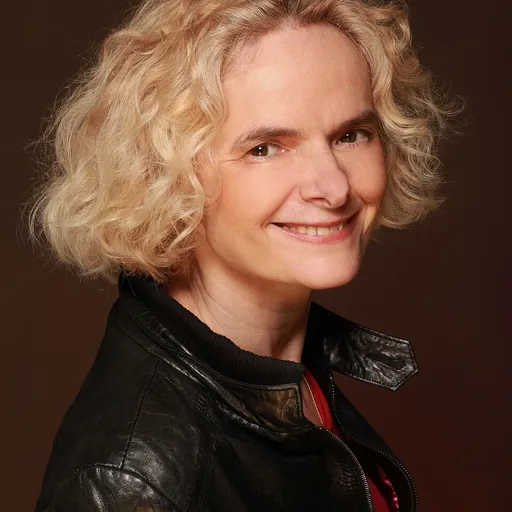
About Nora Volkow
Born 1956. Nora Volkow is an American physician, psychiatrist and researcher.
Nora D. Volkow (born 27 March 1956) is a Mexican-American psychiatrist. She is currently the director of the National Institute on Drug Abuse (NIDA), which is part of the National Institutes of Health (NIH).
Early life and education Born in Mexico City to a Jewish family, Volkow is a daughter of Esteban Volkov, whose mother Zinaida Volkova was the eldest daughter of the Russian communist revolutionary Leon Trotsky.
Volkow was educated at the Modern American School, in Mexico City, and graduated M.D. from the National University of Mexico, before her postdoctoral training in Psychiatry at New York University. She conducted research work with Professor Alan Swann, now at Baylor, leaving to the Department of Energy’s Brookhaven National Laboratory (BNL) in Upton, New York in 1987.
Volkow spent most of her professional career at Brookhaven, where she held several leadership positions. She was first a researcher, and then Director of Nuclear Medicine, Director of the NIDA-DOE Regional Neuroimaging Center at BNL, and finally Associate Director for Life Sciences at BNL. She was also appointed as a Professor in the Department of Psychiatry at Stony Brook University and as Associate Dean for its Medical School. When Volkow moved to the University of Texas, studying patients with schizophrenia was not an option, but studying patients with cocaine addiction was possible. This research has played a part in changing the public's view of drug addiction, from that of a moral violation or character flaw to an understanding that pathological changes to brain structure make it very difficult for addicts to give up their addictions.
Volkow concludes that abnormalities in the prefrontal cortex create a feeling of need or craving that people with addictions find difficult to prevent. She argues that this makes it difficult to override compulsions by exercising cognitive control. The main areas affected are the orbitofrontal cortex, which maintains attention to goals, and the anterior cingulate cortex, that mediates the capacity to monitor and select action plans. Both areas receive stimulation from dopamine neurons that originate in the ventral tegmental area. A steady influx of dopamine makes it difficult to shift attention away from the goal of attaining drugs. It also fastens attention to the motivational value of drugs, not pleasure. Volkow suggests that people with addictions are caught in a vicious circle of physical brain changes and the psychological consequences of those changes, leading to further changes.
National Institute on Drug Abuse
In 2003 Volkow became director of NIDA.
Volkow is the first person from the NIH to visit the Dalai Lama at his residence in Dharamshala, Himachal Pradesh, India. During this 2013 visit, Volkow took part in a dialogue with the Dalai Lama about addiction science, as part of a five-day conference sponsored by the Mind and Life Institute.
Science communication and public advocacy In 2014, Volkow participated in an event organized by The Moth at a World Science Festival, where scientists, writers and artists told stories of their personal relationships with science. During this time, she discussed her family history and how it furthered her ambition to pursue science in order to positively influence others.
In her 2015 TEDMED talk titled "Why do our brains get addicted?", Volkow explored how people with morbid obesity experience alterations to the dopamine reward system resulting in compulsive behavior similar to the mechanisms of addiction. She addressed how stigma around both conditions stems from their perception as personal moral failings, rather than medical disorders.
Awards and recognition
Volkow has been recognized for her contributions, both before and during her time at NIDA. The following are among the most significant: Innovator of the Year. U.S. News & World Report, 2000. Newsweek: Who's Next 2007, a list of 21 people predicted to be newsmakers in 2007. The 2007 Time 100. Times list of the 100 men and women whose power, talent or moral example is transforming the world. The List of the Top 100 Most Powerful Women. Washingtonian magazine's list of women who lead and lobby, educate and enlighten, and look for cures and pathways to a better world. Washington's 100 Most Powerful Women, Washingtonian magazine's list of women who've made it to the top. Finalist for the Samuel J. Heyman Service to America Medal for the Science and Environment Medal (Sammies), Washington DC 2013. These awards recognize outstanding service and are considered among the most prestigious available to federal workers. In 2007, NIDA and another NIH Institute (the National Institute on Alcohol Abuse and Alcoholism) received an Emmy Award for HBO's The Addiction Project. Nora Volkow represented NIDA in receiving the Emmy. In 2011, Volkow received the Joan and Stanford Alexander Award in Psychiatry, from Baylor College of Medicine’s Menninger Department of Psychiatry and Behavioral Sciences.The prize is awarded to "a mental health professional who has made significant contributions in research, education and clinical or community service for people suffering from severe and persistent mental illness." Volkow's award was in recognition of her work in "demonstrating that drug addiction is a disease of the human brain", and "pioneering the use of brain imaging to investigate the toxic effects of drugs and their addictive properties." Hispanic Scientist of the Year Award by Museum of Science & Industry (Tampa) in 2012, for promoting scientific understanding in the community and providing a role model for Hispanic youth. In 2013, Volkow received the Distinguished Scientist Award from the Child Mind Institute, in recognition of her "outstanding contributions to brain development and psychopathology research." The prize is awarded to "a scientist whose lifelong commitment to research in mental health and developmental neuroscience has led to more effective, evidence-based treatments and a deeper understanding of psychiatric, addictive, and developmental disorders." In 2020, Volkow received the Nathan Davis Award from the American Medical Association for her "Outstanding Government Service." Her outstanding work being "groundbreaking research demonstrating the neurobiological basis of addiction."
Personal life Volkow is married to Stephen Adler, a radioimaging physicist at the National Cancer Institute.
Don’t just read it —
keep it.
Full-length biographies made to live with: read them, listen on the way to work, watch them tonight.
- E-book
- Audio
- Video
Instant download · yours to keep · every purchase keeps this site free
Important facts
People in Nora Volkow's life
Named in this biography and alive at the same time



Related people
Same field, nearest in time





Contemporaries
People whose lives overlapped Nora Volkow's

Frequently asked questions
Who is Nora Volkow?
American physician
When was Nora Volkow born?
Nora Volkow was born on 27 March 1956 in Mexico City.
What is Nora Volkow's occupation?
Nora Volkow is a physician, psychiatrist and researcher.
What nationality is Nora Volkow?
Nora Volkow is American.
Sources & further reading
Cite this page
APA: Biography.guide. (2026). Nora Volkow. https://biography.guide/nora-volkow/
MLA: "Nora Volkow." Biography.guide, https://biography.guide/nora-volkow/.
Chicago: "Nora Volkow." Biography.guide. https://biography.guide/nora-volkow/.
Data last updated: 2026-09-23 · Spot an error? Report a correction.
Portrait: Wikimedia Commons · author & licence
Page generated 2026-09-27 05:08 UTC