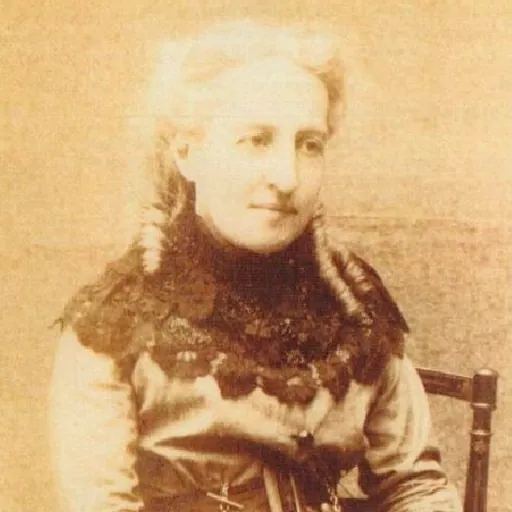
About Noémi Reclus
Lived 1828 – 1905 (aged 77). Noémi Reclus was a French school teacher and communard.
Noémi Reclus (born Marthe Elisabeth Noémi Reclus) (; March 23, 1828 – July 14, 1905) was a French militant republican and teacher who was involved in the Paris Commune in 1871 alongside broader proto-feminist and proto-anarchist activism.
Family Noémi was born into the Reclus family, a Protestant family originating in Le Fleix, Nouvelle Aquitaine which gained notoriety for their involvement in politics, medicine, ethnography, and geography throughout the 19th and 20th centuries. Her father was Jean Reclus (1794–1859), who was the inspector of schools for Gironde, and her mother was his wife Jeanne Ducos. Her sister was Pauline Kergomard (1838–1925) who was instrumental in the development of nursery schooling in France.
Reclus married the anarchist and ethnologist Élie Reclus (1827–1904), who was her cousin, in Bordeaux on May 30 1855. The marriage was a civil ceremony. Noémi's father, Jean, opposed her marriage to Élie and took issue with his involvement in radical politics. In November 1856, Noémi and Élie lived together at 40 boulevard de l’Etoile, in Paris. Her others cousins included Élisée Reclus, Onésime Reclus, Armand Reclus, and Paul Reclus. Her sons, by her husband Élie, were Paul Reclus (1858–1941) who was another notable anarchist, and André Reclus (1861–1936) who was a farmer first in Algeria then in Morocco. Her grandson, (son of Paul), Jacques Reclus (1894–1984) was a notable French-Chinese translator and anarchist.
Life and political involvement Although her work is often discussed in relationship to the wider activities of the Reclus family, Noémi was "an articulate activist in her own right" according to the historian Joy Harvey. During the Second French Empire, Noémi played a leading role in the development of an international militant network "in which the theme of emancipation was a major focus", in the context of a wider socialist and libertarian current. This work involved proto-feminist and proto-anarchist activism, and political engagement with both the church and state.
Noémi was active in feminist clubs during the Paris Commune. Together with André Léo, Louise Michel, and the Reclus brothers, Noémi was involved in the founding of the 'Société pour la Revendication des Droits Civils de la Femme'.
In Paris, Noémi's household hosted a range of socialists, feminists, and "strangers living in Paris as a result of up heavals and wars in Russia, Poland, Italy, Spain, and the United States" alongside a range of explorers and people interested in geography. Mary Putnam Jacobi praised Noémi for running a household without servants, and described Noémi and the Reclus brothers during this time as "bright, fresh, inexhaustible intellects, hearts pure and warm-the most delicate honor, dignity and grace of character-ideas romantic and living". Noémi spent several weeks living in cellars with her two young children while being hidden and protected by supportive neighbours. The family were supported in hiding by Edouard Huet, a professor at the Collège Sainte-Barbe who was a relative of the Republican socialist philosopher François Huet (1814-1869) with whom the family were acquainted.
Exiled from France after the commune, Noémi and her family first left for Italy before settling in Switzerland in Zurich. Élie had managed to obtain a forged passport under the name 'Ernesto Ricardo' via a police officer friend of Henri Schmahl. The family stayed in Zurich to support their eldest son Paul's education. In 1877, Noémie and Élie left Zurich for an extended visit to the United States. While in the United States, Noémie and Élie became acquainted with the Shakers at the Mount Lebanon Shaker Society in New Lebanon, New York. Noémie and Élie lived in Belgium until their deaths.
Role in education During the Paris Commune, Noémi was part of the commission to organise and monitor girls' education in schools. The work which this committee undertook concerning education played a role in removing the influence of the church from schools, and supporting the hiring of secular women teachers.
In 1858–1861, Noémi Reclus taught French at a girls' boarding school in Edinburgh run by the Geddes sisters, she also went to Glasgow with the Murdoch family for whom she had previously been a tutor in Paris. Alongside André Léo, Marie David, H. Leval, G. Francolin, Noémi took part in an attempt to open a "Democratic Primary School" which aimed to center children's needs and "natural faculties" rather than imposing "preconcieved systems" - although the school never opened.
Death Noémi Reclus died on July 14, 1905 – a year after her husband and ten days after Élisée. Noémi was buried at Ixelles, where she is interred with her husband Élie and her brother-in-law Élisée.
Don’t just read it —
keep it.
Full-length biographies made to live with: read them, listen on the way to work, watch them tonight.
- E-book
- Audio
- Video
Instant download · yours to keep · every purchase keeps this site free
Important facts
People in Noémi Reclus's life
Named in this biography and alive at the same time

Related people
Same field, nearest in time





Contemporaries
People whose lives overlapped Noémi Reclus's




Frequently asked questions
Who was Noémi Reclus?
teacher and communarde
When was Noémi Reclus born?
Noémi Reclus was born on 23 March 1828 in Bordeaux.
When did Noémi Reclus die?
Noémi Reclus died on 14 July 1905 in Brussels.
What was Noémi Reclus's occupation?
Noémi Reclus was a school teacher and communard.
What nationality was Noémi Reclus?
Noémi Reclus was French.
Sources & further reading
Cite this page
APA: Biography.guide. (2026). Noémi Reclus. https://biography.guide/noemi-reclus/
MLA: "Noémi Reclus." Biography.guide, https://biography.guide/noemi-reclus/.
Chicago: "Noémi Reclus." Biography.guide. https://biography.guide/noemi-reclus/.
Data last updated: 2026-09-22 · Spot an error? Report a correction.
Portrait: Wikimedia Commons · author & licence
Page generated 2026-09-27 05:03 UTC