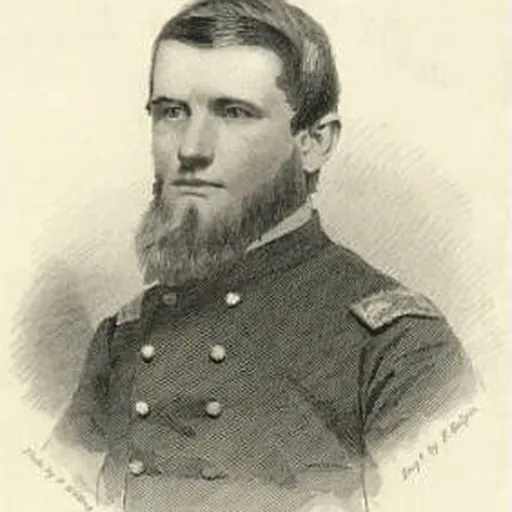
Noah Henry Ferry
Officer of the Michigan Cavalry Brigade
About Noah Henry Ferry
Lived 1831 – 1863 (aged 32).
Noah Henry Ferry (April 30, 1831 – July 3, 1863), was a Major in the Union Army's 5th Michigan Cavalry. He died in the Battle of Gettysburg.
Early life Noah was born in 1831 to Rev. William Montague Ferry and his wife Amanda White Ferry. He was their fourth child and third son. His oldest brother William Montague Ferry Jr. was a Colonel in the Union Army (and later a politician), and his other older brother was U.S. Senator Thomas W. Ferry . The family lived at a Presbyterian missionary on Mackinac Island, where Rev. Ferry ministered to Native American's. In 1834, the Ferry family moved to Grand Haven. Here, the Ferry's started many successful businesses which included interests in lumber, iron, ship building, and banking
Before the War Noah took over the Ferry and Sons Sawmill in White River Township when he was just 23 years old. He was the township's wealthiest citizen, and largest employer.
Civil War During the Civil War, Noah and a group 102 men (many were his employees) enlisted as the "White River Guard." They elected Noah as their commander. The guard was combined with others and became the 5th Michigan Volunteer Cavalry. Noah Ferry was Major of the Regiment. The regiment went to Virginia to fight, and met up with Michigan's 1st, 6th, and 7th Brigade. They were collectively called The Michigan Cavalry Brigade.
Fighting in the war proved tiring and frustrating for The Michigan Cavalry Brigade. Tensions became high, in large part due to constant drunkenness of Colonel Freeman Norvell (the man in charge of The Michigan Cavalry Brigade). During one of Colonel Norvell drunken tirades, Major Ferry held a gun to his head and demanded he relinquish command of the Brigade. Ferry was triumphant in his battle of will. Colonel Norvell resigned and Ferry was offered the position of Colonel of the Brigade. Ferry turned down the role insisting he had not yet earned this position.
Legacy
General Custer's official report talked of the loss of "The brave and chivalric Major N. H. Ferry."
Colonel Russell Alger knew Ferry and his family. Col Alger was with Ferry the day he was killed. Alger wrote, "Major Ferry, who was cheering his battalion to hold its ground, was instantly killed. His death cast a deep gloom upon the whole Brigade. He was a gallant soldier, an exemplary man and his loss was a great blow."
Ferry's Body was buried under a tree on the battle field. Shortly afterwards, Noah's Father William Montague Ferry, and Brother Thomas W. Ferry went to recover his body. His body was brought back to Grand Haven where it lays in the Ferry plot of the Lake Forest Cemetery.
Though buried in Grand Haven, Ferry has the foremost stone in the Michigan section of the Gettysburg National Cemetery.
The main street of Montague Michigan, is named Ferry Street in Noah's Honor. Ferry Church in Montague is also named in Noah's honor.
Don’t just read it —
keep it.
Full-length biographies made to live with: read them, listen on the way to work, watch them tonight.
- E-book
- Audio
- Video
Instant download · yours to keep · every purchase keeps this site free
Important facts
People in Noah Henry Ferry's life
Named in this biography and alive at the same time

Contemporaries
People whose lives overlapped Noah Henry Ferry's




Frequently asked questions
Who was Noah Henry Ferry?
officer of the Michigan Cavalry Brigade
When was Noah Henry Ferry born?
Noah Henry Ferry was born on 30 April 1831.
When did Noah Henry Ferry die?
Noah Henry Ferry died on 3 July 1863.
Sources & further reading
Cite this page
APA: Biography.guide. (2026). Noah Henry Ferry. https://biography.guide/noah-henry-ferry/
MLA: "Noah Henry Ferry." Biography.guide, https://biography.guide/noah-henry-ferry/.
Chicago: "Noah Henry Ferry." Biography.guide. https://biography.guide/noah-henry-ferry/.
Data last updated: 2026-09-21 · Spot an error? Report a correction.
Portrait: Wikimedia Commons · author & licence
Page generated 2026-09-27 04:59 UTC