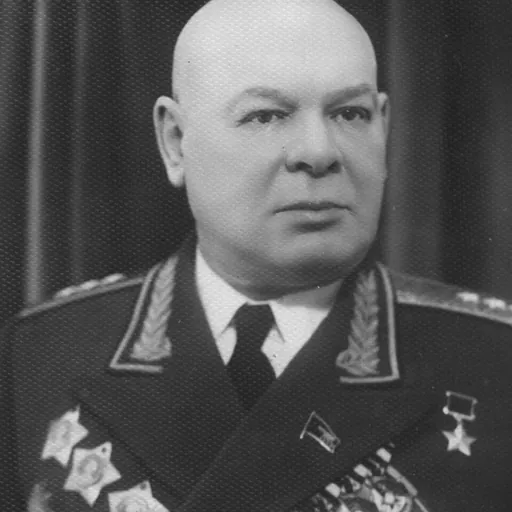
About Nikolay Pukhov
Lived 1895 – 1958 (aged 63). Nikolay Pukhov was a Russian statesperson, military officer and politician.
Nikolay Pavlovich Pukhov (; –March 28, 1958) was a Soviet Army colonel general and a Hero of the Soviet Union who commanded troops during World War II.
Pukhov fought in World War I as a junior officer, afterwards joining the Red Army and fighting in the Russian Civil War, rising to become chief of staff of a division. During the interwar period he served as an instructor at several military academies, and following the Operation Barbarossa, the German invasion of the Soviet Union, he was given command of the 304th Rifle Division. In January 1942 Pukhov was promoted to command the 13th Army, which he led for the rest of the war. He was awarded the title Hero of the Soviet Union for his leadership of the army during the Battle of the Dnieper in September and October 1943. Postwar, Pukhov commanded the 8th Tank Army and several military districts before becoming the head Soviet advisor to the Romanian People's Army, the last position he held before his death.
Early life and World War I Pukhov was born on January 25, 1895, in the village of Grishovo in Kaluga Governorate. The son of an official, he graduated from the Kaluga Theological Seminary in 1915. He enrolled in the Moscow University but did not attend it, working as a history and literature teacher at the higher primary school
Russian Civil War Pukhov joined the Red Guards in February 1918 at Liski as an adjutant in the headquarters for formation of Red Guard detachments, who conducted forced requisitioning in Voronezh Governorate and fought anti-Soviet forces. After the Red Guards were incorporated into the Red Army in May, he became the adjutant of the 2nd Voronezh Regiment (formed from the Red Guard detachments), fighting against the White Army led by Pyotr Krasnov in Voronezh Governorate in the areas of Pavlovsk and Bobrov. In early March 1919, Pukhov transferred to the 8th Army as chief of staff of its Kalach Group of Forces after the regiment was disbanded. In April, he became chief of staff of the 3rd Brigade of the 1st Special Division, formed from the group, and was appointed chief of staff of the Ryazan Infantry Division's 1st Brigade in October. The brigade was part of the screening force against White cavalry commander Konstantin Mamontov's raid into the rear of the Southern Front. In November, the brigade was sent to the 7th Army, where it became part of the 1st Consolidated Division of the Karelian Combat Sector (redesignated the 55th Rifle Division on 21 November), fighting the Finnish Whites on the Karelian Isthmus. In April 1939, Pukhov transferred to become an instructor at the Red Army Military-Economic Academy, and was promoted to Kombrig in April 1940. He became a Major General on 4 June when the Red Army reintroduced generals' ranks.
The army advanced into Ukraine in the Chernigov-Pripyat Offensive. By 26 August, the army had advanced over 300 kilometers in less than a month. On 9 September, the army crossed the Desna River in the area of Obolonnaya and Spasskoye, repulsing German counterattacks for six days before resuming the advance. Between 15 and 16 September, the army crossed the bend of the Desna in the Chernigov and Morovsk area. Expanding the bridgehead, the army captured Chernigov on 21 September. On 23 September, two corps from the army crossed the Dnieper and on 30 September the Pripyat River. On 16 October, Pukhov was awarded the title Hero of the Soviet Union and the Order of Lenin for his leadership in the offensive. Joining the Voronezh Front, which became the 1st Ukrainian Front on October 20, the army fought to recapture Right-bank Ukraine and southeastern Poland. During the Battle of Kiev, Zhitomir–Berdichev Offensive, Rovno–Lutsk Offensive, Proskurov–Chernovtsy Offensive, and the Lvov–Sandomierz Offensive from the end of 1943 to mid-1944, the army advanced more than 750 kilometers. On 26 August 1944, Pukhov was promoted to Colonel General.
Awards and honors Pukhov was a deputy of the Supreme Soviet of the Soviet Union at its 3rd and 4th convocations. He was awarded the following awards and decorations: Hero of the Soviet Union (Gold Star No. 1799) Order of Lenin (4) Order of the Red Banner (3) Order of Suvorov, 1st class (3) Order of Kutuzov, 1st Class (2) Order of Bogdan Khmelnitsky, 1st class Virtuti Militari (Poland) Order of the Cross of Grunwald (Poland) Czechoslovak War Cross 1939–1945 Order of the Republic (Tuvan People's Republic)
Don’t just read it —
keep it.
Full-length biographies made to live with: read them, listen on the way to work, watch them tonight.
- E-book
- Audio
- Video
Instant download · yours to keep · every purchase keeps this site free
Important facts
People in Nikolay Pukhov's life
Named in this biography and alive at the same time

Related people
Same field, nearest in time





Contemporaries
People whose lives overlapped Nikolay Pukhov's

Frequently asked questions
Who was Nikolay Pukhov?
Soviet general (1895–1958)
When was Nikolay Pukhov born?
Nikolay Pukhov was born on 13 January 1895 in Grishovo.
When did Nikolay Pukhov die?
Nikolay Pukhov died on 28 March 1958 in Moscow.
What was Nikolay Pukhov's occupation?
Nikolay Pukhov was a statesperson, military officer and politician.
What nationality was Nikolay Pukhov?
Nikolay Pukhov was Russian.
Sources & further reading
Cite this page
APA: Biography.guide. (2026). Nikolay Pukhov. https://biography.guide/nikolay-pukhov/
MLA: "Nikolay Pukhov." Biography.guide, https://biography.guide/nikolay-pukhov/.
Chicago: "Nikolay Pukhov." Biography.guide. https://biography.guide/nikolay-pukhov/.
Data last updated: 2026-09-22 · Spot an error? Report a correction.
Portrait: Wikimedia Commons · author & licence
Page generated 2026-09-27 05:03 UTC