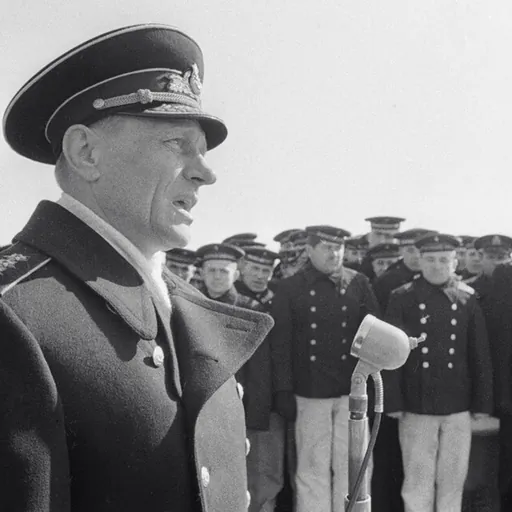
About Nikolay Amel'ko
Lived 1914 – 2007 (aged 92). Nikolay Amel'ko was a Russian military personnel and politician.
Nikolai Nikolayevich Amelko (; 22 November 1914 – 27 June 2007) was an officer of the Soviet Navy. He served during the Winter War and the Second World War and reached the rank of admiral.
Born in 1914, Amelko grew up in the early years of the Soviet Union. Deciding on a naval career at an early age from time spent around naval units in the port city of Leningrad and its environs, he studied at the M. V. Frunze Higher Naval School and was commissioned an officer on graduation. His career nearly ended in disaster when he was accused of crimes during the Great Purge, but was acquitted. He went on to serve on a training ship of the Baltic Fleet, seeing service during the Winter War, and then during the siege of Leningrad during the Second World War. He had command of a detachment of minesweepers which had been converted to lay smoke screens, seeing action in the Gulf of Finland throughout the war. Decorated and promoted for his service, he was appointed to take charge of demining operations in the gulf during the last months of the war, and into the postwar years.
In 1956, now a rear-admiral, Amelko was appointed chief of staff and first deputy commander of the Pacific Fleet. He oversaw the introduction of new technologies and tactics, and the complex international relations with Japan and the United States. Appointed to command the Pacific Fleet in 1962, he dealt with several crises in the region, including the response to the capture of the US spy ship by North Korean forces, and the loss of the Golf II-class submarine K-129, both in 1968. In 1969, Amelko was appointed deputy for anti-submarine forces, and in 1978, he became a Deputy Chief of the , a post he held until 1986. After a brief period as military adviser in the Group of Inspectors General, he retired from the armed forces in 1987. He worked at the Ministry of Foreign Affairs's scientific coordination centre, consulting on military and naval issues, and travelled widely, speaking on naval topics.
He was involved in local and national politics, as a deputy of the Supreme Soviet of the Russian Soviet Federative Socialist Republic, and the Supreme Soviet of the Soviet Union. He was a candidate of naval sciences, and was awarded the Lenin Prize for his work in the creation of a satellite system covering the oceans. He wrote his memoirs, and died in 2007 at the age of 92, having received 43 state awards.
Early years and education The training ship Verny, later renamed Leningradsovet, and Amelko's first command. Amelko was born on 22 November 1914 in Petrograd, in what was then the Russian Empire. His father, Nikolai Lukich (1880–1957) was a worker of Belarusian ethnicity. His mother, Tatyana Kalinovna (1882–1917), died when Nikolai was two years old, and he was raised by his stepmother, Anna Mikhailovna. Born during the First World War, Nikolai Amelko grew up during the war and the February and October Revolutions in 1917, seeing the Russian Empire become the Soviet Union. The family lived on the of Vasilyevsky Island, with Amelko becoming involved in local clubs and the Young Pioneers. He travelled to perform in factories and plants, in military units. Having visited the naval and border guard forces on Goloday Island and Kronstadt, Amelko decided to become a sailor. As a cadet he underwent practical training on the schooner Ucheba, other training ships of the school, and the cruiser Aurora. After graduating from the school in 1936, he was commissioned as a lieutenant and sent to Moscow to join the Red Army's Intelligence Directorate as assistant to the head of the directorate's naval department. Caught up in the Great Purge, he was accused of crimes, but soon acquitted. By 1937, he was commander of the electronic navigation department aboard the training ship Leningradsovet. Smirnov pressed Amelko to indicate a culprit, to which Amelko replied "in the fleet, the commander is responsible for everything, report that I was to blame if you see violations in my actions."
Honours and awards Over his career Amelko received 43 state awards, divided between Soviet, Russian, and foreign awards. The Russian Federation awarded Amelko the Order of Honour in 2001.
Don’t just read it —
keep it.
Full-length biographies made to live with: read them, listen on the way to work, watch them tonight.
- E-book
- Audio
- Video
Instant download · yours to keep · every purchase keeps this site free
Important facts
Related people
Same field, nearest in time



Contemporaries
People whose lives overlapped Nikolay Amel'ko's


Frequently asked questions
Who was Nikolay Amel'ko?
soviet naval officer
When was Nikolay Amel'ko born?
Nikolay Amel'ko was born on 22 November 1914 in Saint Petersburg.
When did Nikolay Amel'ko die?
Nikolay Amel'ko died on 27 June 2007 in Moscow.
What was Nikolay Amel'ko's occupation?
Nikolay Amel'ko was a military personnel and politician.
What nationality was Nikolay Amel'ko?
Nikolay Amel'ko was Russian.
Sources & further reading
Cite this page
APA: Biography.guide. (2026). Nikolay Amel'ko. https://biography.guide/nikolay-amel-ko/
MLA: "Nikolay Amel'ko." Biography.guide, https://biography.guide/nikolay-amel-ko/.
Chicago: "Nikolay Amel'ko." Biography.guide. https://biography.guide/nikolay-amel-ko/.
Data last updated: 2026-09-21 · Spot an error? Report a correction.
Portrait: Wikimedia Commons · author & licence
Page generated 2026-09-27 04:59 UTC