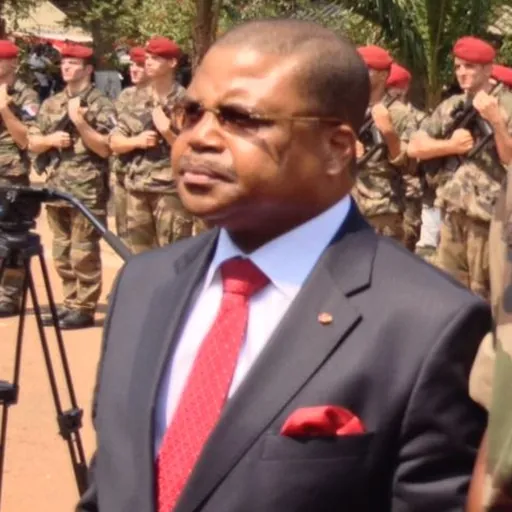
About Nicolas Tiangaye
Born 1956. Nicolas Tiangaye is a politician and lawyer.
Nicolas Tiangaye (born 13 September 1956 ) is a Central African politician and lawyer who was Prime Minister of the Central African Republic from 17 January 2013 until his resignation on 10 January 2014. He was President of the National Transitional Council from 2003 to 2005.
Following a peace agreement between the government and rebels, Tiangaye was designated by the opposition and the rebels as their choice for the post of Prime Minister in January 2013. He stepped down (alongside President Michel Djotodia) on 10 January 2014.
Early life and career Tiangaye was born at Bocaranga in 1956 and became a lawyer. In 1986, Tiangaye was one of three Central African lawyers selected by the deposed emperor Jean-Bedél Bokassa to defend him at his trial. He was also a defense lawyer for François Bozizé in 1989 when Bozizé was accused of plotting against the government. Bozizé was acquitted. Years later, after Tiangaye and Bozizé had become political opponents, Tiangaye said about the case that he "was doing [his] duty as a lawyer" and that he did not regret defending Bozizé. During Patassé's presidency, Tiangaye was at one point offered the post of Prime Minister, but he declined. He was then elected as President of the CNT on 14 June 2003. In that post, he helped draft the 2004 constitution; according to Tiangaye, Bozizé was displeased by the constitution's limit of two presidential terms and was consequently unhappy with Tiangaye. Later, he claimed that the vote in his constituency was rigged against him on Bozizé's orders. Others who were hostile to Tiangaye argued that he lacked genuine popularity and was better suited to the courtroom. Later in the month, on 29 April 2010, Bozizé accepted the need to delay the election until a time when "all the parties involved in these elections, including the international community, will be ready."
Prime minister In December 2012, a coalition of rebel groups called Séléka mounted an offensive against the army and quickly seized control of a large portion of the Central African Republic, threatening Bangui, the capital, and putting the government of President Bozizé in a desperate situation. allowing Bozizé to finish his term as president but also requiring him to accept a prime minister chosen by his opponents, along with a government that would include the political opposition and rebels; However, Bozizé hesitated to appoint Tiangaye without the approval of the Séléka rebels, causing a short delay. The Séléka rebels announced on 15 January 2013 that they endorsed the opposition's choice.
President Bozizé appointed Tiangaye as Prime Minister in a ceremony held in Bangui on 17 January 2013. Tiangaye declared that there was "hard work" ahead, but also "peace on the horizon"; he said that "the government must address urgently ... the pacification of the country and the restructuring of the army". He stressed the importance of cooperation and said that he had "no personal problem with the president." For his part, Bozizé wished Tiangaye good luck.
The peace agreement unraveled in March 2013, as Séléka resumed seizing towns, accusing Bozizé of failing to keep his promises. After days of fighting, the rebels captured Bangui on 24 March 2013, forcing Bozizé to flee the country, and Djotodia was declared President. Djotodia said that there would be a three-year transitional period and that Tiangaye would continue to serve as Prime Minister.
Djotodia promptly suspended the constitution and dissolved the government, as well as the National Assembly. He then reappointed Tiangaye as Prime Minister on 27 March 2013. Tiangaye commanded substantial respect among those who opposed Bozizé, political parties and rebels alike, as well as international observers. 16 positions were given to representatives of civil society. The former opposition parties were unhappy with the composition of the government; on 1 April 2013, they declared that they would boycott the government to protest its domination by Séléka. They argued that the 16 positions given to representatives of civil society were in fact "handed over to Séléka allies disguised as civil society activists".
Sectarian violence escalated in the months after Séléka took power, and by late 2013 Djotodia faced severe pressure from regional leaders and the international community due to his apparent inability to control the situation. By that point the relationship between Tiangaye and Djotodia was characterized as "notoriously bad". Under pressure from regional leaders who felt the situation was untenable, Tiangaye and Djotodia both resigned at a summit held in N'Djamena on 10 January 2014.
Don’t just read it —
keep it.
Full-length biographies made to live with: read them, listen on the way to work, watch them tonight.
- E-book
- Audio
- Video
Instant download · yours to keep · every purchase keeps this site free
Important facts
People in Nicolas Tiangaye's life
Named in this biography and alive at the same time
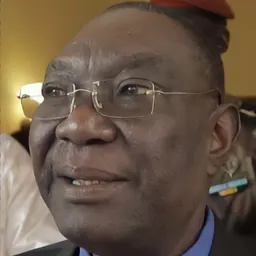

Related people
Same field, nearest in time


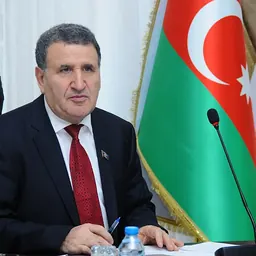

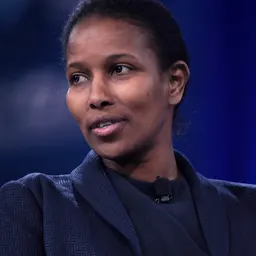
Contemporaries
People whose lives overlapped Nicolas Tiangaye's


Frequently asked questions
Who is Nicolas Tiangaye?
Central African politician and lawyer
When was Nicolas Tiangaye born?
Nicolas Tiangaye was born on 13 September 1956 in Bocaranga.
What is Nicolas Tiangaye's occupation?
Nicolas Tiangaye is a politician and lawyer.
What nationality is Nicolas Tiangaye?
Nicolas Tiangaye's recorded nationality: Central African Republic.
Sources & further reading
Cite this page
APA: Biography.guide. (2026). Nicolas Tiangaye. https://biography.guide/nicolas-tiangaye/
MLA: "Nicolas Tiangaye." Biography.guide, https://biography.guide/nicolas-tiangaye/.
Chicago: "Nicolas Tiangaye." Biography.guide. https://biography.guide/nicolas-tiangaye/.
Data last updated: 2026-09-23 · Spot an error? Report a correction.
Portrait: Wikimedia Commons · author & licence
Page generated 2026-09-27 05:05 UTC