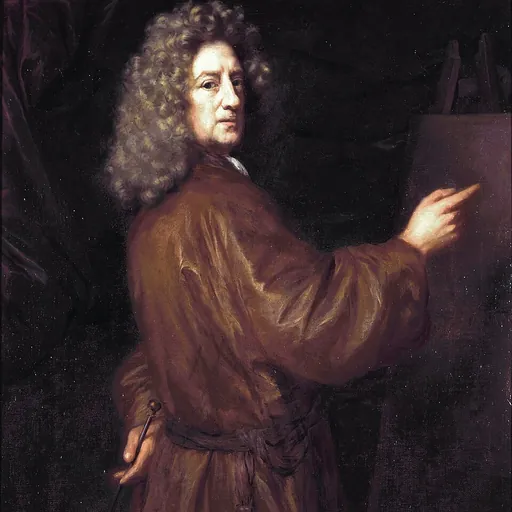
About Nicolaes Maes
Lived 1634 – 1693 (aged 58–59). Nicolaes Maes was a Dutch and Belgian painter.
Nicolaes Maes (January 1634December 1693; buried 24 December 1693) was a Dutch painter known for his genre scenes, portraits, religious compositions and the occasional still life. A pupil of Rembrandt in Amsterdam, he returned to work in his native city of Dordrecht for 20 years. In the latter part of his career he returned to Amsterdam where he became the leading portrait painter of his time. Maes contributed to the development of genre painting in the Netherlands, and was the most prominent portrait painter working in Amsterdam in the final three decades of the 17th century.
Life Nicolaes Maes was born in Dordrecht as the second son of Gerrit Maes, a prosperous cloth merchant and soap boiler, and Ida Herman Claesdr.
He initially trained with a mediocre painter in his hometown. Around 1648, he went to Amsterdam, where he entered Rembrandt's studio. He remained in the studio of Rembrandt for about five years. He had returned to Dordrecht by December 1653. Here he is recorded making marriage arrangements as he posted on 28 December 1653 the bans of his marriage with Adriana Brouwers, the widow of the preacher Arnoldus de Gelder.
A signed and dated picture of 1653 shows that the artist had established himself as an independent artist by that year.
In the middle or end of the 1650s, Maes travelled to Antwerp where he studied the work of Flemish artists such as Peter Paul Rubens, Anthony van Dyck and Jacob Jordaens. During his stay in Antwerp Maes is said to have paid a visit to Jordaens's studio and conversed with the artist at length about painting. By showing Hagar's despondency and Ishmael's isolated posture the work is one of the most moving renderings of this theme, popular with Rembrandt's pupils. Most of Maes's religious compositions are of cabinet size except for the Christ Blessing the Children (National Gallery, London) which depicts life-size figures. Maes applied Rembrandt's stylistic characteristics such as the brushwork and chiaroscuro to domestic scenes that were the favourite subject matter of Dutch genre artists of his time.
His paintings of domestic interiors showing women engaged in household tasks are endowed with a solemn dignity through the play of light and shadow and the limited colour palette derived from Rembrandt. Between 1654 and 1658, he created a large number of pictures of spinners, lace makers and mothers with children that express the contemporary moralistic view of the value of family life and quiet diligence.
Maes created some works showing everyday events occurring on the doorstep of a private house such as milkmaids ringing the doorbell or receiving payment or boys asking for alms. Maes was able to bestow on these mundane transactions a solemn dignity. Another theme treated by Maes in the mid-1650s are elderly female figures shown in half or three-quarter length such as an elderly woman saying grace before a simple meal, praying amid vanitas symbols or dozing over a Bible. He further painted one group portrait of a guild, the Six Governors of the Amsterdam Surgeons' Guild (1680–81, Rijksmuseum Amsterdam).
Selected works Portrait of Laurence Hyde, Earl of Rochester Christ Before Pilate (1649–1650) Portrait of Four Children (1657) Christ Blessing the Children (1652–1653) Admiral Cornelis Evertsen the Youngest (1662) – Portrait of Justus Criex (1666) Eavesdropper with a Scolding Woman (1655) The Idle Servant (1655)
The Lacemaker (1649–1650) The Lacemaker (1655) Old Woman Dozing (1656) Portrait of a Woman (1667) Portrait of a Woman A Woman Spinning (1655) Apostle Thomas (1656) Woman Plucking a Duck (1656) Old Woman at Prayer (1656) Doing the Accounts (1656) The Eavesdropper (1657) Portrait of Jacob Trip (1660) Portrait of Margaretha de Geer, Wife of Jacob Trip (1660) Portrait of Simon van Alphen (1680) Portrait of William the Third of Orange (after 1677) Bathing (between 1655 and 1660) Portrait of a Lady (1677)
Don’t just read it —
keep it.
Full-length biographies made to live with: read them, listen on the way to work, watch them tonight.
- E-book
- Audio
- Video
Instant download · yours to keep · every purchase keeps this site free
Important facts
more
Nicholaes Maes, Nicholas Maes, Nic. Maes, Nicholas Maas, nicolaus maes, Nicolaes mals, Nich. Maas, De Maas, Masse, Maes, n. maes, N. Maas, Mayes, Nic. Maas, Nikolaus Maes, N. Maus, maes nicolaes, Maas, maes nikolaes, C. Maes, Maaes, Nikolaas Maas, nich.s maas, nie. maes, N Maas, Nich. Maes, Nicolas Maaes, Nicolaus Maer, nicol. maesPeople in Nicolaes Maes's life
Named in this biography and alive at the same time



Related people
Same field, nearest in time


Contemporaries
People whose lives overlapped Nicolaes Maes's





Frequently asked questions
Who was Nicolaes Maes?
Dutch painter (1634-1693)
When was Nicolaes Maes born?
Nicolaes Maes was born in 1634 in Dordrecht.
When did Nicolaes Maes die?
Nicolaes Maes died on 24 December 1693 in Amsterdam.
What was Nicolaes Maes's occupation?
Nicolaes Maes was a painter.
What nationality was Nicolaes Maes?
Nicolaes Maes was Dutch and Belgian.
Sources & further reading
Cite this page
APA: Biography.guide. (2026). Nicolaes Maes. https://biography.guide/nicolaes-maes/
MLA: "Nicolaes Maes." Biography.guide, https://biography.guide/nicolaes-maes/.
Chicago: "Nicolaes Maes." Biography.guide. https://biography.guide/nicolaes-maes/.
Data last updated: 2026-09-23 · Spot an error? Report a correction.
Portrait: Wikimedia Commons · author & licence
Page generated 2026-09-27 05:06 UTC