
About Nicola van Houbraken
Lived 1663 – 1723 (aged 59–60). Nicola van Houbraken was an artist and painter.
Nicola or Nicolino or Niccolino van Houbraken, also known as Nicolino Vanderbrach da Messina and Nicola Messinese (1660 – 1723) was an Italian painter of the late-Baroque who was of Flemish descent. He specialized in paintings depicting playful arrangements of fruits, vegetables, vegetation, animals, game in interiors or in forests. He also painted allegories and garland paintings. His work was appreciated by the Medici court in Florence. Nicola's father is believed to have been born in Antwerp. He returned to Messina where he married the daughter of Nicola Francesco Maffei, an architect. He was also active as a painter and art dealer but his oeuvre is unknown. After Nicola's birth the family remained in Messina until they left it for Livorno in 1674 following the Messina revolt against Spanish rule.
Nicola became a successful still life painter, who worked for local patrons and also sent works to all parts of the country. His works were appreciated by the court of the Medici who were then the rulers over Livorno. The Medici were known for their passion for flowers, a passion that had its origins in the collection of roses and carnations of Cosimo de' Medici and Ferdinando II. The Grand Duke requested Nicola to send him a portrait of himself for his gallery of self-portraits in the Galleria dell'Accademia.
Nicola married Caterina Valsisi with whom he had a daughter named Maria Teresa. The daughter also studied art and died in 1765 in Livorno. In 1704, 1706 and 1729 his works were exhibited in the Santissima Annunziata in Florence.
Garland paintings Some of van Houbraken's works fall into the genre of the so-called 'garland paintings'. Daniel Seghers developed the illusionistic aspects of the genre by replacing the cartouche portraits with paintings of bas reliefs and sculptures. By using trompe-l'œil effects, Seghers was able to create the illusion of three-dimensionality, for instance by including elements that look as if they protrude outside of the picture frame. The aim was to give the viewer the impression that they were not looking at a painting but at a real garland of flowers around a genuine sculptured cartouche. Abraham Brueghel, the grandson of Jan Brueghel the Elder, introduced the genre into Italy where he worked for 40 years, first in Rome and then in Naples where he died in 1697. The Calabrian Prince Antonio Ruffo was an admirer of Brueghel’s works several of which he collected at his palace near Messina. Van Houbraken may have become familiar with the garland paintings there.
An example of a garland painting by van Houbraken is the Trompe-l'œil with a marble bas relief representing the Pentecost with flowers (Finarte S.p.A. Old Master Paintings and 19th Century Art sale of 25 November 2019 lot 339). This garland painting shows a garland of flowers around a cartouche which is a trompe-l'œil bas relief representing the Pentecost.
The self-portrait that wasn’t
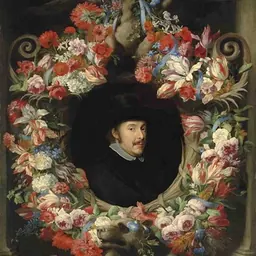
Another example of a garland painting is one of his paintings in the collection of the Uffizi Gallery in Florence, which shows a flower garland frame which in this case encircles a portrait of a man. This work was traditionally identified with the self-portrait that he was believed to have sent to the Grand Duke. Art historians have now shown that the painting is in fact not a self-portrait but a portrait of the French painter François Rivière who worked in Livorno. The misidentification of the sitter happened already in the 18th century. It probably has its roots in the fact that the head of the sitter emerges from the shadow tilted towards the viewer as if it were the artist's reflection in a mirror. The date of the work is not known with certainty. The traditionally estimated date of 1720 has been questioned by certain art historians who place the date of the work at the end of the 17th century. The painting may possibly be identified with a canvas presented at the art exhibition held in 1729 in the cloisters of the Santissima Annunziata in Florence which was described in the catalogue of that same year as a flower painting by Wan-ou-bru-ken with inside the portrait of Mr. Riviera.
The portrait itself is created with a highly illusionistic trompe-l'œil effect. It appears as if the head of the sitter is peeking out through a big gash in the canvas the lower side of which he holds down with his right hand. The effect thus created resembles that in some of the illusionistic portraits of the Dutch painters Gerard Dou and Samuel van Hoogstraten which show people extending their head or hand through a painted window. Van Houbraken goes one step further in creating the illusion that the portrayed person and the canvas are part of the same reality by letting the sitter peek out from an illusory gash in the canvas.
The presumed sitter for the portrait François Rivière has a wry, melancholy smile on his face. This may have to do with the fact that despite his obvious talents as an artist he was not able to achieve commercial success in Livorno and was living in poverty. The smile of the sitter may also refer to the genre of works for which François Rivière was known, which were mainly small-scale comical (cunning) genre scenes.
A pendant to this so-called Self-portrait is also held at the Uffizi. It is called Still life with a fountain and a garland of flowers and fruit. It shows a garland of fruit, mushrooms and other vegetation suspended around a fountain. The upper part of the fountain comprises a mask attached to a sculpted shell held by two volutes. It has been suggested that the pendant paintings depict the competition between sculpture and painting. This was a common topic of discussion in the art community throughout 17th-century Europe. The two sides of the discussion put forward their arguments as to why either art form was superior to the other. It is clear that van Houbraken takes the side of painting, represented by the Portrait of François Rivière. Its superiority is shown by its ability to create near-realistic imitations of life while sculpture, represented by the Still life with a fountain and a garland of flowers and fruit, can only recreate a lifeless image of reality.
Another motif at play in this painting is that of vanitas, i.e. the reflection on the fleetingness and ultimate meaninglessness of all worldly pursuits as they will all end in death and destruction. Flowers are the perfect symbol for this motif as they typically only last for a season before they wither and die.
Allegorical scenes He also painted allegorical scenes with an important still life element such as the Allegory of winter and Allegory of summer (im Kinski auction of 18–20 June 2013 lot 3800A). Winter is personified by a handsome, half-naked man. Summer, the time of harvest, is brimming with abundance.
Don’t just read it —
keep it.
Full-length biographies made to live with: read them, listen on the way to work, watch them tonight.
- E-book
- Audio
- Video
Instant download · yours to keep · every purchase keeps this site free
Important facts
People in Nicola van Houbraken's life
Named in this biography and alive at the same time
Related people
Same field, nearest in time
Contemporaries
People whose lives overlapped Nicola van Houbraken's






Frequently asked questions
Who was Nicola van Houbraken?
painter from Messina (1663-1723)
When was Nicola van Houbraken born?
Nicola van Houbraken was born in 1663 in Messina.
When did Nicola van Houbraken die?
Nicola van Houbraken died in 1723 in Livorno.
What was Nicola van Houbraken's occupation?
Nicola van Houbraken was an artist and painter.
Sources & further reading
· Wikipedia: Nicola van Houbraken
· DBpedia: Nicola van Houbraken
Cite this page
APA: Biography.guide. (2026). Nicola van Houbraken. https://biography.guide/nicola-van-houbraken/
MLA: "Nicola van Houbraken." Biography.guide, https://biography.guide/nicola-van-houbraken/.
Chicago: "Nicola van Houbraken." Biography.guide. https://biography.guide/nicola-van-houbraken/.
Data last updated: 2026-09-26 · Spot an error? Report a correction.
Page generated 2026-09-27 05:15 UTC