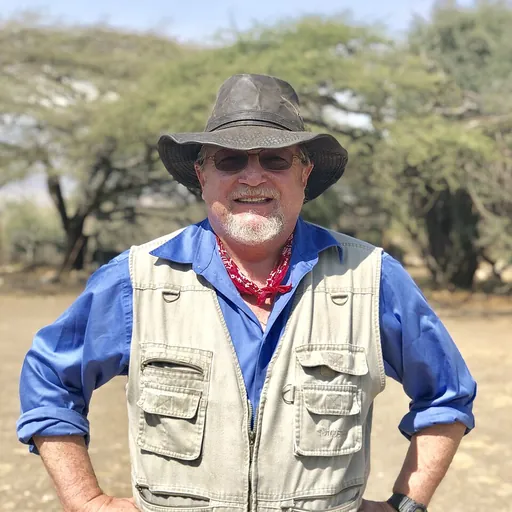
About Nicholas Toth
Born 1952. Nicholas Toth is an American scientist, archaeology and paleoanthropology.
Nicholas Patrick Toth (born September 22, 1952) is an American archaeologist and paleoanthropologist. He is a Professor in the Cognitive Science Program at Indiana University and is a founder and co-director of the Stone Age Institute. Toth's archaeological and experimental research has focused on the stone tool technology of Early Stone Age hominins who produced Oldowan and Acheulean artifacts which have been discovered across Africa, Asia, the Middle East, and Europe. He is best known for his experimental work, with Kathy Schick, including their work with the bonobo (“pygmy chimpanzee”) Kanzi who they taught to make and use simple stone tools similar to those made by our Early Stone Age ancestors.
Early life and education Toth was born and grew up in Cleveland, Ohio. He graduated from Brooklyn High School in 1970 and in 1974 earned a BA with distinction in Liberal Arts and Anthropology from Western College in Oxford, Ohio.
Field and laboratory research alt=Nicholas Toth using a hammerstone to flake stone, creating an Acheulean hand axe. Toth has engaged in field and laboratory research since the late 1970s, resulting in scientific publications on a variety of topics including human evolution, African prehistory, Paleolithic studies, the evolution of human intelligence, lithic technology, raw materials of antiquity, experimental archaeology, microscopic approaches to archaeology, faunal analysis, and taphonomy, geoarchaeology, ethnoarchaeology, primate studies, history of evolutionary thought, and Big History (studying and teaching history from the Big Bang to recent times). Dmanisi in the Republic of Georgia, Gona in Ethiopia, Middle Awash in Ethiopia, Nihewan Basin in China, Lake Natron in Tanzania, Ambrona in Spain, and Koobi Fora in Kenya. During investigations at Gona, Ethiopia in 1999, Toth discovered the fossil cranium of a Homo erectus individual which dates to about 1.2 million years ago.
In his decades of experimental research into the manufacture and use of early stone tools, Toth has replicated thousands of Oldowan and Acheulean artifacts, many of which he has used in controlled experiments involving such things as cutting through thick hides and the butchering of large animals (all animals used in these studies had died of natural causes, no animals were killed for the purposes of this research). This research revealed that the most important tools to the early stone tool makers may have been the sharp-edged flakes that were removed from the choppers and pebble tools, rather than the choppers and pebble tools themselves, as had been previously supposed. Flake assemblages had been a largely ignored part of archaeological collections from sites of this time period because they were thought to have been a by-product of the manufacture of the more formal choppers and other pebble tools. Toth’s research supported the idea that these flakes were the simple, highly effective base of early stone tool technology.
Research with Kanzi In 1990, Toth began a long-term collaborative research project, along with Kathy Schick and psychologist Sue Savage-Rumbaugh, to observe the bonobo Kanzi as he learned to make and use stone tools. Over the course of this research, Toth and Schick worked together to teach Kanzi, by example, to flake stone and use the sharp flakes produced to cut a length of rope that would allow access to a desired food reward. The goal of this research was to compare the products of human tool makers to those of our prehistoric counterparts (which we can see archaeologically through the tools they produced), as well as to those of non-human primates who have not evolved to make stone tools. This research would allow the scientists to investigate what, if any, cognitive and biomechanical adaptations required for stone tool technology may be present in modern day primates.
Given a supply of chert for flaking and stone to use as a hammerstone, Kanzi was able to learn to flake stone, yielding sharp flakes that he was able to use to cut through rope and obtain his edible reward. The flakes and cores produced by Kanzi’s efforts were less sophisticated than the earliest stone tools recognized by archaeologists, suggesting that there is probably an earlier stone tool technology that is not recognized archaeologically.
Olduvai Gorge Coring Project In 2014, Toth, along with three other principal investigators including Kathy Schick, Jackson Njau, and Ian Stanistreet, began the Olduvai Gorge Coring Project to extract geological cores around the gorge in order to increase our knowledge of the geological history of the Olduvai Gorge area. This coring project is the first of its kind to take place at Olduvai and the project has resulted in the extraction of more than 600 meters of geological cores from 3 different locations around the gorge, with the deepest core resulting in 236 meters of recovered core material. This project more than doubles the known stratigraphic sequence at Olduvai, adding 400,000 years of deposits dating as far back as 2.4 million years ago. The coring project is ongoing, with further coring planned and a variety of researchers analyzing the extracted core material.
Honors and distinctions
In 1990, Toth, Kathy Schick, and J. Desmond Clark became the first foreign archaeologists invited to excavate in China since the Peking Man excavations in the 1930s. Toth received Indiana University's annual Outstanding Faculty Award in 1997. Toth was honored with the invitation to deliver the annual Memorial Lecture for the L.S.B. Leakey Foundation in San Francisco in 2001. In 2003 Toth became an Elected Fellow of the American Association for the Advancement of Science (AAAS). In 2019 Toth received an Honorary Doctorate from Tbilisi State University, Republic of Georgia for his contributions to Georgian archaeology.
Don’t just read it —
keep it.
Full-length biographies made to live with: read them, listen on the way to work, watch them tonight.
- E-book
- Audio
- Video
Instant download · yours to keep · every purchase keeps this site free
Important facts
People in Nicholas Toth's life
Named in this biography and alive at the same time




Related people
Same field, nearest in time



Contemporaries
People whose lives overlapped Nicholas Toth's
Frequently asked questions
Who is Nicholas Toth?
American archaeologist
When was Nicholas Toth born?
Nicholas Toth was born on 22 September 1952 in Cleveland.
What is Nicholas Toth's occupation?
Nicholas Toth is a scientist, archaeology and paleoanthropology.
What nationality is Nicholas Toth?
Nicholas Toth is American.
Sources & further reading
Cite this page
APA: Biography.guide. (2026). Nicholas Toth. https://biography.guide/nicholas-toth/
MLA: "Nicholas Toth." Biography.guide, https://biography.guide/nicholas-toth/.
Chicago: "Nicholas Toth." Biography.guide. https://biography.guide/nicholas-toth/.
Data last updated: 2026-09-22 · Spot an error? Report a correction.
Portrait: Wikimedia Commons · author & licence
Page generated 2026-09-27 04:59 UTC