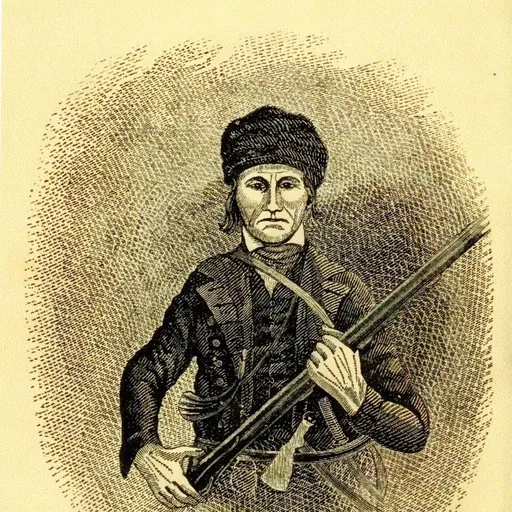
Nicholas Stoner
Adirondack pioneer and Revolutionary War soldier
About Nicholas Stoner
Lived 1762 – 1853 (aged 90).
Nicholas Stoner (Maryland, Dec. 15, 1762–Caroga, New York, Nov. 26, 1853) was a hunter and trapper in the Adirondack Mountains of New York. He served in the Continental Army in the American Revolution and the American forces in the War of 1812. He is buried in Prospect Hill Cemetery, Gloversville, New York.
Early life Nicholas Stoner was born in Maryland in 1762 or 1763, the son of German immigrant Henry Stoner and Catherine Barnes. During his childhood the family moved to New York City, where his uncle, John Binkus, paid for his schooling. After a few years the family again moved, to a frontier community called "Fonda's Bush" (now Broadalbin, Fulton County, New York), east of Johnstown and north of Amsterdam, New York.
Revolutionary War In 1777 Stoner enlisted as a fifer in the Patriot forces in Colonel James Livingston's battalion of the New York Line under Captain Timothy Hughes. His father and younger brother, John, served in the same regiment.
In August 1777 the unit accompanied General Benedict Arnold in the relief of Fort Stanwix. In the fall of that year they fought in the Battles of Saratoga. Stoner accompanied General Arnold in the attack on the Hessian camp in which Arnold was wounded, and Stoner was also wounded on the right side of his head and his ear by fragments of the skull of a fellow soldier killed by a cannonball. Following his recovery he served with his unit in Rhode Island, where his father was wounded and Nicholas captured, but later freed. In 1780 it was said that he was fifer of the guard that conducted convicted British spy Major John André to the gallows, and in 1781 he was at Yorktown for the British surrender. In addition to Scarborough's daughter Mary (b.1782), Nicholas and Anna had six children together — four sons: John (b.1789), Jeremiah (b.1794), Henry (b.1796), and Obediah (b.1801), and two daughters: Mary, and Catherine (b.1802). The family first lived near Johnson Hall, and then moved to Scotch Bush, now in the town of Florida in Montgomery County. Stoner served for a time as deputy sheriff, and also filled various other offices in the town. During this time, too, he became noted as a hunter and trapper, primarily in the area along the Sacandaga River.
One time he engaged in a drunken brawl in De Fonclaire's Tavern in Johnstown, which was frequented by both Canadian and American trappers. One of the Canadian Indians, hearing the name of Stoner, pulled out his scalping knife and boasted of the nine notches indicating scalps taken during the Revolution. He pointed to one, cut deeper than the others, and said that this "was the scalp of old Stoner!" (Nicholas' father) Hearing this Stoner grabbed a red-hot andiron and threw it at the Indian, yelling "You never will scalp another one!" The iron burned a brand across the Indian's neck and knocked him unconscious, at the cost of severe burns to Stoner's own hand. It is not known what became of the injured Native, although he is believed to have died of his injury on the way back to Canada. Stoner was arrested and jailed, but was freed by a mob of fellow Revolutionary War veterans, and was never brought to trial. and resided in Caroga, New York.
War of 1812 At the outbreak of the War of 1812 both Stoner brothers enlisted—John in 1812 and Nicholas in 1813. John died of illness at Sackets Harbor, New York. Nicholas enlisted in the 29th Regiment. In the spring he joined the rest of the army at Plattsburgh as a fife-major, and henceforth was titled "Major Stoner". In September 1814, he took part in the Battle of Plattsburgh, where a small American force repelled a vastly superior British force.
Death Nicholas Stoner died at the age of 92 on November 24, 1853, in Newkirk's Mills (now Newkirk), in the town of Caroga. He was originally buried in Kingsborough Cemetery in Gloversville, which still has a plaque marking the site. His remains were later moved to Prospect Hill Cemetery in Gloversville.
Legacy The Nick Stoner Municipal Golf Course in Caroga is named for Stoner and also exhibits a large statue of him. East Stoner Lake, West Stoner Lake, and Little Stoner Lake at the northern end of Caroga, as well as Nick Stoner Island in nearby Canada Lake, bear his name. The fight song of Gloversville High School was "Old Nick Stoner, the Man whose Praise we sing." A liberty ship, , was launched in 1944.
Don’t just read it —
keep it.
Full-length biographies made to live with: read them, listen on the way to work, watch them tonight.
- E-book
- Audio
- Video
Instant download · yours to keep · every purchase keeps this site free
Important facts
People in Nicholas Stoner's life
Named in this biography and alive at the same time

Contemporaries
People whose lives overlapped Nicholas Stoner's






Frequently asked questions
Who was Nicholas Stoner?
Adirondack pioneer and Revolutionary War soldier
When was Nicholas Stoner born?
Nicholas Stoner was born on 15 December 1762 in Maryland.
When did Nicholas Stoner die?
Nicholas Stoner died on 26 November 1853 in Caroga.
Sources & further reading
Cite this page
APA: Biography.guide. (2026). Nicholas Stoner. https://biography.guide/nicholas-stoner/
MLA: "Nicholas Stoner." Biography.guide, https://biography.guide/nicholas-stoner/.
Chicago: "Nicholas Stoner." Biography.guide. https://biography.guide/nicholas-stoner/.
Data last updated: 2026-09-24 · Spot an error? Report a correction.
Portrait: Wikimedia Commons · author & licence
Page generated 2026-09-27 05:09 UTC