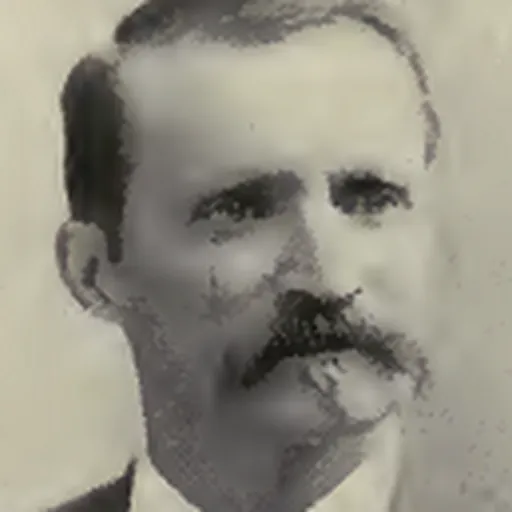
About Nicholas C. Creede
Lived 1843 – 1897 (aged 53–54). Nicholas C. Creede was an American explorer and prospecting.
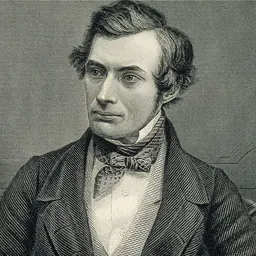
Nicholas C. Creede (c. 1843 – July 12, 1897) was an American prospector famous for discovering the Holy Moses Amethyst vein and other mining properties near Creede, Colorado in the late 1880s and early 1890s.
Early life
Nicholas C. Creede was born William Harvey about 1843 near Fort Wayne, Indiana. At the age of two, the family moved to what would later become Jasper County in Iowa Territory. There, the family took up farming. Siblings included older brothers McConnell, Jerome L. who later became a postmaster, and John W. who later became a judge. He also had at least one sister, Clara.
Army life
In his teens, Creede worked in the U.S. Army Quartermaster's Department but grew weary of the routine work. In 1862, at the age of 19, he volunteered with the United States Army and served seven years as a scout with the Pawnee in campaigns against the Sioux. During this time, he received the pay of a first lieutenant although he held no rank. As part of these duties, he traveled in Nebraska, Colorado, Wyoming, Montana and the Badlands of the Dakotas. He was present in the Black Hills when gold was discovered there, which led to his interest in prospecting.
Name change
In 1870, Creede left the army and returned to Iowa intending to woo and wed a local girl who had caught his eye before he began his travels as a scout. Upon his return, though, he found that she had wed Creede's brother, with whom she had had a child. Although the family eventually reconciled some years later, this event so agitated young Billy Harvey that he changed his name to Nicholas "Nic" C. Creede. The event also strengthened his resolve to become a prospector.
Monarch and Bonanza strikes
Creede's first significant strike was in 1878 in Chaffee County, Colorado, when he discovered the Monarch located near present-day Monarch Pass. As was common during that time as most prospectors rarely had the capital, the knowledge and/or the will to develop the strike themselves, he sold the Monarch for a small sum. He then struck a vein he called the Bonanza which he sold for US$20,000 (~$454,500 US 2011).
Upon interviewing Creede in March 1892 after discovery of the Amethyst, Scientific American described him as reserved, modest, unassuming, taciturn, pure-minded, courageous and generous to a fault, but with a commanding air of a person whose few words were characterized by "great good sense". He was also said not to "know the taste of whisky" or "to know nought of gambling".
Life after the Amethyst strike
Marriage
During his time prospecting near the Jimtown camp, Creede met Nancy Louisa Kyles (née White) of Birmingham, Alabama. Mrs. Kyles ran a boarding house in Del Norte, Colorado, and had already had three husbands before she met Creede. She was also as familiar with the hardships of frontier and mining camp life as Creede himself.
When Creede struck it rich, he built a "neat but plain" log cabin at Creede, and Mrs. Kyles served as his housekeeper while she obtained a divorce from her current husband. She also was said to have often accompanied Creede, and his young nephew Sherman Phifer, on many of Creede's prospecting journeys. They married in Las Vegas, New Mexico on May 25, 1893 and purchased a small cottage for $5,000 in Pueblo, Colorado where Creede's tastes were "simple and his habit economical".
Adoption of Edith Dorothy Walker
In August 1895, the childless Creedes adopted six-month-old Edith Dorothy Hitt Walker. Young Dorothy's history was equal in color and drama to either of the Creedes.
Dorothy was the daughter of Edith Waters Walker. Edith claimed to have been born in San Francisco in 1875 in poverty, hardship and neglect. However, young Edith was removed from poverty when she was adopted by a Mrs. Scott, the widow of a wealthy warehouse owner. Mrs. Scott then married William G. Waters, the foreman of the printing department of a San Francisco daily newspaper. When Mrs. Waters (Scott) became ill, the family moved to southern California for her health. There, "Captain" Waters acquired possession of San Miguel Island and established a home there.
Mrs. Waters died during Edith's youth, leaving Edith on the island with only a housekeeper and hired men for company since Captain Waters was often on the mainland. This lonely existence apparently did not suit Edith, who wished to pursue a career as an actress. So, when a sailboat landed on the island, Edith persuaded the captain of the vessel to take her to the mainland.
Dorothy's father, John Mackay Walters, had his own colorful and dramatic history as the relatively impoverished son of well-to-do California businessman J. B. Walker, who was a partner of "Bonanza King" John William Mackay. Shortly after reaching the mainland, Edith met John Walters. Two weeks later, she performed her first role on stage under the stage name Ynez (Inez) Dean. Four weeks later, Edith and John Walters were wed.
The Walters marriage was stormy and short-lived with Edith Walters leaving the marriage to pursue her acting career. Edith later entered the Los Angeles County Infirmary as a charity inmate. In the early spring of 1895, she gave birth to Dorothy. For nine months, the young mother tried to support them with her acting career. In the summer, she filed suit against her husband seeking divorce, and suit against her step-father to reclaim the inheritance she said was due her from her adopted mother Mrs. Scott. These legal actions garnered the attention of the press as well as Mr. Creede. Creede, moved by the accounts of the young lady's hardships, offered to adopt young Dorothy. The adoption was completed in late summer. According to some reports, Edith wished to give Dorothy a good home because of Edith was concerned that her ill health would soon leave Dorothy an orphan.
Dissolution of the Creede marriage
Mrs. Creede, who had begun taking morphine in 1876 after "having been kicked by a cow" and who was by now a heavy morphine user, was unwilling or unable to care for young Dorothy. So nurses were hired to care for the baby. In February 1896, Miss Maggie Kearny entered the household to serve as a nurse to Dorothy Creede. Although denied by Miss Kearny, Mrs. Creede alleged that in the summer of 1897 Creede began a liaison with Miss Kearny.
In the winter of 1897-98, while Creede was out of town, Nancy Creede dismissed Miss Kearny and had her removed from the Creede's Los Angeles home. It was understood that after the necessary waiting period, Creede would institute divorce proceedings. Miss Kearny returned to the Creede residence on January 14. Mrs. Creede filed a cross complaint asking for half the property, and her attorney advised her to return to Los Angeles to pursue the case. She did so in June, engaging lodgings with her niece at the Clarendon Hotel. Creede was aware that his wife was in town and was said to have been distressed by her proximity, going so far as to have her monitored and her movements reported back to him.
Although widely reported in the press as a suicide, Creede's friends noted that he was in the habit of using morphine in moderate quantities "to quiet the pain caused by neuralgia of the stomach" and assumed he had taken an overdose by mistake. A coroner's jury subsequently ruled the death "accidental self-poisoning by an overdose of morphine taken to relieve pain".
Will and estate
Creede's will left the bulk of the estate to the adopted daughter Dorothy to be made available to her upon reaching age 25 "should she faithfully demean herself and grow to be a good, virtuous woman". The will also contained other, much smaller but nevertheless substantial bequests to his sister, his nephew Sherman Phifer, and his brothers. There were no provisions in the will for Mrs. Creede. His sister Clara's husband, William Phifer, was to serve as executor and as guardian to Dorothy. Creede's estate was subsequently appraised at a value of US$153,716 (~$4,155,000 in US 2011) with US$105,000 (~$2,838,000 in US 2011) in real and the remainder in personal property although this only represented Creede's California holdings. Some estimates placed the total Creede estate at upwards of US$3,000,000 (~$81,000,000 in US 2011).
Distribution of the estate A spate of legal proceedings followed Creede's death, culminating in a highly publicized trial which decided the distribution of the estate. The primary issues at this trial, held in early 1898 in Los Angeles, were: Was Mrs. Creede the legal wife of Mr. Creede, Was the deed of separation in effect at the time of Creede's death a valid instrument, and Was the will a forgery.
Legitimacy of the Creede marriage Nancy White (later Mrs. Nancy Creede) eloped with her first husband, George S. Vandever, in about 1858 when she was a girl of roughly 13 to 16 years of age. They eventually settled in Kentucky where Mr. Vandever enlisted in the army and served in the Civil War. She later learned that her husband had been stabbed, and had died from his wounds. In 1868, she married Jerome Davis in Cape Girardeau, Missouri although he died a short time later in St. Louis, Missouri. In 1886, she married Frank Kyles in Colorado, whom she divorced before marrying Creede. George Vandever, however, was not dead. Rather, he was still very much alive at the time of her marriage to Creede, thus potentially rendering Nancy Kyle's marriage to Creede invalid. According to some sources, she was aware of this potential when she accepted the $20,000 separation settlement in January.
Unknown to Mrs. Creede, however, Vandever had obtained a divorce prior to her marriage to Creede. After he was released from the army, he returned home to find that his wife had disappeared—it being said that she had taken up with another man. According to Vandever, she entered a house of prostitution at Paducah, Kentucky and so, in October 1865, Vandever applied for a divorce on the grounds of adultery rather than simple desertion. The divorce decree was granted in April 1866. So although Mrs. Creede had not sought a divorce from Vandever before marrying Creede, Vandever had obtained a divorce before Nancy Vandever's marriage to Creede.
During the legal proceedings, evidence came to light that Mr. Mark L. White, who was married to Mrs. Creede's sister Elvira, solicited bribes from the attorneys of various claimants either to bring Mr. Vandever forward or, alternately, to keep him from testifying. White also asserted that he had been negotiating with Creede prior to Creede's death to furnish evidence that Mrs. Creede had never obtained a divorce from Vandever. White also claimed that Vandever was in partnership with White in White's blackmailing schemes (although many sources thought this was unlikely, given Mr. Vandever's good character).
Legitimacy of the deed of separation
Mrs. Creede claimed that the deed of separation was invalid as she was coerced and bullied, and was ill and was under the influence of morphine at the time of signing. Testimony associated with this issue confirmed that Mrs. Creede was a heavy morphine user. However, others involved with the events of January 4 testified that she was vigorous and appeared mentally alert on the day she signed the document of separation.
Mrs. Creede also claimed that, in addition to a husband-wife relationship, she and Creede were business partners and that she was entitled to some parts of the estate as a business partner. For example, she claimed that Creede had agreed to give her a percentage of all strikes made during their joint prospecting travels and further claimed to have been present when Creede discovered the Amethyst vein.
Resolution of the case A verdict was reached in August 1898 which determined that, given the divorce decree granted to George Vandever, Nancy Louise Creede was Nicholas C. Creede's true and lawful wife. However, the court also ruled that the deed of separation Mrs. Creede had signed in January 1897 was valid and applied not only to community property but any business partnerships (should any have existed). She was, therefore, not entitled to any portion of the estate other than the $20,000 she had previously received.
Guardianship of Dorothy Creede Guardianship of Dorothy Creede was claimed by William Phifer as defined by the will, by Mrs. Creede, and by the child's mother Edith Waters Walder who had subsequently recovered from her illness, married a San Franciscan hardware dealer and was now known as Edith Bashford.
Regarding William Phifer's claim, concern was expressed that a man should have guardianship of such a young girl. Mr. Phifer died before the case was settled leaving claims for guardianship split among his son, Sherman Phifer, and three others. Regarding Mrs. Creede's claim, it was established that in legal terms, only Mr. Creede had adopted the little girl. The papers Mrs. Creede had signed at the time of adoption were simply agreements to the adoption by Mr. Creede. The court ultimately decided, in 1898, that Mrs. Bashford would be granted guardianship of Dorothy until she came of age. With that decision, Dorothy was relocated to Mrs. Bashford's home in San Francisco.
Dorothy Creede's later life and death
In 1901, young Miss Creede, under the guardianship of her mother, succeeded in overthrowing the restriction on inheritance at age 25 and received a substantial portion of the estate at that time. She graduated from Tamalpais High School in the Mill Valley area of Sausalito, California in 1914, married William Lloyd Ritchie and bore one daughter, Edith Romer Ritchie in the late summer of 1918. Mrs. Ritchie (Creede) died at the age of 23 in November 1918 at the St. Francis Hospital only a few months after the birth of her daughter when a case of bronchitis developed into the Spanish flu. The bulk of the Creede estate then passed to her daughter with the remainder passing to her mother Mrs. Bashford.
Related lawsuits The legal wrangling associated with Creede's death did not end with the ruling on Dorothy Creede's guardianship. John T. Jones, as administrator of the estate on Miss Creede's behalf, filed suit in 1899 claiming that David H. Moffat and other members of the Moffat-led consortium conspired to induce Creede, who is said to have been mentally unbalanced, to give them his stock in the Amethyst Mining Company free of charge. The suit claimed that a one-third interest in the Amethyst mines was worth over US$5,000,000 (~$135,000,000 US 2011).
Don’t just read it —
keep it.
Full-length biographies made to live with: read them, listen on the way to work, watch them tonight.
- E-book
- Audio
- Video
Instant download · yours to keep · every purchase keeps this site free
Important facts
People in Nicholas C. Creede's life
Named in this biography and alive at the same time




Related people
Same field, nearest in time



Contemporaries
People whose lives overlapped Nicholas C. Creede's
Frequently asked questions
Who was Nicholas C. Creede?
American prospector and Silver Boom millionaire
When was Nicholas C. Creede born?
Nicholas C. Creede was born in 1843 in Fort Wayne.
When did Nicholas C. Creede die?
Nicholas C. Creede died on 12 July 1897 in Los Angeles, California.
What was Nicholas C. Creede's occupation?
Nicholas C. Creede was an explorer and prospecting.
What nationality was Nicholas C. Creede?
Nicholas C. Creede was American.
Sources & further reading
· Wikipedia: Nicholas C. Creede
Cite this page
APA: Biography.guide. (2026). Nicholas C. Creede. https://biography.guide/nicholas-c-creede/
MLA: "Nicholas C. Creede." Biography.guide, https://biography.guide/nicholas-c-creede/.
Chicago: "Nicholas C. Creede." Biography.guide. https://biography.guide/nicholas-c-creede/.
Data last updated: 2026-09-22 · Spot an error? Report a correction.
Portrait: Wikimedia Commons · author & licence
Page generated 2026-09-27 05:03 UTC