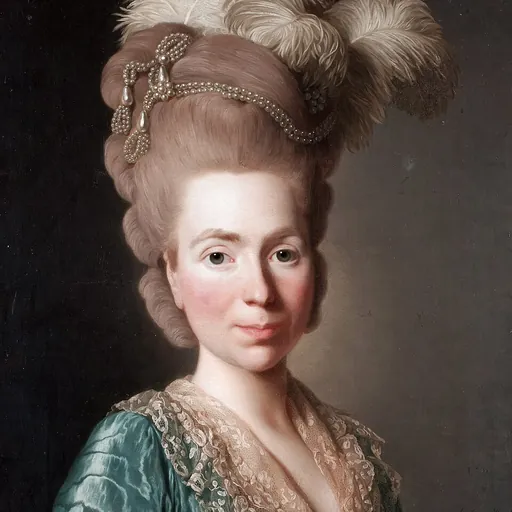
About Nathalie Golitsyn (Chernysheva)
Lived 1744 – 1837 (aged 93). Nathalie Golitsyn (Chernysheva) was a Russian lady-in-waiting.
Princess Natalya Petrovna Golitsyna (; (Чернышёва); 28 January 1741) was a Russian noblewoman, lady-in-waiting, socialite, and Dame of the Order of St. Catherine's first degree.
Born into the noble Chernyshyov family, Natalya Petrovna was the daughter of the diplomat Pyotr Chernyshyov, ambassador to Berlin at the time of her birth. She moved with the family to London, following her father's duties as ambassador to the royal courts of Europe, and returned to Russia for periods. Appointed one of Empress Catherine the Great's maids of honour in 1762, she married Prince Vladimir Borisovich Golitsyn in 1766. Taking charge of the management of his estates, she greatly increased the family's fortunes, before the couple moved abroad with their family for their education. They settled in Paris, where Natalya became a darling of the French court, nicknamed the "Moscow Venus". Returning to Russia during the French Revolution, the family established itself in St Petersburg.
Princess Golitsyna continued her socialising, establishing a popular salon that became an important focal point of the court. She continued to receive the attentions of the Russian emperors, being awarded orders of nobility, and mixing with the highest echelons of society. Popular in public, though regarded as somewhat autocratic, she took especial care of her children, enforcing strict rules and standards of behaviour. Her influence and control over their lives was such that even in adult life they were afraid to sit in front of her, and she continued to manage the family estates and finances. Despite being Governor-General of Moscow, her son Dmitry had to have the Emperor intercede on his behalf for a raise in the allowance she gave him. In later life she became known in society as "Princesse Moustache" as her facial hair became more prominent. She was an inspiration for the countess in Alexander Pushkin's short story The Queen of Spades, another nickname that became attached to her. She died at the age of 96, having been a part of the Imperial court through the lives of five Emperors and Empresses.
Family and early life The Chernyshyov family in a 1750s portrait by David Lüders. Pyotr Chernyshyov with his wife Ekaterina Andreyevna and their daughters Anna, Darya and Natalya, and their son Grigory.
Natalya was born in Berlin on 28 January 1741, the second daughter of Count Pyotr Chernyshyov, diplomat and ambassador to the Margraviate of Brandenburg. Her mother was Ekaterina Andreyevna, daughter of a famous chief of the secret office in Biron, Count Andrei Ivanovich Ushakov. She was a niece of Counts Zakhar and Ivan Chernyshov and the sister of the lady in waiting Princess Darya Petrovna Saltykova. Natalya went with the family to London, her father's new posting as ambassador to the Kingdom of Great Britain, and received an excellent education, eventually being able to speak five languages. The Chernyshyovs were recalled to Russia in 1756, spending four years in the country before her father's appointment in 1760 as ambassador to the court of Louis XV of France.
Upon the Chernyshyovs' return to Russia in 1762, Natalya and her sister Darya became known as two of the most learned women in Russia. In 1762 she was appointed maid of honour to Empress Catherine the Great, and was awarded a unique gold medal with Catherine's portrait by the empress for her dance in the "Court Carousel" of 1766. In October 1766 she married the 35-year-old Prince Vladimir Borisovich Golitsyn, in a wedding attended by the Empress herself, who decorated the Princess's hair with diamonds and accompanied her to the church. He wrote his mother about the activities of the National Constituent Assembly (France). On 14 July 1790 they were back in Paris. Empress Catherine ordered all Russians abroad to return home, and the Golitsyns returned to Russia in August 1790, except the brothers who visited Rome, where they were portrayed by Hugh Douglas Hamilton. She left two diaries from this period, which were subsequently published; Notes About the Events of My Life , covering the years 1781 to 1783, and Notes About My Travels , covering the years 1783 to 1790. Evidence shows that she personally managed her property, and in Radogoshch the estate's office building, a distillery, stud-farm and stone church were built during her time as owner.
Pushkin and the Queen of Spades Princess Golitsyna was an inspiration for the character of the countess in Alexander Pushkin's The Queen of Spades, written in 1833. On its publication in 1834 Pushkin wrote about its reception, noting that "At the court, they found similarities between the old Countess and Princess Natalya Petrovna and do not seem to be angry." A story spread that Princess Golitsyna's grand-nephew, Prince had gone to her for help after losing a large sum of money at cards. Princess Golitsyna replied that she knew the secret of the three magic cards, the three, the seven and the ace, having been told it by her friend in France, the Count of St. Germain. Sergei Golitsyn then used this knowledge to win the money back. Sergei Golitsyn had then related this story to Pushkin. Princess Golitsyna, who by the time of the publication of her story was in her 90s, began to be identified with the character, being nicknamed the "Queen of Spades", while her house in St Petersburg became known as the . In later years the house and the intersection it stood on came to be considered a haunted site.
The popular story stemmed from a friend of Pushkin's, , who related to historian P. I. Bartenev that it had been a Golitsyn who had told the cards anecdote to Pushkin. The Golitsyn in question was identified as likely being Sergei by Mstislav Tsiavlovskii, a connection challenged by A. A. Ilin-Tomich who presented evidence that he was not the source of the anecdote. When queried about the likeness with Zagryazhskaya, the great-aunt of Pushkin's wife Natalia, by Pavel Nashchokin, Pushkin admitted "It was easier for me to portray Zagryazhskaya, than for Golitsyna, whose character and habits were more complicated." The Oxford edition also notes that, despite the story of Sergei Golitsyn and Pushkin, neither Zagryazhskaya or Golitsyna were the inspiration for the occult aspect of the story involving the Count of St. Germain.
Princess Golitsyna died in St Petersburg on 1 January 1838, at age 96. In her long life she had been maid of honour during the reigns of five emperors and empresses, and a lady in waiting at the courts of Alexander I and Nicholas I. She was buried in the Golitsyn family tomb in the Donskoy Monastery in Moscow.
Don’t just read it —
keep it.
Full-length biographies made to live with: read them, listen on the way to work, watch them tonight.
- E-book
- Audio
- Video
Instant download · yours to keep · every purchase keeps this site free
Important facts
People in Nathalie Golitsyn (Chernysheva)'s life
Named in this biography and alive at the same time



Related people
Same field, nearest in time
Contemporaries
People whose lives overlapped Nathalie Golitsyn (Chernysheva)'s






Frequently asked questions
Who was Nathalie Golitsyn (Chernysheva)?
Russian noble
When was Nathalie Golitsyn (Chernysheva) born?
Nathalie Golitsyn (Chernysheva) was born on 17 January 1744 in Berlin.
When did Nathalie Golitsyn (Chernysheva) die?
Nathalie Golitsyn (Chernysheva) died on 20 December 1837 in Saint Petersburg.
What was Nathalie Golitsyn (Chernysheva)'s occupation?
Nathalie Golitsyn (Chernysheva) was a lady-in-waiting.
What nationality was Nathalie Golitsyn (Chernysheva)?
Nathalie Golitsyn (Chernysheva) was Russian.
Sources & further reading
· Wikipedia: Nathalie Golitsyn (Chernysheva)
Cite this page
APA: Biography.guide. (2026). Nathalie Golitsyn (Chernysheva). https://biography.guide/nathalie-golitsyn-chernysheva/
MLA: "Nathalie Golitsyn (Chernysheva)." Biography.guide, https://biography.guide/nathalie-golitsyn-chernysheva/.
Chicago: "Nathalie Golitsyn (Chernysheva)." Biography.guide. https://biography.guide/nathalie-golitsyn-chernysheva/.
Data last updated: 2026-09-21 · Spot an error? Report a correction.
Portrait: Wikimedia Commons · author & licence
Page generated 2026-09-27 05:00 UTC