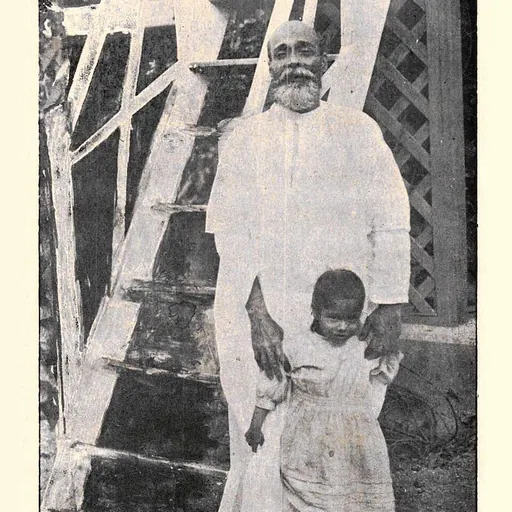
Narayan Vaman Tilak
Marathi poet from Maharashtra, India, and a famous convert to Christianity
About Narayan Vaman Tilak
Lived 1861 – 1919 (aged 57). Narayan Vaman Tilak was an Indian writer and missionary.
Narayan Vaman Tilak (6 December 1861 – 9 May 1919) was a Marathi poet from the Konkan region of then Bombay Presidency in British India, and a famous convert to Christianity from the Hindu Chitpavan Brahmin Community.
Early life Narayan Tilak was born into a Hindu Kokanastha Chitpavan Brahmin family on 6 December 1861 in the village of Karajhgaon in Ratnagiri District of Bombay Presidency. From 1869–1873, he studied elementary school in the town of Kalyan near Mumbai, and for the next two years (1874–76), studied primarily Sanskrit and Marathi literature, especially poetry, under Ganeshshastri Lele in Bhatjicha Math, Nashik. He also read Arunodaya (Sunrise) by Baba Padmanji, six times.
Tilak's journey to Christianity was painful as he understood the reactions that would follow conversion. He anonymously corresponded with a missionary magazine and after confirmation through a series of dreams decided to be baptized. After four months of instruction by his spiritual father Rev. Justin E. Abbott, his baptism in Mumbai on 10 February 1895 was carried out by an untouchable, at Tilak’s request.
Christian work
Talik taught for a year at Hume High School in Byculla, but, unable to cope with the principal of Hume High School, Rev. Edward Sackett Hume's strict western-style discipline, he moved to Ahmednagar, a major center of the American Marathi Mission, at the invitation of Rev. Robert Allen Hume, who was dean of the Theological Seminary. There Tilak reinvented himself and also began to reinterpret the colonial Mission itself.
Tilak began teaching in the seminary in Ahmadnagar and was ordained as a minister in the Congregational church on 10 February 1904 at Rahuri. Besides doing rural pastoral work, Tilak played a key role in the transformation of its prime Christian beneficiaries, who were primarily the rural poor and former Untouchables of the Mahar and Mang castes.
He became editor of (and frequent contributor to) the Marathi section of the missionary magazine Dnyanodaya in 1912, a position he held until his death.
After about ten years as a Christian he began expressing his faith in local idioms, particularly the poetic style of the Varkari Hindu sampradaya of Maharashtra. The many songs he composed remain very popular among Marathi speaking Christians. He composed kirtans (musical religious services with a mixture of poetry and dramatic retelling of Hindu stories of religious inspiration, along with humor and vigorous community participation) and was so popular, he even trained others to professionally conduct kirtans. This continued into his Christian years when he led kirtans, trained Christian kirtankars, including his wife Laxmi, and published a little handbook Kirtan Kalap as a guide.
However, Tilak was a critic of traditional Christianity, and for the last two years of his life moved beyond the church to focus on developing a new brotherhood (that he called an ashram ) of baptized and unbaptized disciples of Jesus. Laxmi described how he would disappear at night to watch and participate in Dashavatari plays in the neighboring village of Gangapur and return in the wee hours of the morning. His talent for acting in diverse roles did not fail to catch the attention of the villagers. Rumors of his acting and singing and compositions reached his brother-in-law who went and ascertained for himself the truth. Indeed, Narayan was a gifted actor and poet. (See Smruti Chitre, Part 1) Death Tilak died on 9 May 1919 at the J.J. Hospital, Byculla in Mumbai. Family Tilak’s father was a government registrar and his mother died when he was 11.
Tilak was married to Manubai Lakshmibai when he was 18 and she was 11; they lived apart until they were 28 and 21 respectively and they went on to have four children.
His poetry includes:
Khristayan (ख्रिस्तायन) Wanawasi Phool (वनवासी फुल) Sushila (सुशीला) Majhi Bharya (माझी भार्या) Bapache Ashru (बापाचे अश्रू) Parwatarohan (पर्वतारोहण) Srushtichi Bhaubij (सृष्टीची भाऊबीज) Pure Janato Micha Majhe Bala (पुरे जाणतो मीच माझे बळ) Ranashing (रणशिंग) Majhya Janambhumiche Nav (माझ्या जन्मभूमीचे नाव) Priyakar Hindistan (प्रियकर हिंदीस्तान) Lekarachi Jidnyasa (लेकराची जिज्ञासा) Kawichi Winawani (कवीची विनवणी) Kawi (कवि) Kevdhe He Krourya (केव्हडे हे क्रौर्य)
Don’t just read it —
keep it.
Full-length biographies made to live with: read them, listen on the way to work, watch them tonight.
- E-book
- Audio
- Video
Instant download · yours to keep · every purchase keeps this site free
Important facts
People in Narayan Vaman Tilak's life
Named in this biography and alive at the same time

Related people
Same field, nearest in time


Contemporaries
People whose lives overlapped Narayan Vaman Tilak's


Frequently asked questions
Who was Narayan Vaman Tilak?
Marathi poet from Maharashtra, India, and a famous convert to Christianity
When was Narayan Vaman Tilak born?
Narayan Vaman Tilak was born on 6 December 1861 in Karajgaon.
When did Narayan Vaman Tilak die?
Narayan Vaman Tilak died on 9 May 1919.
What was Narayan Vaman Tilak's occupation?
Narayan Vaman Tilak was a writer and missionary.
What nationality was Narayan Vaman Tilak?
Narayan Vaman Tilak was Indian.
Sources & further reading
· Wikipedia: Narayan Vaman Tilak
· DBpedia: Narayan Vaman Tilak
Cite this page
APA: Biography.guide. (2026). Narayan Vaman Tilak. https://biography.guide/narayan-vaman-tilak/
MLA: "Narayan Vaman Tilak." Biography.guide, https://biography.guide/narayan-vaman-tilak/.
Chicago: "Narayan Vaman Tilak." Biography.guide. https://biography.guide/narayan-vaman-tilak/.
Data last updated: 2026-09-20 · Spot an error? Report a correction.
Portrait: Wikimedia Commons · author & licence
Page generated 2026-09-27 05:15 UTC