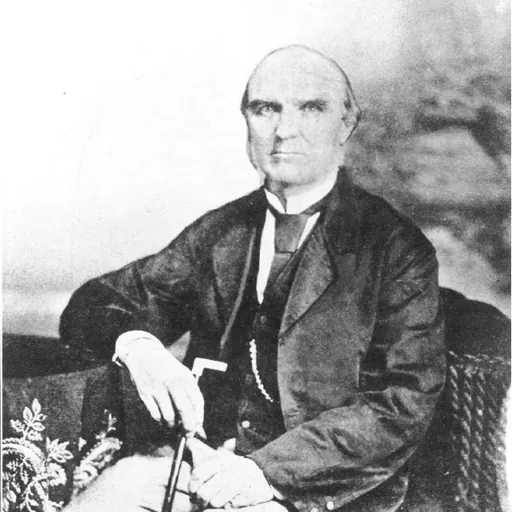
About N. R. Pogson
Lived 1829 – 1891 (aged 62). N. R. Pogson was a British and English astronomer.
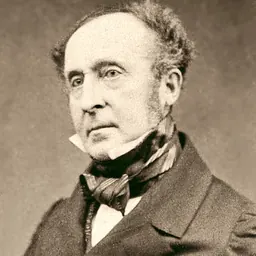
Norman Robert Pogson, CIE (23 March 1829 – 23 June 1891) was an English astronomer who worked in India at the Madras observatory. He discovered several minor planets and made observations on comets. He introduced a mathematical scale of stellar magnitudes with the ratio of two successive magnitudes being the fifth root of one hundred (~2.512) and referred to as Pogson's ratio.
Youth and education
Norman was born in Nottingham, the son of George Owen Pogson, a hosiery manufacturer, lace dealer and commission agent, "with enough income to support an extended family", and his wife, Mary Ann. It was intended that he should follow his father into business, and he was accordingly sent for "commercial education", but he was fascinated by science, and his mother supported and encouraged this interest. His early education was largely informal. He left school at 16, intending to teach mathematics. He was introduced to astronomy through George Bishop's Observatory at South Villa Regent's Park from 1846.
Professional career + Asteroids discovered: 8 42 Isis 23 May 1856 43 Ariadne 15 April 1857 46 Hestia 16 August 1857 67 Asia 17 April 1861 80 Sappho 2 May 1864 87 Sylvia 16 May 1866 107 Camilla 17 November 1868 245 Vera 6 February 1885 After working as an assistant at the South Villa Observatory in 1851, he moved to the Radcliffe Observatory in Oxford in 1852. Despite Pogson's isolation he had at the time of his death discovered 134 stars, 106 variable stars, 21 possible variable stars and 7 possible supernovae. Pogson also made special expeditions, observing a total solar eclipse on 18 August 1868 at Masulipatnam and making spectrometric studies.
His most important contribution was to note that in the stellar magnitude system introduced by the Greek astronomer Hipparchus, stars of the first magnitude were a hundred times as bright as stars of the sixth magnitude. Pogson's suggestion in 1856 was to make this a standard; thus, a first magnitude star is 1001/5 or about 2.512 times as bright as a second magnitude star. This fifth root of 100 is known as Pogson's Ratio.
The magnitude relation is given as follows:
where m is the stellar magnitude and L is the luminosity, for stars 1 and 2.
In 1868 and 1871, Pogson joined the Indian solar eclipse expeditions. He received a telegram from Ernst Friedrich Wilhelm Klinkerfues on 30 November 1872 which read Biela touched Earth on 27th. search near Theta Centauri, a message so esoteric that it caught the fancy of the newspapers of the time. Unfortunately the skies were cloudy in Madras and when it cleared up on 2 December 1872, he observed an object (recorded as X/1872 X1) which he believed to be a return of Biela's Comet but was later found to be a different object which has been called "Pogson's comet".
One of Pogson's assistants was Chintamani Raghunatha Chary. He worked for many years with Pogson and his retirement in 1878 was a blow to Pogson. . Edith outlived him and retired to Wimbledon where she died on 31 December 1946.
Pogson's daughter Elizabeth Isis Pogson (born on 28 September 1852) served as his assistant at the Madras observatory from 1873 to 1881. She went on to become a meteorological reporter for Madras. First proposed for a fellowship of the Royal Astronomical Society in 1886, she was finally admitted in 1920.
Honours
Pogson was created a Companion of the Most Eminent Order of the Indian Empire in January 1878.
The following celestial features are named after him: Asteroid 1830 Pogson The lunar crater Pogson Asteroid 42 Isis is believed to be named after his daughter, Elizabeth Isis Pogson
Don’t just read it —
keep it.
Full-length biographies made to live with: read them, listen on the way to work, watch them tonight.
- E-book
- Audio
- Video
Instant download · yours to keep · every purchase keeps this site free
Important facts
People in N. R. Pogson's life
Named in this biography and alive at the same time



Related people
Same field, nearest in time

Contemporaries
People whose lives overlapped N. R. Pogson's



Frequently asked questions
Who was N. R. Pogson?
British astronomer (1829–1891)
When was N. R. Pogson born?
N. R. Pogson was born on 23 March 1829 in Nottingham.
When did N. R. Pogson die?
N. R. Pogson died on 23 June 1891 in Chennai.
What was N. R. Pogson's occupation?
N. R. Pogson was an astronomer.
What nationality was N. R. Pogson?
N. R. Pogson was British and English.
Sources & further reading
Cite this page
APA: Biography.guide. (2026). N. R. Pogson. https://biography.guide/n-r-pogson/
MLA: "N. R. Pogson." Biography.guide, https://biography.guide/n-r-pogson/.
Chicago: "N. R. Pogson." Biography.guide. https://biography.guide/n-r-pogson/.
Data last updated: 2026-09-21 · Spot an error? Report a correction.
Portrait: Wikimedia Commons · author & licence
Page generated 2026-09-27 05:00 UTC