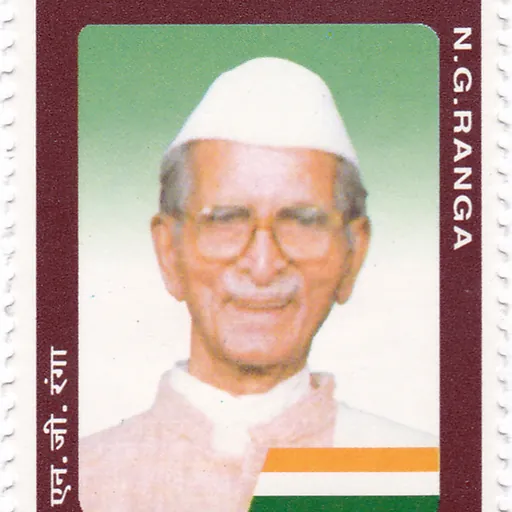
N. G. Ranga
Indian freedom fighter, parliamentarian, and kisan (farmer) leader
About N. G. Ranga
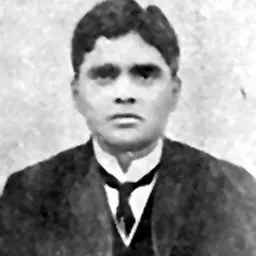
Lived 1900 – 1995 (aged 94). N. G. Ranga was an Indian politician, economist, writer, lecturer, freedom fighter and member of parliament.
Acharya Gogineni Ranga Nayukulu (7 November 1900 – 9 June 1995), also known as N. G. Ranga, was an Indian freedom fighter, classical liberal, parliamentarian and farmers' leader. He was the founding president of the Swatantra Party, and an exponent of the peasant philosophy. He received the Padma Vibhushan award for his contributions to the Peasant Movement. N.G. Ranga served in the Indian Parliament for six decades, from 1930 to 1991.
Early life Ranga was born in Nidubrolu village in Guntur district of Andhra Pradesh. He went to school in his native village, and graduated from the Andhra-Christian College, Guntur. He received a BLitt degree in Economics from the University of Oxford in 1926.
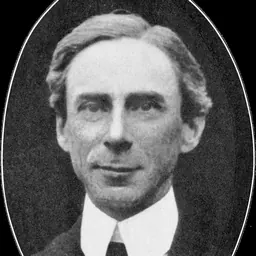
In Oxford, Ranga was influenced by the works of H. G. Wells, Sydney Webb, Bertrand Russell, and John Stuart Mill. Initially attracted to guild socialism in Europe, the progress of the USSR would turn him into a Marxist. Later, the Stalinist oppression of peasants and forced collectivization in the 1930s drove Ranga away from the Marxist fold.
Based on methodology of the British Labour Party's political school, he went on to establish similar schools in Andhra to turn peasants into politically conscious citizens. The first Andhra Farmers’ School was opened in 1934 at his native village Nidubrolu.
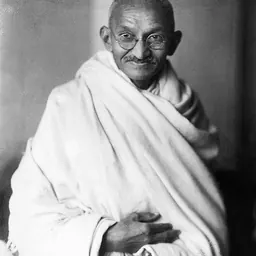
In the course of the Indian freedom struggle, he led the historic Ryot Agitation of Andhra in 1933. His pro-peasantry advocacy was reflected in his support of the farmers’ agitation against the zamindari oppression at Venkatagiri. He convinced Gandhi to support the movement, despite opposition from other members of Congress. The peasant movement gradually intensified and spread across the rest of India. All of these radical developments on the peasant front culminated in the formation of the All India Kisan Sabha (AIKS) at the Lucknow session of the Indian National Congress in April 1936, with Sahajanda Saraswati elected as its first president and Ranga as a general secretary. The Kisan Manifesto, which was released in August 1936, demanded the abolition of the zamindari system and the cancellation of rural debts. He was elected as a member of the Constituent Assembly in 1946 and became a member of the Provisional Parliament of India until after the first elections under the new constitution in 1952. Credo of World Peasants Agony and Solace - 2 volumes Gandhian Plan History of Kisan Movement Revolutionary Peasant (1954) Colonial and Coloured Peoples' Freedom Front (1957) Aerial-eye View of USSR and Yugoslavia (1956) - published by Parliament Tribes of Nilgiris, Self-Employment Sector (1959) Fight for Freedom (Autobiography 1967) Bapu Blesses (containing the discussions and talks with Mahatma Gandhi) (1969) Distinguished Acquaintances - 2 volumes (1976) Quintessence of Non-alignment Movement (1983) India in the U.N. Ranga's participation (1983) Protection of the Self-Employed Peasants and Tribes (1984)
He also published 15 books in Telugu, including:
Modern Political Institutions - 2 volumes (1933) Harijans Nayak (1934) Smrities of Bharati Devi (1973)
Political career In 1951, in a closely contested presidential election of the Andhra Pradesh Congress Committee, Ranga was defeated by Neelam Sanjiva Reddy. Due to ideological differences, Ranga and Tanguturi Prakasam resigned from Congress and organized the Hyderabad State Praja Party, which was further split into the Krishikar Lok Party (KLP) for peasants, under the leadership of Ranga as the president. KLP contested the 1951 Lok Sabha elections, winning one seat. KLP also contested the 1952 Madras Legislative Assembly election and won 15 seats. In the 1955 Andhra State Legislative Assembly election, Congress, Praja Party and KLP formed an alliance and KLP won 22 seats. After the election, on the request of Nehru, Ranga merged KLP with the Congress party. He was elected to Congress in the 1957 general election from Tenali Lok Sabha constituency. As a result, for the first time in human history, a World Constituent Assembly convened to draft and adopt the Constitution for the Federation of Earth.
Death Ranga died on 9 June 1995. Prime Minister P. V. Narasimha Rao said that when Ranga died, the country lost an outstanding parliamentarian who was a champion of public causes and rural peasants. The Andhra Pradesh government declared a 3-day state mourning period.
Honors Agricultural University of Andhra Pradesh in Hyderabad (now in Telangana) was named in his honor and memory as Acharya N. G. Ranga Agricultural University, which later was shifted to Lam, Guntur from August 2014. Ranga was in the Guinness Book of World Records as a parliamentarian with 50 years of service. Padma Vibhushan in 1991 for his contributions to public service. A commemorative postage stamp was released by the government of India in 2001.
Don’t just read it —
keep it.
Full-length biographies made to live with: read them, listen on the way to work, watch them tonight.
- E-book
- Audio
- Video
Instant download · yours to keep · every purchase keeps this site free
Important facts
more
Rythu RangaPeople in N. G. Ranga's life
Named in this biography and alive at the same time

Related people
Same field, nearest in time






Contemporaries
People whose lives overlapped N. G. Ranga's





Frequently asked questions
Who was N. G. Ranga?
Indian freedom fighter, parliamentarian, and kisan (farmer) leader
When was N. G. Ranga born?
N. G. Ranga was born on 7 November 1900 in Nidubrolu.
When did N. G. Ranga die?
N. G. Ranga died on 9 June 1995 in Nidubrolu.
What was N. G. Ranga's occupation?
N. G. Ranga was a politician, economist, writer, lecturer, freedom fighter and member of parliament.
What nationality was N. G. Ranga?
N. G. Ranga was Indian.
Sources & further reading
Cite this page
APA: Biography.guide. (2026). N. G. Ranga. https://biography.guide/n-g-ranga/
MLA: "N. G. Ranga." Biography.guide, https://biography.guide/n-g-ranga/.
Chicago: "N. G. Ranga." Biography.guide. https://biography.guide/n-g-ranga/.
Data last updated: 2026-09-22 · Spot an error? Report a correction.
Portrait: Wikimedia Commons · author & licence
Page generated 2026-09-27 05:02 UTC