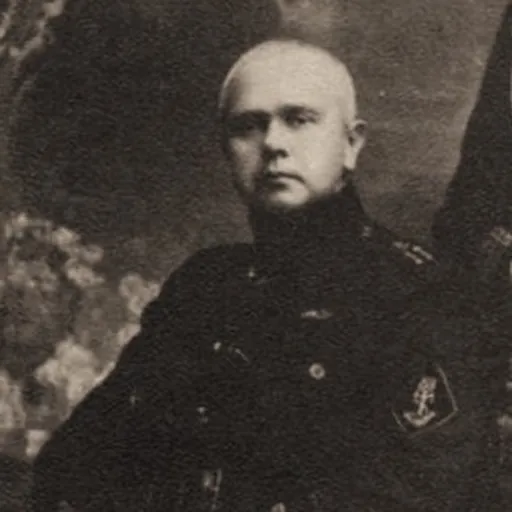
About Mykhailo Bilinskiy
Lived 1883 – 1921 (aged 38). Mykhailo Bilinskiy was a Russian and Ukrainian military personnel.
Mykhailo Ivanovych Bilinskyi or Bilynskyi (; 12 July 1883 – 17 November 1921) was a Ukrainian military leader, Rear Admiral of the Ukrainian People's Republic and leader of the Ukrainian Independence movement. He helped to build up the Ukrainian Maritime Ministry and served as Minister of Maritime Affairs of the UPR.
Bilinskyi also served as Minister of Internal Affairs of the UPR and was the organizer and commander of the Marine Division of the Directory of UPR (1919–1921). He died in battle during the Second Winter Campaign for Ukrainian independence.
Biography
Childhood and Youth
According to naval records, Mykhailo Bilynskyi (in official documents — Bilinsky) was born on 12 July 1883. His father was most likely Ivan Iasonovych Bilinsky, priest of St. Michael's Church in the town of Drabiv. However, Savchenko-Bilskyi claims that M. I. Bilynskyi was born into the family of a wealthy peasant in the village of Drabove-Bariatynske, now in Cherkasy Oblast. He was of hereditary noble status — his grandfather, Father Iason, was awarded the Order of Saint Anna, 3rd class, in 1870, and in 1884 he, his five children, and grandchildren received noble titles.
After graduating from the 2nd Kyiv Gymnasium, Mykhailo continued his studies at the Lazarev Institute of Oriental Languages in Moscow, mastering Arabic, Armenian, Persian, Turkish, Crimean Tatar, and Georgian, and completing a practical course in Eastern calligraphy.
In a personal card filled out and signed by Bilynskyi on 11 November 1920, he listed the following:
Service in the Russian Navy
Bilynskyi began military service in 1906 as a cadet in the Baltic Fleet. He participated in domestic voyages aboard the training ship Riga. In July 1906 a mutiny broke out aboard the vessel, and Bilynskyi was among those who did not support the revolutionary calls. For helping suppress the uprising, he was awarded the silver medal For Bravery on the St. George ribbon.
In 1907 he served aboard the battleships Panteleimon and Tri Sviatytelia. After passing examinations on 12 September 1908, he received the rank of sub-lieutenant of the Admiralty and was transferred to the 2nd Baltic Fleet Crew. On 3 December 1910, due to his transfer to the 3rd Border Guard Brigade of the Separate Border Guard Corps in Arensburg, he was redesignated as a cornet. He served on the island of Ösel.
At the end of December 1911, Bilynskyi retired to the reserve with the rank of sub-lieutenant and began serving in the Ministry of Finance. In 1914, with the outbreak of World War I, he was mobilized and assigned to the Baltic Fleet, where he commanded a company of recruits of the 2nd Baltic Fleet Crew. In February 1915 he was promoted to lieutenant, and in May 1915 awarded the Order of Saint Stanislaus, 3rd class. In 1916 he received the Order of Saint Anna, 3rd class.
During 1915–1916 Bilynskyi also served aboard ships, first as officer of the watch and later as inspector aboard the yacht Strela. On 31 October 1916 he received his first naval rank — midshipman. During the revolutionary year 1917 and early 1918 he served as assistant commander of the 2nd Baltic Fleet Crew. This organization united Ukrainian sailors serving in the Baltic Fleet and actively promoted the idea of Ukrainian autonomy. At that time more than 12,000 sailors in the Baltic Fleet identified themselves as Ukrainians.
On the initiative of Bilynskyi, Shramchenko, and other activists, the cruiser Svetlana and destroyers Ukraina and Haidamak were "Ukrainized" through personnel exchanges with other ships. On 12 October 1917 Ukrainian blue-and-yellow flags were raised on the ships. They were intended to be transferred into the future Ukrainian naval forces. However, the Bolshevik seizure of power and organizational struggles of navy institutions prevented the realization of these plans, forcing Ukrainian sailors to leave Petrograd and return to Ukraine.
The raising of Ukrainian flags on the Baltic Fleet caused a major reaction of the Black Sea Fleet. On the same day, Ukrainian national flags were raised on the battleships Volia, Georgii Pobedonosets, the armored cruiser Potemkin (renamed Fighter for Freedom), and other vessels.
Period of the Central Rada
Bilynskyi arrived to Kyiv when work had only just begun on the creation of the General Secretariat of Naval Affairs of the Ukrainian People's Republic. A member of the Central Committee of the Ukrainian Party of Socialist-Independists, he became an active organizer of the Secretariat, established on 22 December 1917 under Dmytro Antonovych. Under the Central Rada he served on the commission for concluding a peace treaty with Romania and was present in Berlin for the signing of the Treaty of Brest-Litovsk as a naval affairs specialist.
Hetmanate of Skoropadskyi
By order of 24 April 1918, Senior Lieutenant Mykhailo Bilinsky was appointed chairman of a commission "for the creation of general staffing structures" of the Naval Ministry. During the rule of Hetman Pavlo Skoropadskyi, Bilynskyi served as assistant chief of the Main Economic Directorate of the Naval Ministry.
On 29 April, the entire Black Sea Fleet was handed over to the Ukrainian People's Republic. Mikhail Sablin was appointed Commander-in-Chief of the Navy, and a telegram was sent out to Kyiv: "Effective today the Sevastopol fortress and the Fleet in Sevastopol raised the Ukrainian flag. Sablin assumed the command of the Fleet". Having no reply the admiral ordered to repeat the telegram beginning with the words "Comrades of [the] Kiev Central Rada...", unaware that the Rada had been deposed by Skoropadskyi.
From May to October 1918 Bilynskyi was a member of the Ukrainian delegation headed by Serhii Shelukhin, which negotiated peace terms with Soviet Russia.
Ukrainian People's Republic
After the fall of the Hetmanate on 26 December 1918, Bilynskyi was appointed Minister of Naval Affairs of the Ukrainian People's Republic. According to orders of Symon Petliura and the law On the Organization of Naval Forces on the Black Sea Coast, the territory around Mykolaiv, Ochakiv, and Kherson was declared the Maritime Front, with Bilynskyi as commander. In February 1919 he proposed the creation of the first marine infantry regiment. Since UPR forces retreated westward, the regiment was formed in Galicia from former sailors of the Austro-Hungarian Adriatic Fleet and local Hutsul lumber rafters, who became the core of the 1st Hutsul Marine Infantry Regiment.
On 24 April 1919 Bilynskyi resigned in protest against the policies of the Directory and was appointed commander of the newly formed Marine Infantry Division. His ministerial duties were transferred to Captain 1st Rank Mykola Zlobin. In May 1919, when it became clear that the Black Sea Fleet could not be reclaimed, Bilynsky formed a marine division. After protesting the arrest with a hunger strike, he was released, but was barred from promotion in rank.
On 24 July 1919 he began forming the 2nd Marine Infantry Regiment under Lieutenant Ilko Sych. A 3rd regiment was later formed in Brody, and the Marine Infantry Division was sent to the outskirts of Volochysk in order to fight against the Red Army. In September 1919 the Naval Ministry was abolished and its functions transferred to the Naval Directorate of the Military Ministry. Bilynskyi remained with the marines on the front lines and joined the First Winter Campaign of the UPR Army. He was later interned in Poland with the UPR Army.
Exile in Poland
The government of the Ukrainian People's Republic continued to operate in exile in Poland after 1920, while Ukrainian military personnel were held in internment camps administered with the cooperation of Polish authorities. After the defeat of the Ukrainian People's Republic, Bilynskyi remained active in the émigré government structures in Poland. On 3 May 1920 Prime Minister Isaak Mazepa appointed Bilynskyi Minister of Internal Affairs. He headed a joint commission working on draft constitutions for the UPR. On 18 October 1920 he was appointed adviser to the Ministry of National Economy. On 17 November 1921 the Volhynian Group fought the 2nd and 3rd Brigades of the 9th Cavalry Division. Part of the Ukrainian troops became encircled near the village of Mali Minky in Ovruch County. Refusing to surrender, Bilynskyi shot himself. He was later buried by local peasants.
The émigré government of the UPR posthumously promoted Bilynskyi to the rank of rear admiral.
Commemoration There is Captain Bilynskyi Street in Lviv and Mykhailo Bilynskyi Street in Kyiv. In July 2016 a memorial plaque honoring Bilynskyi was unveiled at the Drabiv Local History Museum. On 5 July 2019, by decree of the President of Ukraine, the 36th Separate Marine Brigade of the Ukrainian Naval Infantry was named after Mykhailo Bilynskyi. In Zaporizhzhia, Pestel Street was renamed Mykhailo Bilynskyi Street. In Mykolaiv, General Shepetov Street was renamed Rear Admiral Bilynskyi Street. In Odesa, Amvrosii Buchma Street was renamed Mykhailo Bilynskyi Street.
Don’t just read it —
keep it.
Full-length biographies made to live with: read them, listen on the way to work, watch them tonight.
- E-book
- Audio
- Video
Instant download · yours to keep · every purchase keeps this site free
Important facts
People in Mykhailo Bilinskiy's life
Named in this biography and alive at the same time

Related people
Same field, nearest in time


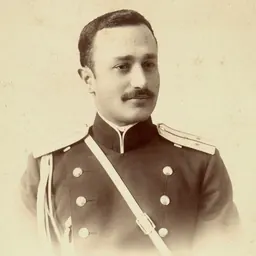



Contemporaries
People whose lives overlapped Mykhailo Bilinskiy's


Frequently asked questions
Who was Mykhailo Bilinskiy?
Ukrainian military leader (1883–1921)
When was Mykhailo Bilinskiy born?
Mykhailo Bilinskiy was born on 4 November 1883 in Drabiv.
When did Mykhailo Bilinskiy die?
Mykhailo Bilinskiy died on 17 November 1921 in Mali Minky.
What was Mykhailo Bilinskiy's occupation?
Mykhailo Bilinskiy was a military personnel.
What nationality was Mykhailo Bilinskiy?
Mykhailo Bilinskiy was Russian and Ukrainian.
Sources & further reading
· Wikipedia: Mykhailo Bilinskiy
Cite this page
APA: Biography.guide. (2026). Mykhailo Bilinskiy. https://biography.guide/mykhailo-bilinskiy/
MLA: "Mykhailo Bilinskiy." Biography.guide, https://biography.guide/mykhailo-bilinskiy/.
Chicago: "Mykhailo Bilinskiy." Biography.guide. https://biography.guide/mykhailo-bilinskiy/.
Data last updated: 2026-09-23 · Spot an error? Report a correction.
Portrait: Wikimedia Commons · author & licence
Page generated 2026-09-27 05:07 UTC