
About Mustafa Kamal
Lived 1935 – 2015 (aged 79–80). Mustafa Kamal was a Bangladeshi, Indian and Pakistani judge and barrister.
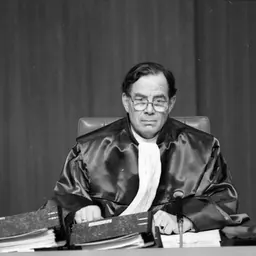
Mustafa Kamal (Bengali: মোস্তফা কামাল; 9 May 1933 – 5 January 2015) was the 9th Chief Justice of Bangladesh. His landmark judgment was on the Masdar Hossain case, widely known as the 'separation of judiciary', which was a milestone in the quest for separation of powers between the judiciary and the executive of the state. Kamal was a pioneer of alternative dispute resolution (ADR) in Bangladesh, and is considered by many as the 'father of ADR' in Bangladesh.
Background Kamal was born on 9 May 1933 in the village of Domar in Rangpur District of the Bengal Presidency in British India (now in Bangladesh). He was named by the national poet of Bangladesh Kazi Nazrul Islam after the Turkish President Mustafa Kemal Atatürk. Kamal's father, Abbasuddin Ahmed, was a legendary Bengali Renaissance singer and composer. Mustafa Kamal's younger brother, Mustafa Zaman Abbasi, is a musicologist and writer, and his younger sister, Ferdausi Rahman, is a legendary playback singer and vocalist.
Early life and education
Kamal spent his early childhood in the village of Balarampur of Cooch Behar - a princely state during the British Raj and now a district of West Bengal, India. Later, he was moved to the district town of Cooch Behar and attended schools from there. He shifted with his family to Dhaka, the capital of erstwhile East Pakistan in 1947.
Justice Mustafa Kamal's formal education started in Cooch Behar's Jenkins School, when he was enrolled in class three in 1940. In 1950, Kamal got himself admitted in the University of Dhaka, Bangladesh. Kamal studied Political Science in his B.A. (Hons) and M.A. In the year 1953 and 1954 respectively, he achieved those degrees securing `first class first’ in both. He also stood first among all candidates in the Arts faculty and was awarded a special scholarship from the Pakistan Government. He returned to Dhaka, and began his professional career as a lawyer in the same year. In 1961, he also joined the Department of Law in the University of Dhaka as a part-time Lecturer, and continued until 1968. He also served as the legal advisor to Rajuk at that period of time. The Government of Bangladesh appointed him as an Additional Attorney General in 1976. In 1977, he was appointed as the Advocate General of the High Court, when the High Court got separated from the Supreme Court.
However, the implementation was being delayed; seemingly, there was a lack of political goodwill. Justice Mustafa Kamal, after his retirement, continued to advocate the cause, and spoke boldly on the reluctance of the Executive to implement the directives of the Supreme Court of Bangladesh. After a long period of political procrastination, the implementation started in 2007.
Kamal felt the need of independence and autonomy of the judiciary even before 1995, when a group of judicial officers brought before the court the constitutional issue that led to the outcome of the Masdar Hossain case. In 1994, Kamal was invited by the University of Dhaka to deliver the prestigious Kamini Kumar Dutta Memorial Law Lecture; he chose the topic ‘Bangladesh Constitution: Trends & Issues’. This lecture provided with invaluable insights that helped build a consensus on necessary reforms.
Redefining 'locus standi' In the judgement of Dr. Mohiuddin Farooque Vs Bangladesh (Civil Appeal No. 24 of 1995), the Appellate Division of the Supreme Court of Bangladesh took a firm stand on the modern liberal trend of Public Interest Litigation leaving aside the traditional view of locus standi. The Supreme Court decided to interpret the term ‘a person aggrieved’ in a liberal mood and with a progressive attitude, and thus widened the writ Jurisdiction of the High Court conferred on it by Article 102 of the Constitution of the People's Republic of Bangladesh. The leading judgment was delivered by Justice Mustafa Kamal on 25 July 1996. The implication of the judgment was that voluntary societies, representative organisations, trade unions and constitutional activists and individuals having no personal interest would now be able to test the validity of a law or an action of a public official affecting the general public by making the power of judicial review of the Supreme Court on their own standing.
Iddat 'Iddat' is a 'Quranic provision' which maintains that 'the husband', after divorce, is required to support 'the wife' for a specific period of time. A Writ Petition was filed by a Non Government Organization (NGO) seeking cancellation or amendment of the provision. The High Court gave its judgment against the Quranic provision of Iddat. The case was forwarded to the Appellate Division of the Supreme Court by way of appeal. Justice Mustafa Kamal played an active role to overturn the judgment. The Appellate Division called two religious scholars to provide with their expert-opinions. The bench of the Appellate Division agreed unanimously to overturn the High Court judgment. In his judgment, Kamal expressed his complete disapproval of High Court judges' ignorance of basic Islamic knowledge, norms and philosophy.
Kamal died on 5 January 2015 of heart disease in Gulshan, Dhaka at the age of 81.
Don’t just read it —
keep it.
Full-length biographies made to live with: read them, listen on the way to work, watch them tonight.
- E-book
- Audio
- Video
Instant download · yours to keep · every purchase keeps this site free
Important facts
Family & relationships
People in Mustafa Kamal's life
Named in this biography and alive at the same time




Related people
Same field, nearest in time





Contemporaries
People whose lives overlapped Mustafa Kamal's





Frequently asked questions
Who was Mustafa Kamal?
Bangladeshi judge
When was Mustafa Kamal born?
Mustafa Kamal was born in 1935 in Bengal Presidency, British India, Rangpur District.
When did Mustafa Kamal die?
Mustafa Kamal died on 5 January 2015 in Dhaka.
What was Mustafa Kamal's occupation?
Mustafa Kamal was a judge and barrister.
What nationality was Mustafa Kamal?
Mustafa Kamal was Bangladeshi, Indian and Pakistani.
Sources & further reading
· DBpedia: Mustafa Kamal (judge)
Cite this page
APA: Biography.guide. (2026). Mustafa Kamal. https://biography.guide/mustafa-kamal-judge/
MLA: "Mustafa Kamal." Biography.guide, https://biography.guide/mustafa-kamal-judge/.
Chicago: "Mustafa Kamal." Biography.guide. https://biography.guide/mustafa-kamal-judge/.
Data last updated: 2026-09-20 · Spot an error? Report a correction.
Page generated 2026-09-27 05:15 UTC