
About Muktanand Swami
Lived 1758 – 1830 (aged 71–72). Muktanand Swami was a monk and writer.
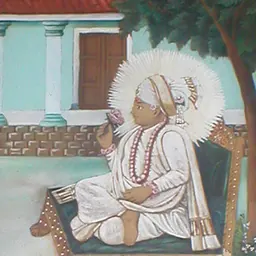
Muktanand Swami (1758–1830), born Mukunddas, was a swami and paramahansa of Bhagwan Swaminarayana.
Biography
He was born Mukunddas to Anandram and Radhabai in Amrapur village (Dist-Amreli), Gujarat in 1758.
While children of his age group were indulging in sports and games, Mukunddas sat quietly in seclusion with closed eyes. Mukunddas learned Vedas, scriptures and music from two teachers, Jaduram and Hathiram, who were scholars in literature and fine arts.
Swaminarayan and Muktanand Swami
In Loj, Shukhanand Swami a fellow swami and devotee residing at the hermitage found a young swami with divine aura bathing by a well near the village. Impressed by the sight of the divine by the young brahmachari to hermitage and introduced him to Muktanand Swami. Muktanand Swami found himself drawn towards the divine presence of the youthful saint and coming forward offered pranams. On a mutual introduction, Muktanand Swami gathered that the visitor was the son of DharmaDev and BhaktiDevi, and had spent seven years in the seclusion of the mountains and forests. His present name was Varniraj (forestdweller) Nilkanth Varni (Swaminarayan). Muktanand Swami asked Nilkanth Varni to stay in Loj until Ramanand Swami returned the following year.
Satsang gives great importance to Muktanand Swami, because the foundation of this great sect was laid by him by closing interactive window between hermitage and neighbour, and separated women from the gents in Satsang Sabha on instance from Nilkanth Varni.
He, though in age was senior to Nilkanth Varni (renamed Sahajanand Swami by Ramanand Swami), but in succession to Ramanand Swami he proposed Sahajanand Swami as the successive preceptor and head of the sect. In 1801, Muktanand Swami accepted Ramanand Swami's appointment of Nilkanth Varni as leader of the spiritual tradition.
In the Swaminarayan Sampradaya, he is known as "the mother of Satsang," a title given by Swaminarayan, He chose Muktanand Swami to represent the Swaminarayan Sampradaya at the Gathering of Vadodara, where the latter was victorious.
Currently, Muktanand Swami's lineage continues with the great saint, HDH Sadguru Shastri Shri Ghanshyamprakashdasji Swami - Shree Swaminarayan Mandir Loyadham. The lineage is as follows: 1) Swaminarayan 2) Sadguru Muktanand Swami 3) Sadguru Adharanand Swami 4) Sadguru Haripriyadasji Swami 5) Sadguru Vaikunthcharandasji Swami 6) Sadguru Narayanswarupdasji Swami 7) Sadguru Nandkishordasji Swami and today this illustrious spiritual tradition of one of Swaminarayan's elite saints is being edified by HDH Sadguru Shastri Shri Ghanshyamprakashdasji Swami.
Works
Muktanand Swami is known for his lyrical compositions which conveyed messages about spiritual teachings and morality. Muktanand Swami was also an instrumentalist and vocalist. He was equally at ease in dancing.
Mukund Bavani is a collection of his devotional poetry. The Aarti that is sung in all Shri Swaminarayan Temples, Jay Sadguru Swami was written by Muktanand Swami in praise of Shri Hari or Swaminarayan.
Vachanamrut Muktanand Swami, along with Gopalanand Swami, Nityanand Swami, and Shukanand Swami, was a compiler of the Vachanamrut, a scripture comprising Swaminarayan's discourses.
Dharmakhyan (Dharmākhyan) Pancharatna (Pancharatna) Vivek Chintamani (Vivek Chintāmaṇi) Uddhava Gita (Uddhava Gītā) Satsang Shiromani (Satsang Śiromaṇi) Sati Gita (Satī Gītā) Shikshapatri Bhasha (Śikṣāpatrī Bhāṣā) Shri Vasudev Avatar Chintamani (Śrī Vāsudeva Avatāra Chintāmaṇi) Mukund Bavani (Mukund Bāvanī) Dhamvarnachaturi (Dhāmavarṇachāturi) Avdhut Gitam (Avdhutgītām) Guru Chovisi (Guru Chovisi) Krishnaprasad (Kriṣṇaprasād) Narayan Charitra (Nārāyaṇ Charitra) Narayan Kavach (Nārāyaṇ Kavach) Vaikunth Dham Darshan (Vaikuntha Dhām Darśan) Shri Bhagavad Gita Bhasha Tika (Śrimadbhagavadgītābhāṣāṭīkā) Kapil Gita (Kapil Gītā) Gunvibhag (Gunvibhāg) Shri Narayan Gita (Śrī Nārāyaṇ Gītā) Rukmini Vivah (Rukmiṇī Vivāh)
Reception Muktanand Swami's devotional composition, Dhira Dhurandhara, which was routinely sung by Mahatma Gandhi, was published alongside the works of Nishkulanand Swami and other poets in Gandhi's Ashram Bhajanavali, a compilation of prayers. Some of Muktanand Swami's works have been translated by Harindra Dave, a Gujarati writer.
The Bhagavadgomandal, a 20th-century Gujarati-language reference text, states that the vivah (wedding) compositions found in Muktanand Swami's Rukmini Vivah (Rukmiṇī Vivāh) are sung at most wedding celebrations.
Don’t just read it —
keep it.
Full-length biographies made to live with: read them, listen on the way to work, watch them tonight.
- E-book
- Audio
- Video
Instant download · yours to keep · every purchase keeps this site free
Important facts
People in Muktanand Swami's life
Named in this biography and alive at the same time


Related people
Same field, nearest in time



Contemporaries
People whose lives overlapped Muktanand Swami's






Frequently asked questions
Who was Muktanand Swami?
medieval Hindu Swaminarayan saint poet
When was Muktanand Swami born?
Muktanand Swami was born in 1758.
When did Muktanand Swami die?
Muktanand Swami died in 1830.
What was Muktanand Swami's occupation?
Muktanand Swami was a monk and writer.
Sources & further reading
Cite this page
APA: Biography.guide. (2026). Muktanand Swami. https://biography.guide/muktanand-swami/
MLA: "Muktanand Swami." Biography.guide, https://biography.guide/muktanand-swami/.
Chicago: "Muktanand Swami." Biography.guide. https://biography.guide/muktanand-swami/.
Data last updated: 2026-09-20 · Spot an error? Report a correction.
Page generated 2026-09-27 05:24 UTC