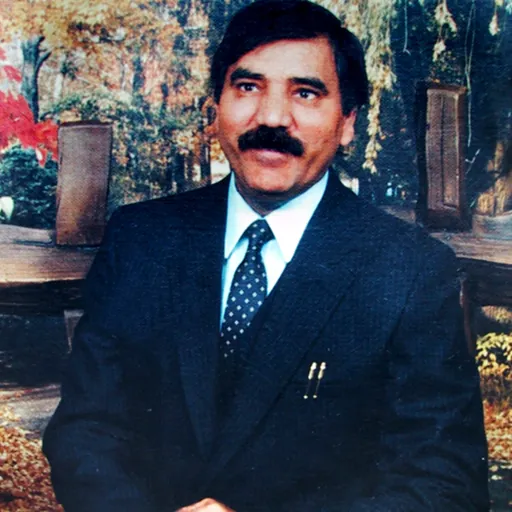
Mujaddid Ahmad Ijaz
Pakistani-American experimental physicist
About Mujaddid Ahmad Ijaz
Lived 1937 – 1992 (aged 54). Mujaddid Ahmad Ijaz was a Pakistani and Indian physicist and nuclear physicist, known for Atoms for Peace, Isotope and Nuclear power in Pakistan.
Mujaddid Ahmed Ijaz (Urdu: ; June 12, 1937 – July 9, 1992) was a Pakistani-American experimental physicist noted for his role in discovering new isotopes that expanded the neutron-deficient side of the atomic chart. Some of the isotopes he discovered enabled significant advances in medical research, particularly in the treatment of cancer, and further advanced the experimental understanding of nuclear structures. Ijaz conducted his research work at Oak Ridge National Laboratories (ORNL). He and his ORNL colleagues published more than 60 papers in physics journals announcing isotope discoveries and other results of their accelerator experiments from 1968 until 1983.
Ijaz participated in the U.S. Atoms for Peace initiative during the 1970s. As a tenured professor of physics at Virginia Tech, he acted as thesis adviser to graduate students from around the world in experimental physics disciplines. Ijaz made extensive trips abroad during his career, including sabbaticals as a visiting professor at Saudi Arabia's King Fahd University of Petroleum and Minerals. in the early 1980s and as a visiting faculty member at the Abdus Salam International Centre for Theoretical Physics in Trieste, Italy in 1985. He retired Professor Emeritus of Physics from Virginia Tech in December 1991 after a 27-year career in teaching and research. His early interest in science and physics was attributed to his step-father's work in the local meteorology department.
After graduating from high school and finishing college entrance exam requirements, Ijaz was admitted to Government College in Lahore.
Ijaz and his wife arrived in Tallahassee, Florida, in August 1960, where they settled as incoming graduate students at Florida State University. His thesis was titled Study of Angular Distributions of Elastically Scattered 8 to 19 Mev Alpha Particles from Al27 and from Ohio University in May 1964 with a Ph.D. in Nuclear Physics with a thesis titled Proton-Proton Collisions at 2.0 BeV.
Academic and scientific research career Virginia Polytechnic Institute Mujaddid Ijaz joined the faculty of the Virginia Tech Physics department in September 1964 as an assistant professor of physics. In his early years as a faculty member, Ijaz devoted much of his time to his teaching responsibilities, including acting as adviser to the university's roster of graduate students and doctoral candidates. He conducted his early research at the Physics department's newly installed nuclear reactor, which at the time was equipped with a neutron activation analysis laboratory. Ijaz's early experimental results earned him an appointment as research collaborator at the Oak Ridge National Laboratories in 1966 under a University Isotope Separator at Oak Ridge (UNISOR) grant funded by the U.S. Energy Department.
Ijaz attained the rank of Full Professor of Physics in 1977, and during the same year served as acting head of the physics department. After several foreign sabbaticals in the 1980s, the first at U.P.M. in Dhahran, Saudi Arabia from 1979 until 1981 and another at I.C.T.P. in 1985, he continued his teaching duties at Virginia Tech until retirement in December 1991 as Professor Emeritus of Physics. During the latter part of his career, Ijaz published papers that focused on methods and results in teaching, religion and science and other aspects of physics that did not form part of his technical research in earlier years. Also a physicist and teaching researcher at Virginia Tech, Lubna Razia Ijaz established a scholarship in 1996 that is awarded to students involved in physics education.
Oak Ridge National Laboratories
Mujaddid Ijaz began his research work at the Oak Ridge National Laboratories (ORNL) in 1966 under Virginia Tech funding contributed to the UNISOR program. The reactor was built in 1965 with the highest neutron flux of any reactor at the time. It produced more medical isotopes while allowing higher fidelity of materials research than any other reactor available in the U.S. Energy Department's science and energy laboratory system during the 1970s. Ijaz and his colleagues at Oak Ridge, led by Kenneth S. Toth, used the High Flux Reactor to discover new isotopes and map characteristics of existing isotopes, including isotopes of Erbium, Ytterbium, Thulium, Osmium, Hafnium, Tungsten, Mercury, Titanium, and Lead. In December 1982, physicists at the University of Arizona used the mercury isotopes discovered by Toth, Ijaz et al. to successfully model behavior expected of heavier particles than traditional accelerator experiments could produce at the time due to energy limitations.
During the 1970s, Ijaz participated Pakistan's first facility, a 5 MW PARR-I pool-type facility, was provided by the United States in 1965. The reactor began operations on December 21, 1965, under the supervision of Pakistani scientists led by Abdus Salam.
Notable collaborations Mujaddid Ijaz collaborated with notable physicists and mathematicians throughout his 27-year career. Most notable among these were his collaborations with Abdus Salam whose groundbreaking work in electroweak interactions together with American physicists Steven Weinberg and Sheldon Glashow earned them the Nobel Prize in Physics in 1979.
In 1976, Salam recommended creating an international forum for the advancement of science and technology to be hosted by Pakistan in the Hazara region while serving as Science Advisor to the Prime Minister of Pakistan. Since then, the Nathiagali Physics Conferences has gathered notable scientists from around the world during summer breaks to break the intellectual isolation faced by Pakistani scientists. Ijaz participated in these conferences several times during the mid-1970s under National Science Foundation grants. He was also a member of the National Academy of Sciences and a fellow of the American Physical Society. He married Razia Begum (nee Nazir) in June 1960 prior to emigrating to the United States. Razia later took her husband's chosen name, Lubna, when they both became naturalized American citizens on January 5, 1970. They had five children: Mansoor, Farouk, Atif and Mujeeb. Neelam, their only daughter, was born in Pakistan.
The Ijazes initially settled in Blacksburg, where Virginia Tech was situated, and lived there from 1964 until 1969. After several years of living in the rural community of Floyd, Virginia, they returned to Christiansburg, a township near Virginia Tech, in 1973, building a home in the Appalachian Mountains that today remains the family's homestead.
Mujaddid Ijaz died on July 9, 1992, at his home in Shawsville, Virginia, of complications arising from a protracted battle with brain and lung cancer. He was buried in traditional Muslim rituals at the site of his most favored farm in Alum Ridge, surrounded by a large gathering of his family from around the United States and his physics colleagues and friends from southwestern Virginia. President George H. W. Bush consoled Ijaz's widow in a letter dated July 24, 1992.
Selected publications
Don’t just read it —
keep it.
Full-length biographies made to live with: read them, listen on the way to work, watch them tonight.
- E-book
- Audio
- Video
Instant download · yours to keep · every purchase keeps this site free
Important facts
Family & relationships
People in Mujaddid Ahmad Ijaz's life
Named in this biography and alive at the same time


Related people
Same field, nearest in time



Contemporaries
People whose lives overlapped Mujaddid Ahmad Ijaz's


Frequently asked questions
Who was Mujaddid Ahmad Ijaz?
Pakistani-American experimental physicist (1937-1992)
When was Mujaddid Ahmad Ijaz born?
Mujaddid Ahmad Ijaz was born on 16 July 1937 in Lahore.
When did Mujaddid Ahmad Ijaz die?
Mujaddid Ahmad Ijaz died on 14 July 1992 in Shawsville.
What was Mujaddid Ahmad Ijaz's occupation?
Mujaddid Ahmad Ijaz was a physicist and nuclear physicist.
What was Mujaddid Ahmad Ijaz known for?
Mujaddid Ahmad Ijaz was known for Atoms for Peace, Isotope and Nuclear power in Pakistan.
What nationality was Mujaddid Ahmad Ijaz?
Mujaddid Ahmad Ijaz was Pakistani and Indian.
Sources & further reading
· Wikipedia: Mujaddid Ahmad Ijaz
· DBpedia: Mujaddid Ahmed Ijaz
Cite this page
APA: Biography.guide. (2026). Mujaddid Ahmad Ijaz. https://biography.guide/mujaddid-ahmad-ijaz/
MLA: "Mujaddid Ahmad Ijaz." Biography.guide, https://biography.guide/mujaddid-ahmad-ijaz/.
Chicago: "Mujaddid Ahmad Ijaz." Biography.guide. https://biography.guide/mujaddid-ahmad-ijaz/.
Data last updated: 2026-09-24 · Spot an error? Report a correction.
Portrait: Wikimedia Commons · author & licence
Page generated 2026-09-27 05:08 UTC