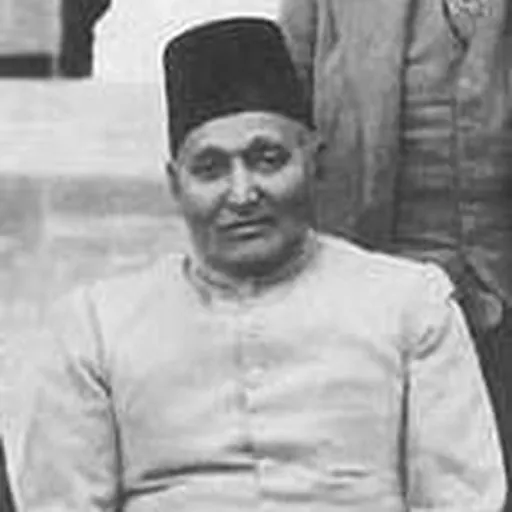
About Muhammed Saadulah
Lived 1885 – 1955 (aged 69). Muhammed Saadulah was an Indian politician.
Early life Syed Muhammad Saadulla was born on 21 May 1885 in Guwahati, to an Assamese Muslim family.
His father, Syed Muhammad Tayyabulla, came from Kacharihat, a village near the town of Golaghat, to Guwahati around 1878.
Lawyer Saadulla, M.A., B.L., became a Pleader in Guwahati and set up practice at Lakhtakia in 1910. In the same year, he married the eldest daughter of Syed Muhammad Saleh of Kacharihat. He soon made his mark as a lawyer. He became chairman, Guwahati Municipality, and was nominated as a member of the Legislative Council at Shillong. Assam became a Chief Commissioners Province in April 1919. Saadulla participated in the council's deliberations, and expressed himself freely and forcefully on the matters of interest of the people of Assam. The qualities of citizenship which inspired him to unselfish efforts for what he believed to be right and patriotic were evident early in his political career.
Preoccupation with legal profession and civic responsibilities and duties of a Legislative Councillor left Saadulla with little time for recreation. Nevertheless, he played association football and cricket for the Town Club regularly at Judge's Field. Most afternoons he played Lawn tennis at the erstwhile Jubilee Gardens, where the regulars were Tarun Ram Phukan, Gopinath Bordoloi and Hemanta Kumar Lahiri.
As his financial circumstances improved, Saadulla purchased a plot of land adjacent to his father's house, where he built a large residence for the joint family and an outbuilding to serve as his office. He became a prominent political figure in Assam. Contemporary accounts described him as energetic, self-confident, analytical, and possessing a strong memory.
In a decade, all ambition has been fulfilled, and Saadulla was recognized as the most conspicuous pleader in Assam. He had the gratification of being able to refuse two offers of important employment under the Government. He became restless and found himself disposed to a change. He consulted his younger brother, Syed Muhibulla, a Professor of Arabic and Persian at Cotton College, Guwahati and asked for the blessings of his 80-year-old father, and prepared to leave for Calcutta.
In 1922, in his mid-thirties, Saadulla enrolled himself as an Advocate at the Calcutta High Court. He rented a house in Turner Street in the neighborhood of A.K. Fazlul Huq, Nawab Ataur Rahman, Barrister Khuda Bux and Nawabzada A.F.M. Abdul Ali. Before long, briefs from Assam for appeal before the High Court began to arrive and once more Saadulla was engrossed in preparing plaints. Success came slowly, but no sooner he was settled in the new establishment his wife and three sons joined him and he spent as much time in their company as possible.
Assam became a Governor's province, under the GOI Act 1833 with an enlarged Legislative Council; and accordingly Elections were held in November 1880. Saadulla decided to concentrate on practice at the Calcutta High Court, and therefore did not enter Assam politics. He came to Guwahati with his family to be at the bed-side of his dying father, Syed Tayyabulla, who died on 22 November 1922. A year later he returned to Assam once more to stand for elections to the Reformed Legislative Council, and was returned with a comfortable majority.
Politics Towards the end of February, 1924 Saadulla received a letter from Sir Kerr, Governor of Assam offering him a seat in his Council. As the newly elected Legislative Council was due to meet at Shillong on 24 March, there was very little time to decide between Calcutta High Court Bar and Ministership in Assam. Saadulla wrote to the Governor accepting his offer and assuring him of reaching Shillong well in advance of the date of commencement of the Council session. He was sworn in as Minister, and rented a house known as "Rookwood" for his family. In 1924 his wife died at child-birth in the early hours of 9 December. He never really recovered from the cruel shock and profound grief. He never remarried and immersed himself in work and bringing up an infant daughter and looking after three sons.
Elections to the third Reformed council were held in November, 1926, and Saadulla was returned from his constituency by large majority. He was re-appointed as a Minister. The honour of Knighthood was conferred on him in 1928.
He was seriously ill in 1951. He recovered gradually and was restored to health. Thereafter he accepted life in retirement, with social activities, including dispensing hospitality on a magnificent scale.
His health deteriorated, at the approach of winter at Shillong, and to escape the rigours of cold weather, he went down to plains. He died at Guwahati, his birthplace, on 8 January 1955.
Don’t just read it —
keep it.
Full-length biographies made to live with: read them, listen on the way to work, watch them tonight.
- E-book
- Audio
- Video
Instant download · yours to keep · every purchase keeps this site free
Important facts
People in Muhammed Saadulah's life
Named in this biography and alive at the same time

Related people
Same field, nearest in time




Contemporaries
People whose lives overlapped Muhammed Saadulah's



Frequently asked questions
Who was Muhammed Saadulah?
Prime Minister of Assam from 1937 to 1946
When was Muhammed Saadulah born?
Muhammed Saadulah was born on 21 May 1885 in Guwahati.
When did Muhammed Saadulah die?
Muhammed Saadulah died on 8 January 1955.
What was Muhammed Saadulah's occupation?
Muhammed Saadulah was a politician.
What nationality was Muhammed Saadulah?
Muhammed Saadulah was Indian.
Sources & further reading
· Wikipedia: Muhammed Saadulah
Cite this page
APA: Biography.guide. (2026). Muhammed Saadulah. https://biography.guide/muhammed-saadulah/
MLA: "Muhammed Saadulah." Biography.guide, https://biography.guide/muhammed-saadulah/.
Chicago: "Muhammed Saadulah." Biography.guide. https://biography.guide/muhammed-saadulah/.
Data last updated: 2026-09-23 · Spot an error? Report a correction.
Portrait: Wikimedia Commons · author & licence
Page generated 2026-09-27 05:05 UTC