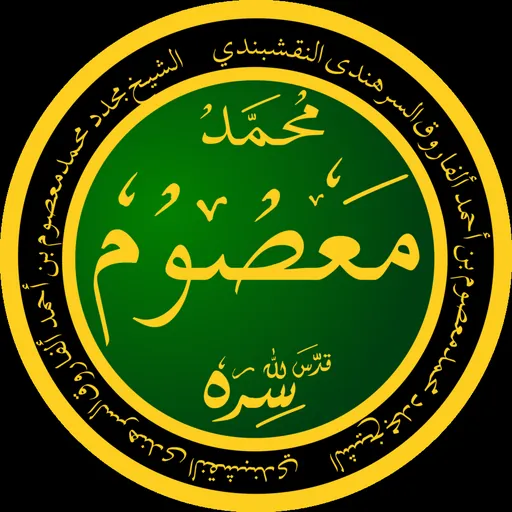
Muhammad Ma'sum
About Muhammad Ma'sum
Lived 1599 – 1668 (aged 69).
Khawāja Muḥammad Maʿṣūm (Urdu/Persian: خواجہ محمد معصوم ;1599–1668), also known as Maʿṣūm-i Thānī (“the Second Maʿṣūm”), was an Indian Naqshbandī-Mujaddidī Sufi master, Islamic scholar and the son and principal successor of Shaykh Ahmad Sirhindi (d. 1624), the founder of the Mujaddidi branch of the Naqshbandi order. He is widely revered in South Asian Islamic history as the Urwat-ul-Wuthqa (The Unbreakable Bond/Rope of Allah) and the Qayyum-i-Thani (The Second Qayyum).
Early life Masum was the third son of Ahmad Sirhindi. He was born on Monday, 6th May 1599 CE (11th Shawwāl 1007 Hijrī) in Sirhind, Lahore Subah, Mughal Empire (modern-day Punjab, India). It is said that his birth coincided with his father's spiritual ascension, leading Shaykh Ahmad to view his son's birth as a source of immense blessings. He received a comprehensive education in Islamic sciences (Qurʾān, ḥadīth, fiqh) alongside intensive Sufi training under his father.
Spiritual journey Khawaja Muhammad Ma’sum played a critical role in consolidating and expanding the Naqshbandi-Mujaddidi order across the Islamic world, particularly in the Mughal Empire and Central Asia. Under his leadership, the Mujaddidi order grew rapidly. Historical records suggest he appointed thousands of deputies (khalifas) who traveled to various regions to teach Islamic spirituality and jurisprudence. Like his father, he emphasized the integration of Tasawwuf (Sufism) with strict adherence to the Sharia (Islamic Law) and the Sunnah of the Prophet Muhammad. He argued that true spiritual realization could not be separated from religious observance. He is known to have had a significant influence on the Mughal court. He was a spiritual guide to the Mughal Emperor Aurangzeb, encouraging the emperor to implement orthodox Islamic policies.
Literary works His most famous written legacy is the collection of his letters, known as Maktubat-i Ma’sumiyya: A three-volume collection of letters addressed to disciples, scholars and rulers. These letters discuss complex topics of theology, Sufi metaphysics (such as Wahdat ash-Shuhud), and spiritual mentorship.
Personal life Masum had six sons and six daughters. The sons were:
Shaykh Muḥammad Ṣibghat-Allāh Sirhindī Shaykh Muḥammad Ḥujjat-Allāh Sirhindī Shaykh Muḥammad ʿUbayd-Allāh Sirhindī Shaykh Muḥammad ʾAshraf Sirhindī Shaykh Muḥammad Saif ad-Dīn Sirhindī Shaykh Muḥammad Ṣiddīq Sirhindī
Death and burial He died on 16th August 1668 CE (9th Rabīʿul ʾAwwal 1079 Hijrī). He was buried alongside his father.
Succession and legacy He was succeeded by his son, Khawaja Muhammad Saif ad-Dīn, who continued his father's work. His shrine serves as a major site of reverence in Sirhind, located near his father's mausoleum. His descendants became known collectively as the Maʿṣūmī family, many of whom remained important religious figures.
Don’t just read it —
keep it.
Full-length biographies made to live with: read them, listen on the way to work, watch them tonight.
- E-book
- Audio
- Video
Instant download · yours to keep · every purchase keeps this site free
Important facts
People in Muhammad Ma'sum's life
Named in this biography and alive at the same time

Contemporaries
People whose lives overlapped Muhammad Ma'sum's






Frequently asked questions
Who was Muhammad Ma'sum?
(1599-1668)
When was Muhammad Ma'sum born?
Muhammad Ma'sum was born on 1 May 1599 in Sirhind-Fategarh.
When did Muhammad Ma'sum die?
Muhammad Ma'sum died on 17 August 1668 in Sirhind-Fategarh.
Sources & further reading
· DBpedia: Khawaja Muhammad Masum
Cite this page
APA: Biography.guide. (2026). Muhammad Ma'sum. https://biography.guide/muhammad-ma-sum/
MLA: "Muhammad Ma'sum." Biography.guide, https://biography.guide/muhammad-ma-sum/.
Chicago: "Muhammad Ma'sum." Biography.guide. https://biography.guide/muhammad-ma-sum/.
Data last updated: 2026-09-24 · Spot an error? Report a correction.
Portrait: Wikimedia Commons · author & licence
Page generated 2026-09-27 05:08 UTC