
Mountain Chief
Indigenous leader
About Mountain Chief
Lived 1848 – 1942 (aged 93–94). Mountain Chief was a traditional leader or chief and warrior.
Mountain Chief ( or ; – February 2, 1942) was a South Piegan warrior of the Blackfoot Tribe. Mountain Chief was also called Big Brave (Omach-katsi) and adopted the name Frank Mountain Chief. signed the Treaty of Fort Laramie in 1868, and worked with anthropologist Frances Densmore to interpret folksong recordings.
Early life Mountain Chief (Blackfoot/South Piegan) was born around 1848 at Oldman River in Alberta, Canada (then British North America). Mountain Chief's father became chief around the time that Lewis and Clark visited in 1806. Mountain Chief had two full sisters, Litte Snake and Last Kill. He also had three other half-brothers, Sitting In The Middle, Red Bull, and Last Kill, and one half-sister, Lone Cut. Mountain Chief was married to five different women, including Bird Sailing This Way, Fine Stealing Woman, Hates To Stay Alone, and Gun Woman For Nothing. And he had seven known children with these five wives, including Stealing In The Daytime, Rose Mountain Chief, Antoine Mountain Chief, Walter Mountain Chief, Tackler (Teckla), Emma Mountain Chief, on January 23, 1870, and led to the death of approximately 200 Piegans from Chief Heavy Runner's Amskapi Pikuni (Blackfoot/South Piegan) band camped on the Marias River. The massacre resulted from an incident which inflamed already tense relations between the Blackfoot Confederacy and the white settlers in Montana. All five attackers in Owl Child's party belonged to Mountain Chief's band. At the time of Owl Child's attack, Mountain Chief was the head chief of the Amskapi Pikuni. General Philip Sheridan sent a band of cavalry led by Major Eugene Baker at Fort Ellis Mountain Chief gained prominence through warfare with the Crows and Kutenai and facilitated treaty negotiations in the 1880s and 1890s, visiting Washington, D.C., often. on Native American sign language. Gen. Scott recommended that Densmore meet with Mountain Chief, and the two initially met on February 8, 1916 to record songs.
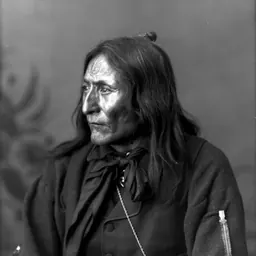
Mountain Chief was identified in this image because of the Plains Indian head covering he is wearing and by the "U" on his moccasins which identify him as Blackfeet. When the photograph appeared on the cover of the Folkways recording Healing Songs (1965), Mountain Chief was just referred to as an "Indian Singer."
Later life Mountain Chief was the last hereditary chieftain of the Blackfeet Nation. He died at his home in Browning, Montana, on February 2, 1942, at a reported age of 94, Mountain Chief's life was mentioned in oral histories included in James Willard Schultz's Blackfeet and Buffalo: Memories of Life among the Indians (1981).
Don’t just read it —
keep it.
Full-length biographies made to live with: read them, listen on the way to work, watch them tonight.
- E-book
- Audio
- Video
Instant download · yours to keep · every purchase keeps this site free
Important facts
People in Mountain Chief's life
Named in this biography and alive at the same time


Related people
Same field, nearest in time


Contemporaries
People whose lives overlapped Mountain Chief's



Frequently asked questions
Who was Mountain Chief?
indigenous leader
When was Mountain Chief born?
Mountain Chief was born in 1848 in Oldman River.
When did Mountain Chief die?
Mountain Chief died on 2 February 1942 in Browning.
What was Mountain Chief's occupation?
Mountain Chief was a traditional leader or chief and warrior.
Sources & further reading
Cite this page
APA: Biography.guide. (2026). Mountain Chief. https://biography.guide/mountain-chief/
MLA: "Mountain Chief." Biography.guide, https://biography.guide/mountain-chief/.
Chicago: "Mountain Chief." Biography.guide. https://biography.guide/mountain-chief/.
Data last updated: 2026-09-20 · Spot an error? Report a correction.
Page generated 2026-09-27 05:34 UTC