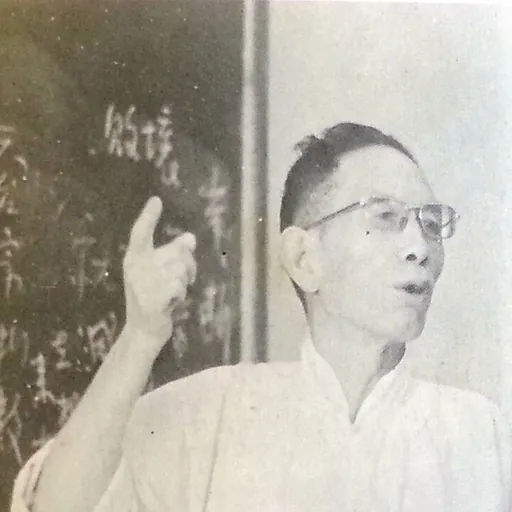
About Mou Tsung-san
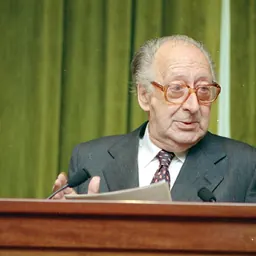
Lived 1909 – 1995 (aged 85). Mou Tsung-san was a Chinese and Taiwanese philosopher and translator.
Biography Mou Zongsan was born into the family of an innkeeper in Qixia, Shandong. He went to Peking University for college prep (1927) and undergraduate courses (1929). During that time he became a follower of Xiong Shili, author of the New Treatise on Consciousness-only and soon to be the most eminent philosopher in China until supplanted by Mou himself. After graduating in 1933, Mou moved around the country working as a secondary school teacher and a faculty member at different universities. In 1949 he followed the Nationalist government to Taiwan. His student at Tunghai University was Tu Weiming. In 1960 he moved to Hong Kong and eventually took up a post at New Asia College in Hong Kong (now part of the Chinese University of Hong Kong) and helped found New Asia Middle School. During the last two decades of his life Mou was something of an intellectual celebrity. He lectured frequently on Confucian, Buddhist, Daoist, and Kantian philosophy at Hong Kong University, National Taiwan Normal University, and National Taiwan University. He died in Taipei in 1995, leaving dozens of disciples in top academic jobs in Taiwan and Hong Kong.
Works Mou's complete works contains more than 30 volumes written over about 60 years. In religious studies and philosophy programs, attention is paid mostly to his production in his last 30 years. These can be divided into histories of Chinese philosophy and philosophic treatises.
Histories of philosophy Physical Nature and Speculative Reason 才性與玄理 (1963). This is Mou's main treatise on "Neo-Daoism" or xuanxue 玄學. It is an analysis of intellectual developments of the Wei-Jin dynasties (220-420 CE), said to set the agenda for much of later Chinese philosophy and anticipate the developments in Buddhist philosophy later understood by Mou as a pattern underlying the main line of Song-Ming Confucianism.
Substance of Mind and Substance of Human Nature 心體與性體 (1968–1969). This is probably the most studied of Mou's books, and by far the most famous in the West. It is a three volume history of Confucianism in the Song (960-1279) and Ming (1368-1644) dynasties, often called "Neo-Confucianism" in the West. It challenges usual two-part division of Neo-Confucian thought into a "school of principle" (lixue 理學), the Cheng-Zhu school represented by Cheng Yi, Cheng Hao, and Zhu Xi, and a "school of mind" ( 心學) or represented by Lu Xiangshan and Wang Yangming. Mou identifies a third lineage, whose main figures are Hu Hong (Hu Wufeng) and Liu Zongzhou (Liu Jishan), which best conveys the basic message of the classical sage Mencius. Mou's later book From Lu Xiangshan to Liu Jishan (1979) is treated as the fourth volume of this book.
Buddha-Nature and Prajna 佛性與般若 (1977). This is Mou's main examination of Buddhist philosophy, written in two volumes. It upends the usual Chinese recognition of the Huayan school as the most well-developed form of Buddhism and puts the Tiantai school in first place. Mou credits Tiantai with having the best concepts for understanding the authoritative Hong-Liu line of Confucianism.
Philosophical treatises Intellectual Intuition and Chinese Philosophy 智的直覺與中國哲學 (1971). In this treatise, Mou applies the Kantian idea of 'intellectual intuition' to Chinese philosophy, which he believes affirms the idea that human beings can have such awareness. He expresses strong interest in the utility of Buddhist philosophy for Confucian purposes. This book is often thought of as an early version of Phenomenon and Thing-in-Itself.
Phenomenon and Thing-in-Itself 現象與物自身 (1975). This develops Mou's famous doctrine of "two-level ontology," patterned off of Kantian and Buddhist metaphysics.
Treatise on Summum Bonum (1985). This is Mou's last major work. Mou did not intend it as his final book, but scholars generally treat it as the definitive summary of his thinking. It attempts to use Tiantai ontological concepts as inspiration to find Confucian solution to Kant's problem of the highest good or summum bonum. It includes a chapter with Mou's commentary on Mencius and a more complete evaluation of the place of Daoist and Buddhist philosophy for the modern Confucian.
Philosophical work
Mou and Kant
Following his teacher Xiong Shili, Mou Zongsan sought to articulate and justify a moral metaphysics. A moral metaphysics asserts the interconnectedness of ontology and morality, implying the moral value of all objects including the self. Mou's philosophy attempts to demonstrate the limits of Kant, suggesting instead the ways in which Chinese thought may surpass Kantian morality. Several of Mou's titles directly reveal his engagement with Kant – Intellectual Intuition and Chinese Philosophy, Phenomenon and Thing-in-Itself, and Treatise of the Perfect Good – a commitment that is reflected in Mou's decision to express his philosophy in Kantian terms. For example, Mou's philosophy inherits the Kantian concepts of autonomy, intellectual intuition, and Thing-in-Itself, although Confucianism inspires Mou to transform these concepts. The reason behind this decision to use Kantian terms remains unknown, but some scholars argue that Mou's use of certain terminologies aims to facilitate a dialogue between the East and West, pointing to Mou's comparison of Mencius and Kant, whereby he demonstrates the compatibility of Chinese and Western philosophies.
Mou's philosophy develops as a critique and transformation of Kant's critical philosophy. Mou believes in the compatibility of Chinese thought and Kantian philosophy because both are backed by the Way, where the Way is essentially truth and different philosophies manifest different aspects it. Mou's analysis of Kant centers on Kant's Critique of Pure Reason. In his treatise Intellectual Intuition and Chinese Philosophy (zhi de zhexue yu zhongguo zhexue) 智的直覺與中國哲學 (1971), Mou not only wrote his reflection on Heidegger’s philosophy (and translated two chapters from Being and Time), but also criticized Heidegger’s fundamental ontology with his moral metaphysics. In fact, Mou may have been influenced by Heidegger even in his early major work Substance of Mind and Substance of Human Nature (xinti yu xingti) 心體與性體 (1968–1969). Mou’s argument of the “Three modes” of Neo-Confucianism may be inspired by Heidegger's “Three ontological difference”, which was introduced to Mou from Max Müller’s works.
Mou Zongsan agrees to a certain extent with Heidegger’s interpretation of Kant. Mou introduces a two-layer structure of understanding of the transcendental determination of the Kantian categories: a “logical” layer of understanding and an “ontological” layer of understanding. Mou believes the Kantian thesis that “objectivity is subjectivity” is not an “ontical proposition” but rather an “ontological proposition”. He agrees with Heidegger's analysis of Transcendental Schematism, which indicates that the meaning of objectification presupposes a subjective horizon that enables the object to appear. Mou names the ontology of the phenomenal world as “attached ontology” (zhi de cunyoulun). Mou rejects Kant's declaration that human beings are incapable of producing any intuitive knowledge of thing-in-itself. He embraces Heidegger's affirmation of the “subjective” character of the Kantian transcendental distinction, which he learns from Kantbuch:
The distinction between the concept of thing in itself and that of appearance is not objective but merely subjective.The thing in itself is not another but another aspect (respectus) of the representation with regard to the same object.
Mou's critique In general, Mou holds a critical attitude towards Heidegger's fundamental ontology in his treatise Intellectual Intuition and Chinese Philosophy:
Heidegger’s descriptions could let us think of a disclosure of a “true mind” (zhen xin) for instance when he speaks about “call of consciousness”(Ruf, liangxin de huhuan), feeling of guilt ( jiuze zhi gan), dread (Sorge, jiaolü), determined being (Entschlossenheit, jueduan) or nothingness (Nichtigkeit, xuwu). Nevertheless, all these descriptions are still “floating” and he has not been able to pave the way for a “true mind.”
According to Mou, Heidegger's descriptions are “floating” because Heidegger's thought does not recognize any transcendental reality (chaoyue de shiti) but focus on the immanent metaphysics (neizai xingershangxue) to develop his fundamental ontology. “True metaphysics” is “transcendent.” In the eyes of Mou Zongsan, since the immanent metaphysics merely focuses on the problem of the meaning of phenomenal beings, it fails to deal with Kant's transcendental concepts of freedom, immortality, and God. Mou also thinks Heidegger's philosophy is too heroic and romantic and thereby fails to maintain an inherent calmness to approach to “true mind.” Besides, Mou disagrees with Heidegger's “value-free,” and in particular, “morally-neutral” approach. The lack of moral awareness indicates that Heidegger's fundamental ontology does not reach the realm of moral metaphysics, but merely offers an empty and inauthentic answer to the subject.
In short, Mou considers Heidegger only as a “commentator” or “usurper” of Kant. According to Mou, the reason why Heidegger's fundamental ontology fails to reach the realm of moral metaphysics is that Heidegger sticks to the Kantian thesis of the finitude of human being and fails to recognize the intellectual intuition (zhi de zhijue) of human beings. Mou claims that although the study of Kant's philosophy helps him understand the relation between phenomenal world and metaphysical ontology, it is his teacher Xiong Shili who makes him realize the fundamental union of the two via the intellectual intuition. The idea of intellectual intuition is widely manifested in Confucianism, Neo-Confucianism, Daoism and Buddhism, especially in the thought of Wang Yangming, who assimilates moral learning with the course of action such as archery and calligraphy. According to Mou, intellectual intuition is not the central concept of a highly complex speculative system, but a form of knowledge acquired through our deeds (including emotions and intentions). It turns out that Mou may agree with Heidegger more than he believes. Heidegger's discussions of Being actually achieve a similar metaphysical level with Mou's discussions of transcendental concepts, such as God, freedom, ren or Dao. Instead of being “floating”, Heidegger's fundamental ontology finds its root in the “transcendent metaphysics” in Being. Far away from “a way of being” in immanent metaphysics, Heidegger's Being actually serves as an ontological basis for beings in phenomenal world. Moreover, in Heidegger's theory, the unveiledness of the Being of beings (“beings” encompass the phenomenal world) is inseparable from the practical and ethical reason. This echoes with Mous’ belief in unifying phenomenal world with metaphysical ontology through the intellectual intuition. They also share a similar interpretation of the “knowledge”. Mou believes moral learning can pave a way to moral metaphysics, while Heidegger also believes that we can open ourselves to the Being in our daily lives.
Mou's “misplacement” of Heidegger's transcendental metaphysics may arise from his misconception of Heidegger's Time (Zeit, shijian). Mou's ontological ultimate is benti, or ultimate reality. Additionally, ascribing human beings intellectual intuition ultimately assigns humans moral responsibility. However, this allows individuals access to Kant's noumenon. According to Mou, intellectual intuition for human beings is the foundation of all of Chinese thought. In Phenomena and Noumena Mou Zongsan writes that, “if it is true that human beings cannot have intellectual intuition, then the whole of Chinese philosophy must collapse completely”. Despite Mou's attempt at Confucian Modernity, critics claim that New Confucianism cannot handle modernity's interconnectedness and its inevitable negative consequences. Others argue that because Mou is not political, he should not even be considered a Confucian because much of Confucian doctrine advocates for the active pursuit of change. However, the limitations of speech in China during the time period when Mou philosophized may address this criticism.
Students
Cai Renhou 蔡仁厚 Dai Lianzhang 戴璉璋 Wang Bangxiong 王邦雄 Zeng Zhaoxu 曾昭旭 Lu Xuekun 盧雪崑 Huizhen You 尤惠貞 Chen Guimiao 陳癸淼
Wei Zhengtong 韋政通 He Shujing 何淑靜 Zhu Jianmin 朱建民 Fan Liangguang 范良光 Wang Caigui 王財貴 Lee Shui-chuen 李瑞全 Zhou Yangshan 周楊山
Yang Zuhan 楊祖漢 Yan Guoming 顏國明 Lin Yuehui 林月惠 Li Minghui 李明輝 Zhuang Yaolang 莊耀郎 Liu Jinxian 劉錦賢
Xie Daning 謝大寧 Lin Anwu 林安梧 Fan Kewei 樊克偉 Tu Weiming 杜維明 Wu Rujun (Ng Yu-kwan) 吳汝鈞 Chen Rongzhuo (Wing-cheuk Chan) 陳榮灼
Don’t just read it —
keep it.
Full-length biographies made to live with: read them, listen on the way to work, watch them tonight.
- E-book
- Audio
- Video
Instant download · yours to keep · every purchase keeps this site free
Important facts
People in Mou Tsung-san's life
Named in this biography and alive at the same time


Related people
Same field, nearest in time



Contemporaries
People whose lives overlapped Mou Tsung-san's



Frequently asked questions
Who was Mou Tsung-san?
Chinese philosopher (1909-1995)
When was Mou Tsung-san born?
Mou Tsung-san was born on 12 June 1909 in Qixia County.
When did Mou Tsung-san die?
Mou Tsung-san died on 12 April 1995 in Taipei.
What was Mou Tsung-san's occupation?
Mou Tsung-san was a philosopher and translator.
What nationality was Mou Tsung-san?
Mou Tsung-san was Chinese and Taiwanese.
Sources & further reading
Cite this page
APA: Biography.guide. (2026). Mou Tsung-san. https://biography.guide/mou-tsung-san/
MLA: "Mou Tsung-san." Biography.guide, https://biography.guide/mou-tsung-san/.
Chicago: "Mou Tsung-san." Biography.guide. https://biography.guide/mou-tsung-san/.
Data last updated: 2026-09-23 · Spot an error? Report a correction.
Portrait: Wikimedia Commons · author & licence
Page generated 2026-09-27 05:05 UTC