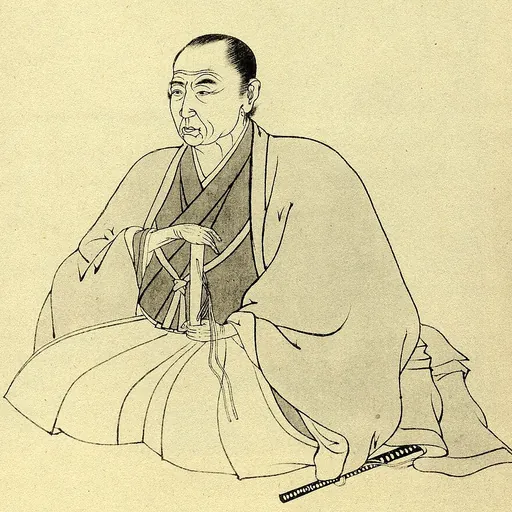
About Motoori Ōhira
Lived 1756 – 1833 (aged 77). Motoori Ōhira was a Japanese linguist.
was a scholar and a successor to Motoori Norinaga. He wrote under the pen name .
Life Ōhira was born in Matsusaka, Ise Province (now Matsusaka, Mie Prefecture) as the eldest son of , a and pupil of Motoori Norinaga. Ōhira became a pupil of Norinaga's in when he was 13. From early morning to afternoon, he dedicated himself to the family business, and from afternoon to night, he dedicated himself to his studies.
He was adopted by Norinaga in 1799 when he was 43 and became the head of the family estate when Norinaga's biological son, Motoori Haruniwa, lost his sight. He served the Kishū Tokugawa family in various positions, such as lecturer, where he laid the foundations for and classical studies establishments.
He had an adopted son, Motoori Uchitō.
Career After Norinaga's death, Ōhira took over administration of the . The Suzuya School was a private school with over 500 pupils throughout the country by the time of Norinaga's death and expanded even further once led by Ōhira.
Ōhira continued to work on Norinaga's teachings and defined as the study of classical texts beginning with the Kojiki and Nihon Shoki and in order to achieve “” and correctly interpret the meaning of these texts, one must rid oneself of any . Examples of such Chinese thought he provided were disparaging the emperor by revering Buddhas over , or disparaging funerals so that one does not have to feel the sorrow of death. He also criticized the assignment of kokushi from the central government and the decision to ban imperial proclamations, as he claimed these were a result of the harmful impacts of Confucianism. This was a continuation of Norinaga's stance rejecting Chinese thought.
Ōhira continued to work on the teachings of Norinaga in the field of as well. Norinaga argued Japanese poetry could be divided into two types, and , a stance which Ōhira adopted, leading to debates with fellow scholar and poet Harumi Murata.
Works
Don’t just read it —
keep it.
Full-length biographies made to live with: read them, listen on the way to work, watch them tonight.
- E-book
- Audio
- Video
Instant download · yours to keep · every purchase keeps this site free
Important facts
People in Motoori Ōhira's life
Named in this biography and alive at the same time

Related people
Same field, nearest in time




Contemporaries
People whose lives overlapped Motoori Ōhira's





Frequently asked questions
Who was Motoori Ōhira?
Japanese scholar (1756-1833)
When was Motoori Ōhira born?
Motoori Ōhira was born on 17 March 1756 in Matsusaka.
When did Motoori Ōhira die?
Motoori Ōhira died on 23 October 1833.
What was Motoori Ōhira's occupation?
Motoori Ōhira was a linguist.
What nationality was Motoori Ōhira?
Motoori Ōhira was Japanese.
Sources & further reading
Cite this page
APA: Biography.guide. (2026). Motoori Ōhira. https://biography.guide/motoori-ohira/
MLA: "Motoori Ōhira." Biography.guide, https://biography.guide/motoori-ohira/.
Chicago: "Motoori Ōhira." Biography.guide. https://biography.guide/motoori-ohira/.
Data last updated: 2026-09-22 · Spot an error? Report a correction.
Portrait: Wikimedia Commons · author & licence
Page generated 2026-09-27 05:02 UTC