
About Morris Jacob Raphall
Lived 1798 – 1868 (aged 69–70). Morris Jacob Raphall was an American rabbi.
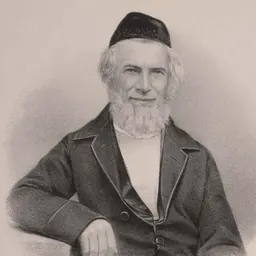
Morris Jacob Raphall (October 3, 1798 – June 23, 1868) was a rabbi and author born in Stockholm, Sweden. From 1849 until his death he resided in the United States. He is most remembered for having declared, on the eve of the Civil War, that the Bible and God endorse slavery.
Biography At the age of nine Raphall was taken by his father, who was banker to the King of Sweden, to Copenhagen, where he was educated at the Hebrew grammar school. "He was educated for the Jewish ministry in the college of his faith in Copenhagen, in England, where he went in 1812, and afterward in the University of Giessen, where he studied in 1821-24." Raphall married Rachel Goldston on August 3, 1825 and they had five children (Alfred, James, Esther, Charles, and Isabella). Rachel was one of seven children of Manasseh Goldston (also known as Goldstein and Goulston). In February 1827 Raphall was named as a defendant in an insurance fraud case involving a fire at a fur shop owned by his brother in law Noah Goldston. Raphall was found guilty and sentenced to 18 months prison. He devoted himself to the study of languages, for the better acquisition of which he subsequently traveled in France, Germany, and Belgium. He received the Ph.D. degree from the University of Erlangen (Germany). After lecturing on Hebrew poetry in 1834 he began to publish the Hebrew Review, and Magazine of Rabbinical Literature, the first Jewish periodical in England;
For some time he acted as honorary secretary to Solomon Herschell, chief rabbi of Great Britain. He made translations from Maimonides, Albo, and Herz Wessely; conjointly with the Rev. D. A. de Sola he published a translation of eighteen treatises of the Mishnah; he also began a translation of the Pentateuch, of which only the first volume appeared. In 1840, when the blood accusation was made at Damascus, he traveled to Syria to aid in the investigation, and was appointed rabbi and preacher of Manhattan's B'nai Jeshurun congregation, at the time called the Greene Street Synagogue. He continued there until 1866, his duties then being relaxed owing to his poor health. Generally, rabbis from the Southern states supported slavery, and those from the North opposed slavery, but there were many exceptions. The most notable debate was between Raphall, who endorsed slavery, and David Einhorn and Michael Heilprin, two more liberal rabbis who opposed it. 150 years after emancipation, Ken Yellis and Richard Kreitner wrote in The Forward that the record shows that New York's Jews were overwhelmingly pro-slavery and on the wrong side of history regarding slavery and the Civil War.
As "the dissolution of the Union [became] more and more imminent [President] Buchanan issued a proclamation...appointing January 4th, 1861, as a national fast day, on which prayers for the preservation of the Union were to be offered throughout the country." Speeches or sermons were given in many places that day. Raphall took the opportunity to deliver his views on slavery at his B'nai Jeshurun Synagogue. Raphall took as his point of departure Jonah 2:3–4, in which the city of Nineveh is saved from destruction (by God) since the residents heeded the warning of Jonah. Raphall's position was that if both sides would heed the Bible, the upcoming calamity could be avoided.
"e took the square stand that Judaism sanctioned slavery and that the institution was morally right."
His discourse was published the next day on the first page of the New York Herald and the New York Evening Express; it was reported on at length in the New York Times. At "the invitation of a number of leading gentleman of this city", he repeated his talk a week later as a public lecture (tickets required), and by February 1 it was advertised for sale as a 20-page pamphlet, The Bible View of Slavery.
Einhorn and Heilprin, concerned that Raphall's position would be seen as the official policy of American Judaism, vigorously disputed his arguments, and argued that slavery – as practiced in the South – was immoral and not endorsed by Judaism.
Don’t just read it —
keep it.
Full-length biographies made to live with: read them, listen on the way to work, watch them tonight.
- E-book
- Audio
- Video
Instant download · yours to keep · every purchase keeps this site free
Important facts
People in Morris Jacob Raphall's life
Named in this biography and alive at the same time


Related people
Same field, nearest in time


Contemporaries
People whose lives overlapped Morris Jacob Raphall's





Frequently asked questions
Who was Morris Jacob Raphall?
British-born American rabbi
When was Morris Jacob Raphall born?
Morris Jacob Raphall was born in 1798 in Stockholm.
When did Morris Jacob Raphall die?
Morris Jacob Raphall died in 1868 in New York City.
What was Morris Jacob Raphall's occupation?
Morris Jacob Raphall was a rabbi.
What nationality was Morris Jacob Raphall?
Morris Jacob Raphall was American.
Sources & further reading
· Wikipedia: Morris Jacob Raphall
· DBpedia: Morris Jacob Raphall
Cite this page
APA: Biography.guide. (2026). Morris Jacob Raphall. https://biography.guide/morris-jacob-raphall/
MLA: "Morris Jacob Raphall." Biography.guide, https://biography.guide/morris-jacob-raphall/.
Chicago: "Morris Jacob Raphall." Biography.guide. https://biography.guide/morris-jacob-raphall/.
Data last updated: 2026-09-26 · Spot an error? Report a correction.
Page generated 2026-09-27 05:14 UTC