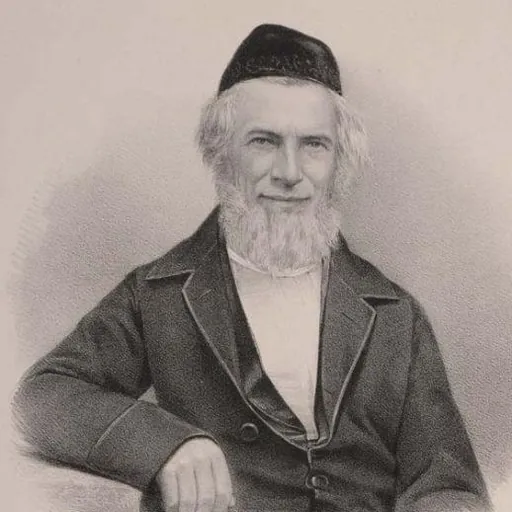
About Jacob Ettlinger
Lived 1798 – 1871 (aged 73). Jacob Ettlinger was a German rabbi and talmudist.
Jacob Ettlinger (17 March 1798 – 7 December 1871) was an Ashkenazi rabbi and author, and one of the leaders of Orthodox Judaism. He is sometimes referred to as the Aruch la-Ner (ערוך לנר), after his best-known publication.
Biography Ettlinger was born in Karlsruhe, Baden, and died in Altona, Prussia. He received his early education from his father Aaron, who was Klausrabbiner (rabbi of a small synagogue) in Karlsruhe. Aaron was also a recognized Talmudical scholar who was steeped in Kabbalah.
Ettlinger rounded off his Talmudical education in the yeshiva of Abraham Bing in Würzburg, one of the most significant Torah centers in Germany. While there, he attended the University of Würzburg, mainly studying philosophy. He was thus among the earliest German rabbis who possessed academic training. It should be pointed out, however, that he never received any formal degree. any sacrifice offered during the period of exile will be automatically invalidated, since the Torah clearly states that God declared he would no longer "inhale" the "scent" of the offerings in the epoch of exile, thus rendering any intent of generating reiach void and farcical.
In the famed Machine Matzo Controversy, Ettlinger ruled that machine-made Matzo could be used on Passover. He writes, "If they are disgusted with it because it is a new thing; we, the rabbis of Germany who are upright in their hearts... also distance [ourselves from] innovations regarding Torah and mitzvos as far as a bowshot away. However, what the experts and natural scholars innovate in regards to nature, why should we not accept the good from them, to strengthen the holes in our knowledge, to keep the mitzvos... as any understanding man could judge for himself."Nevertheless, he instituted that the matzos' edges be cut off, so that they would appear round, like traditional matzos.
In 1859, Ettlinger was consulted about an incident where a man, claiming to be the prophet Elijah and acting on the word of God, defiled a married woman. Ettlinger was asked to determine whether the woman had acquired the status of an unfaithful wife, rendering her forbidden to her husband. Ettlinger began his response by stating: "I have reviewed all of the aspects, and it is very difficult to find a cure and a remedy for this plague of stupidity that would permit this woman to her husband." However, his final conclusion was that since the woman had believed she was acting under the express orders of God, she was to be looked at as if she had been physically compelled and had no choice in the matter.
Aruch la-Ner Ettlinger's work Aruch la-Ner, consisting of novellae on many Talmudical tractates, is one of the standard texts in Yeshivas around the world. This is most probably due to "the rigid intellectual discipline, and detailed analysis of Talmudic sources" that are the hallmark of this work. It is quoted extensively by scholars such as Elchonon Wasserman, Adin Steinsaltz, Boruch Ber Leibowitz, and Reuven Grozovsky.
Works His published works are: Bikkurei Yaakov (ביכורי יעקב), on the laws of Sukkot, Altona, 1836 (2d ed. with the addition of Tosefot Bikkurim, including glosses of Akiba Eiger and Seligman Baer Bamberger, Altona, 1858) Aruch la-Ner (ערוך לנר), glosses on various Talmudic treatises (on Yevamot, Altona, 1850; on Makkot and Keritot, Altona, 1855; on Sukkah, Altona, 1858; on Niddah, Altona, 1864; on Rosh ha-Shanah and Sanhedrin, Warsaw, 1873) Binyan Tziyon (בנין ציון), responsa, Altona, 1868; She'elot u-Teshuvot Binyan Tziyon ha-Chadashot, Wilna, 1874 (a continuation of the preceding) An edition with a new additional part from manuscripts and other sources with introductions, references, notes, indexes and biographies was published by Rabbi Yehuda Aharon Horovitz, Jerusalem, 1989 and 2002 Minchat Ani (מנחת עני), homilies, Altona, 1874 Mincha Arucha (מנחה ערוכה) sermons, articles and brochures translated into Hebrew by Aviezri Wolf. Edited and published by Rabbi Yehuda Aharon Horovitz, Jerusalem 2008.
He published various sermons in German, among them Antrittsrede, Gehalten in der Grossen Synagoge zu Altona, Altona, 1836; Rede beim Trauergottesdienst beim Ableben Friedrich III, Altona, 1840; and numerous articles in the Treue Zionswächter, a collection of which was published by L. M. Bamberger, Abhandlungen und Reden, Schildberg, 1899
Don’t just read it —
keep it.
Full-length biographies made to live with: read them, listen on the way to work, watch them tonight.
- E-book
- Audio
- Video
Instant download · yours to keep · every purchase keeps this site free
Important facts
People in Jacob Ettlinger's life
Named in this biography and alive at the same time


Related people
Same field, nearest in time




Contemporaries
People whose lives overlapped Jacob Ettlinger's





Frequently asked questions
Who was Jacob Ettlinger?
German rabbi (1798–1871)
When was Jacob Ettlinger born?
Jacob Ettlinger was born on 17 March 1798 in Karlsruhe.
When did Jacob Ettlinger die?
Jacob Ettlinger died on 7 December 1871 in Altona.
What was Jacob Ettlinger's occupation?
Jacob Ettlinger was a rabbi and talmudist.
What nationality was Jacob Ettlinger?
Jacob Ettlinger was German.
Sources & further reading
Cite this page
APA: Biography.guide. (2026). Jacob Ettlinger. https://biography.guide/jacob-ettlinger/
MLA: "Jacob Ettlinger." Biography.guide, https://biography.guide/jacob-ettlinger/.
Chicago: "Jacob Ettlinger." Biography.guide. https://biography.guide/jacob-ettlinger/.
Data last updated: 2026-09-23 · Spot an error? Report a correction.
Portrait: Wikimedia Commons · author & licence
Page generated 2026-09-27 05:06 UTC