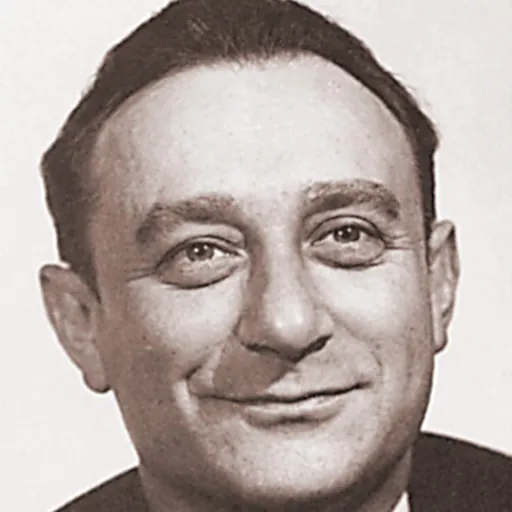
About Morris Childs
Lived 1902 – 1991 (aged 88). Morris Childs was an American politician.
Morris H. Childs (born Moishe Chilovsky; June 10, 1902 – June 5, 1991) was an American political activist and American Communist Party functionary who became a Soviet espionage agent and then a double agent for the Federal Bureau of Investigation (1952) until leaving both services by 1982. Beginning in 1958, Childs acted as a secret courier on behalf of the American party, briefing Soviet officials on political affairs in the American party and carrying funds to support the American Communist movement from Moscow to New York City, reporting details all the while to his FBI handlers. Over the course of two decades of activity in this role, Childs played a major part in the transfer of more than $28 million in Soviet subsidies to the American movement. For his activity as a courier on behalf of the Soviet government, Childs was awarded the Order of the Red Banner in 1975. His work as a spy for the American intelligence community was recognized in 1987 when Childs (together with his brother Jack) was awarded the Presidential Medal of Freedom by President Ronald Reagan.
Early years Morris H. Childs was born Moishe Chilovsky on June 10, 1902, in Kiev, Russian Empire, to an ethnic Jewish family. The family spoke Russian in the home, not Ukrainian or Yiddish. Morris's father, Josef Chilovsky, engaged in revolutionary activities against the Tsarist regime, for which he was imprisoned and subsequently exiled to Siberia. Josef was able to flee Russia via the Black Sea and he emigrated to the United States, landing in Galveston, Texas, in March 1910.
The family name was Americanized from Chilovsky to "Childs" in Chicago. Morris, as Moishe was now known, attended a demanding Jewish school in the city and worked in his father's shoemaking shop and as a messenger in the Chicago financial district. Towards the end of the decade Childs joined a trade union in order to get a job driving a milk delivery wagon, where he first made the acquaintance of members of the then-underground American Communist movement.
During the bitter factional war within the American communist movement throughout the decade of the 1920s, Childs was a consistent supporter of the Chicago-based faction led by William Z. Foster, head of the party's trade union operations. From the mid-1920s, Childs was a protégé and friend of the man who help bring the famous union organizer Foster into the Communist Party's orbit, Earl Browder.
In 1929, Childs was selected by the Communist Party USA (CPUSA) to attend the elite International Lenin School in Moscow, a training school for professional revolutionaries. Early in 1930, Childs was approached by an agent of the Soviet secret police, the OGPU, who had noted in Childs' file that he had helped to successfully identify a police spy in the Communist organization of Chicago. The man asked Childs to become an informer for the agency to help keep tabs on the ideological foibles of his Lenin School comrades. During his second year at the Lenin School, Childs made the personal acquaintance of a number of high-level Soviet officials who taught courses at the school, including exiled Finnish revolutionary leader Otto Kuusinen and a young ideology expert named Mikhail Suslov.
Childs remained at the Lenin School until 1932.
Childs was a candidate for public office for the Communist Party, running for US Congress in an Illinois at-large district in 1936. Childs was also a member of the CPUSA's governing Central Committee. Childs, a supporter of a majority faction headed by Eugene Dennis, was a target of a hardline minority group (which included William Z. Foster, Robert Thompson, and Benjamin Davis) which used Childs's absence from the Daily Worker to engineer his ouster as editor. The Dennis group assented to this maneuver in an attempt to calm troubled waters with the minority. In 1932 Browder tapped Jack Childs to attend the Lenin school to be trained as a communications expert, since the Comintern now sought those holding American passports because of their versatility.
Upon his return to the United States, Jack was put to work at the side of Earl Browder at party headquarters in New York City, acting as chauffeur, personal assistant, and bodyguard. This proximity to Browder was a blessing when the "man from Kansas" was General Secretary of the CPUSA but became a curse in 1945 when Browder was removed from his leadership position and expelled from the party, ostensibly for his "revisionism". As a so-called "Browderite", Childs also lost his party job, instead making use of his former radio training to open a small electrical and painting supply store in New York City.
Jack Childs dropped out of the Communist Party in 1947 and spent his time and money taking care of his physically ailing brother as best he was able. His sudden lack of party activity generated a routine September exploratory visit by two special agents of the FBI in an effort to gauge his level of disaffection and to see whether he might be a willing source of information about the top levels of the Communist Party. As Morris had been abandoned, fired from his job and left penniless, as well as stricken by a heart attack and seemingly near death, he had begun to question the Communist Party. When his FBI interlocutors intimated to Jack Childs their desire to infiltrate the top level of the Communist Party with an informant, Jack had a potential solution, declaring "Morris is your ticket to the top". Acting on its own authority, the Chicago office undertook to pay for Morris's treatment at the Mayo Clinic, managing to restore him physically.
Over the next several years — a period during which the Communist Party was forced into retreat by the combined forces of government action and the public antipathy that was part of the Second Red Scare — the Childs brothers worked themselves back into the good graces of top party leaders.
The oblique communications between the Communist Parties of the Soviet Union and the United States forced upon the Americans by the Smith Act proved inefficient and ineffectual and in 1956 the FBI learned that a move was planned to reestablish direct ties between Moscow and New York. bringing information on affairs in the turbulent American party and making arrangements for the delivery of cash for its support from the International Department of the Communist Party of the Soviet Union.
Childs and CPUSA leader James E. Jackson at the 21st Congress of the Communist Party of the Soviet Union, January 1959.
Childs was one of two delegates to the 21st Congress of the CPSU, held in Moscow from January 27 to February 5, 1959. Joining Childs in the Soviet Union as an official representative of the American Communist Party was James E. Jackson Jr., husband of Esther Cooper Jackson.
The CPSU held Childs in great esteem. In 1975, in honor of his 75th birthday, Soviet leader Leonid Brezhnev hosted a banquet in Childs' honor at the Kremlin, where he quietly presented him with a medal, the Order of the Red Banner, for the services which he performed conducting funds on behalf of the CPSU's international department.
Childs undertook his last mission to Moscow in 1977. Each and every transaction was painstakingly reported by Childs to his FBI handlers, along with information about affairs in the Soviet and American communist parties, as well as inside information about the international communist movement. Never before or since in the FBI's history has it kept agents on a single case for such a protracted period.
Death and legacy Morris Childs died June 5, 1991, aged 88, in Chicago.
Morris Childs' papers are held by the Hoover Institution Archives at Stanford University in Palo Alto, California.
Works
Illinois Needs a Farmer-Labor Party. Chicago: Workers Literature Distributors, 1936. Illinois Program and Publicity Committee, 20th Anniversary USSR, 1917-1937: Souvenir Book. (Contributor.) Chicago: Communist Party of the United States of America, 1937. Unite the People of Illinois for Jobs, Security, Peace and Democracy. Chicago: Illinois State Committee of the Communist Party, 1938.
Footnotes
Operation SOLO files FBI SOLO FBI files Washington, DC: Federal Bureau of Investigation —Very large file. F.J. Baumgardner, "Baumgardner Memorandum of 19 June 1958." Washington, DC: Federal Bureau of Investigation, August 2011. —Memo summarizing genesis of Operation SOLO.
Don’t just read it —
keep it.
Full-length biographies made to live with: read them, listen on the way to work, watch them tonight.
- E-book
- Audio
- Video
Instant download · yours to keep · every purchase keeps this site free
Important facts
People in Morris Childs's life
Named in this biography and alive at the same time



Related people
Same field, nearest in time






Contemporaries
People whose lives overlapped Morris Childs's

Frequently asked questions
Who was Morris Childs?
American activist (1902-1991)
When was Morris Childs born?
Morris Childs was born on 10 June 1902 in Kyiv.
When did Morris Childs die?
Morris Childs died on 2 June 1991 in Chicago.
What was Morris Childs's occupation?
Morris Childs was a politician.
What nationality was Morris Childs?
Morris Childs was American.
Sources & further reading
Cite this page
APA: Biography.guide. (2026). Morris Childs. https://biography.guide/morris-childs/
MLA: "Morris Childs." Biography.guide, https://biography.guide/morris-childs/.
Chicago: "Morris Childs." Biography.guide. https://biography.guide/morris-childs/.
Data last updated: 2026-09-24 · Spot an error? Report a correction.
Portrait: Wikimedia Commons · author & licence
Page generated 2026-09-27 05:08 UTC