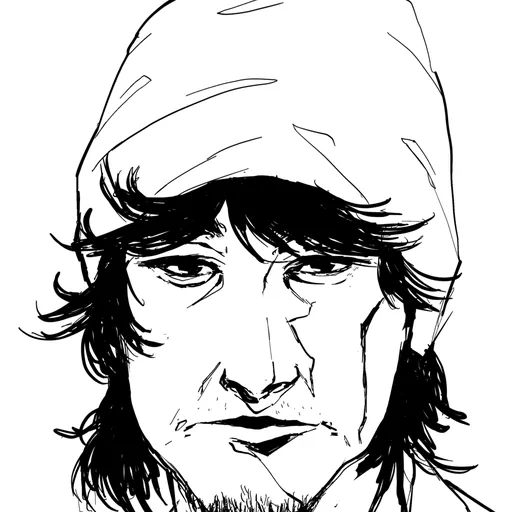
Mitsuo Iso
Japanese animator, screenwriter, director, animation director
About Mitsuo Iso
Born 1966. Mitsuo Iso is a Japanese animator, screenwriter, film director, impresario, animation director and director, known for Dennō Coil.
is a Japanese animator and director. He worked as a freelance artist through Neomedia, Studio Zaendo, and Studio Ghibli. When he participates in anime works as an animator, he sometimes uses aliases such as Mikio Odagawa and Hideo Tateda, or does not give his name.
Iso is known for his offbeat key animation in the prologue of Gundam 0080, large portions of Asuka's battle in The End of Evangelion and the first half of the tank battle in Ghost in the Shell.
As a director, Den-noh Coil, a science fiction TV Animation series for which he wrote the original story and screenplay, storyboarded and directed, won the 29th Nihon SF Taisho Award, the 39th Seiun Award Best Dramatic Presentation, the Japan Media Arts Festival Animation Division Excellence Award, and the 7th Tokyo Anime Award TV Animation Division Excellence Award.
Career After dropping out of university, Iso began working as an animator in the mid-1980s.
He joined the 1988 film Mobile Suit Gundam: Char's Counterattack. He was credited as a key animator under both his real name and pen name Mikio Odagawa, and also served as mechanical animation director under the name Odagawa.
The battle scene at the beginning of the 1989 OVA Mobile Suit Gundam 0080: War in the Pocket made a strong impression on the anime industry and anime fans about Iso. (Until then, mobile suits (giant humanoid robots) had mostly been depicted as costumed humans or as a whole mass.) However, Iso thought that if the robot's torso was a machine, it needed to be separated from the skeleton (chassis), so he drew it so that its materials and structure could be imagined. He then used camera angles that made the viewer look far up into the sky to show the horror of the giant weapon. Director Fumihiko Takayama gave him the opportunity to do some niche design work, and he designed some of the mechanics and military equipment.
He was with Studio Ghibli from 1990 to 1992. He then joined in the omnibus animation film Memories (1995), for which Katsuhiro Otomo was the executive producer and general director. He received an offer from Studio 4°C to work on props for Episode 1: Magnetic Rose, directed by Kōji Morimoto. He also participated in the planning meetings for Morimoto's Noiseman Sound Insect (1997).
Iso joined the Neon Genesis Evangelion television series (1995–1996) and the film (1997). As an animator, he drew scenes for episodes 1 and 19 of the TV series, episode 21 of the video format version, and the movie The End of Evangelion (episode 25 of the video version). He initially joined the project as an animator, but the storyline from the middle of the series onwards was largely undefined at that point. So he came up with various plots and ideas and proposed them to director Hideaki Anno. Apart from those, Iso also provided settings and ideas for the entire series, albeit uncredited, and many of the dialogues and plots he created were used in the middle and later episodes of the TV series. He worked in visual effects as well as key animation.
In RahXephon (2002), Iso worked as Digital Works and cinematographer positions throughout this television series. As for Digital Works, he retouched key animations and art with special effects and computer graphics. He wrote the original story and the screenplay for all the episodes, and won the Nihon SF Taisho Award and the Seiun Award as a science fiction writer. The work depicts everyday life in the near future, when wearable devices called Dennō Glasses have become widespread, and has had a profound influence on later XR technicians and artists. However, the project has been put on hold because The Orbital Children project preceded this one.
Iso announced the production of The Orbital Children in 2018, and began full-scale production of the film in 2020. The Orbital Children was released exclusively worldwide on Netflix on 20 January 2022, and was released in theatres in Japan as a two-part film, the first part on the same day as Netflix and the second part on 11 February 2022. He wrote the original story and screenplay for the work, and directed it. He is also credited for the cinematography. Kenichi Yoshida was brought on as character designer and Toshiyuki Inoue as main animator.
Style As an animator Mitsuo Iso is known for his jerky yet detailed animation, full of dense sophisticated motion. He refers to his own style as "full limited". In traditional animation, animation with a drawing count below one drawing every two frames (or "on twos") is considered limited animation. Mixing twos, threes and fours in a balanced form of timing, Iso draws every keyframe without passing his work to an in-betweener, allowing him full control to create the most detailed motion possible with a balanced and efficient number of drawings, hence the term "full limited". Iso's idea of "full limited" is a method for controlling the image from the animator's standpoint, and he has the calculation that if he draws everything in key animation, the timesheets will not be modified by the director.
Iso is one of the animators who played a central role in the movement from the late 1980s to the 1990s, when the expression of "realistic" animation matured in the Japanese animation industry. He has changed the technique of animation and has done so many times. His thoroughgoing style of painting has won him high praise not only from anime fans, but also from fellow animators. He has pioneered new expressions in animation with movements that give a sense of the mass and inertia of objects, and effects such as explosions, smoke and flames, and has influenced many creators. The methods of depicting clods of earth, rocks and other debris as a coherent mass, or depicting explosions as moving in three dimensions, were copied by everyone and became the industry standard. As digital animation became mainstream, his methods had a significant impact on many animators, especially those who were presenting their work privately on the internet. The reason why he finally worked on cinematography is determined by Iso. He used to write the scales on paper and hand them over to the cinematographer during the analogue animation era, but after digital animation he controls them himself in After Effects.
As a director Iso is a director who can create all the ideas for producing an animation work by himself, including visual aspects such as character, mechanic and prop design. He is involved in almost every step of the director's work, including the original, and controls everything himself.
Unlike when working as an animator, Iso focuses more on dialogue and story development and does not try to move the animation too much.
Iso makes as many variations of the story as possible when creating original works. The number of drafts reached 30 for Dennō Coil and 100 for The Orbital Children. By writing different patterns of plots and examining them all, he explores storylines he had not thought of and decides whether they are interesting enough for him as an audience.
Iso controls the footage in the final production process, cinematography, to ensure perfection.
Works
Don’t just read it —
keep it.
Full-length biographies made to live with: read them, listen on the way to work, watch them tonight.
- E-book
- Audio
- Video
Instant download · yours to keep · every purchase keeps this site free
Important facts
People in Mitsuo Iso's life
Named in this biography and alive at the same time


Related people
Same field, nearest in time




Contemporaries
People whose lives overlapped Mitsuo Iso's


Frequently asked questions
Who is Mitsuo Iso?
Japanese animator, screenwriter, director, animation director (1966-)
When was Mitsuo Iso born?
Mitsuo Iso was born in 1966 in Aichi Prefecture.
What is Mitsuo Iso's occupation?
Mitsuo Iso is an animator, screenwriter, film director, impresario, animation director and director.
What is Mitsuo Iso known for?
Mitsuo Iso is known for Dennō Coil.
What nationality is Mitsuo Iso?
Mitsuo Iso is Japanese.
Sources & further reading
Cite this page
APA: Biography.guide. (2026). Mitsuo Iso. https://biography.guide/mitsuo-iso/
MLA: "Mitsuo Iso." Biography.guide, https://biography.guide/mitsuo-iso/.
Chicago: "Mitsuo Iso." Biography.guide. https://biography.guide/mitsuo-iso/.
Data last updated: 2026-09-22 · Spot an error? Report a correction.
Portrait: Wikimedia Commons · author & licence
Page generated 2026-09-27 05:02 UTC