
About Misia Sert
Lived 1872 – 1950 (aged 78). Misia Sert was a French pianist, salonnière, socialite, patron of the arts and fashion model.
Misia Sert (born Maria Zofia Olga Zenajda Godebska; 30 March 1872 – 15 October 1950) was known primarily as a patron of contemporary artists and musicians during the decades she hosted salons in her homes in Paris. Born in the Russian Empire and of Belgian, French and Polish descent, she became a professional pianist and gave her first public concert in 1892. She was a patron and friend of numerous artists, for whom she regularly posed, appearing on magazine covers and posters. Her salons were frequented by contemporary writers and musicians played their newest works.
In addition, Sert made creative and financial contributions to Sergei Diaghilev, impresario of the Ballets Russes. He consulted closely with her on elements of this innovative dance company, ranging from costume design to choreography.
Early life Maria Zofia Olga Zenajda Godebska, known as Misia, was born on 30 March 1872 in Tsarskoye Selo, a town known as the Tsar's village, 13 miles outside Saint Petersburg, Russian Empire. Her father, Cyprian Godebski (1835-1909), was a renowned Polish sculptor and professor at the Imperial Academy of Arts in St. Petersburg and had ties to the aristocracy. Her mother, Eugénie Sophie Léopoldine Servais (called Zofia in Polish), of French-Belgian descent, was the daughter of noted Belgian cellist, Adrien-François Servais and his wife.
Zofia Godebska knew that her husband engaged in extra-marital affairs. While pregnant, she traveled from St. Petersburg to Tsarskoye Selo, where she surprised Godebski, who was working there temporarily on a court project and living with his current mistress. Zofia died soon after giving birth to her daughter, thereafter called Misia, the Polish diminutive of Maria. Godebski sent the infant girl to be cared for by his wife's Servais family at Halle, Belgium, near Brussels. several years before Misia was born, others in the family circle taught her to read music as a young child and encouraged her to develop her gifts as a pianist.
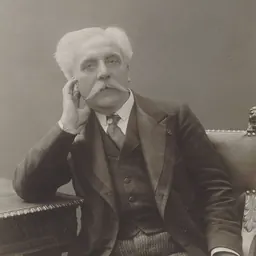
Godebska's father remarried several times, ultimately reclaiming his daughter and bringing her to live with him and his newest wife in Paris. The girl missed the ambiance of her maternal grandparents’ home in Halle. Her father placed her in a convent boarding school in the city, Sacré-Coeur, where she was a student for eight years, 1882-1890. Her only pleasure was the piano lessons she took one day a week from musician and composer Gabriel Fauré, who was then deputy organist at Église de la Madeleine. Godebska left school and moved to London temporarily, using borrowed funds.
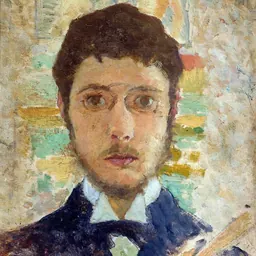
All were mesmerized by the charm and youth of their hostess Misia. In 1889, Natanson debuted La Revue Blanche, a periodical committed to nurturing new talent and showcasing the work of post-Impressionists known as Les Nabis. Misia Natanson became the muse and symbol of La Revue blanche, appearing in advertising posters created by Toulouse-Lautrec, Édouard Vuillard and Pierre Bonnard. A portrait of her by Renoir is now in the National Gallery, London.
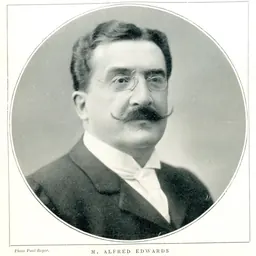
Natanson’s La Revue blanche, coupled with his political activism, required an influx of capital in amounts he could not supply. Needing a benefactor, he approached Alfred Edwards, a newspaper magnate, the founder of the foremost newspaper in Paris, Le Matin. Edwards had become enamored with Misia Natanson and had taken her as his mistress in 1903. He said he would supply money, but only on the condition that Natanson relinquish his wife to him. The couple divorced. The Sert couple ultimately divorced on 28 December 1927.
The South-West Brabant Museum in Halle, her parents' home, has a collection on her life, as well as that of her maternal grandfather and father.
On 9 July 2022 a new bridge was opened near Charleroi that was named for her.
Don’t just read it —
keep it.
Full-length biographies made to live with: read them, listen on the way to work, watch them tonight.
- E-book
- Audio
- Video
Instant download · yours to keep · every purchase keeps this site free
Important facts
People in Misia Sert's life
Named in this biography and alive at the same time

Related people
Same field, nearest in time




Contemporaries
People whose lives overlapped Misia Sert's



Frequently asked questions
Who was Misia Sert?
art patron (1872–1950)
When was Misia Sert born?
Misia Sert was born on 30 March 1872 in Saint Petersburg, Pushkin.
When did Misia Sert die?
Misia Sert died on 15 October 1950 in 1st arrondissement of Paris, Paris.
What was Misia Sert's occupation?
Misia Sert was a pianist, salonnière, socialite, patron of the arts and fashion model.
What nationality was Misia Sert?
Misia Sert was French.
Sources & further reading
Cite this page
APA: Biography.guide. (2026). Misia Sert. https://biography.guide/misia-sert/
MLA: "Misia Sert." Biography.guide, https://biography.guide/misia-sert/.
Chicago: "Misia Sert." Biography.guide. https://biography.guide/misia-sert/.
Data last updated: 2026-09-22 · Spot an error? Report a correction.
Page generated 2026-09-27 05:21 UTC