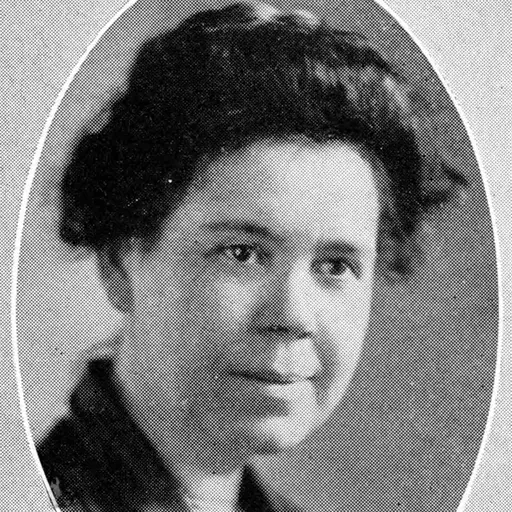
About Minnie J. Nielson
Lived 1874 – 1958 (aged 84). Minnie J. Nielson was an American politician.
Minnie Jean Nielson (January 18, 1874 – February 27, 1958) was an American educator and literacy activist from North Dakota. She served as the eleventh North Dakota Superintendent of Public Instruction from 1919 to 1926.
Early life Nielson was born in Jackson, Michigan, on January 18, 1874, to Scottish parents James Wylie Nelson and Mary Hallady Stewart. In 1880, Wylie Nielson, with his wife and three children, relocated to Dakota Territory, settling in present-day Barnes County, North Dakota.
Wylie Nielson had sold his hardware store in Jackson and opened an agricultural supplies store with James Baille. The Nielson family was among the earliest settlers of the Valley City area.
In 1919, Fargo College honored Nielson with a Doctor of Laws degree to commemorate her achievements as an educator and for her work with liberty loan drives during World War I.
Early career Nielson taught physics and chemistry at Valley City High School.
In 1906, she was elected Superintendent of Barnes County Schools and served in this role for twelve years. During her time in this role, she became known for her frequent travels throughout the county in her bright red Maxwell automobile, which was one of the first automobiles in Valley City.
1918 campaign and election The months preceding the election of 1918 came at a turbulent time in the United States. The influenza pandemic was spreading, and World War I was still being fought in Europe.
Politically, it was also a fluctuating time for the state of North Dakota. The Nonpartisan League (NPL) had risen to prominence in the state. In the 1916 gubernatorial election, Lynn Frazier, the NPL candidate, won in a landslide. The party's candidate for Attorney General, William Langer, was also elected with a vast majority of the votes.
During this period, Nielson decided to run for the office of Superintendent of Public Instruction, which was the only state office open to women at the time.
Leading up to the 1918 election, Nielson was attacked by the NPL, especially by their candidate Neil C. Macdonald. Articles began appearing in pro-NPL newspapers questioning her legal qualifications for the position. The biggest issue from Nielson's opponents revolved around the fact that she had attended multiple colleges and universities, but she had not earned any degrees from them.
Publicly, Macdonald focused on the qualification issue, but in private he was much more blunt toward Nielson. In a September 1918 letter, he wrote, "They have a Miss Nielson after me; a dear, fat old maid, who is making a campaign on three issues, namely: One, that she is a woman, second, that she is poorly educated, and therefore anything and everything can teach school if she is elected, third, that she and her friends are against the League, and fourth that she is a Scandinavian; all of which is true except the last one, for it happens that her father and mother were born in Scotland. She is trying to work the nationality racket."
Nielson turned to an unlikely ally: William Langer, the NPL-endorsed Attorney General. A rift had been forming between Langer and the NPL. Langer began distancing himself from the party, criticizing party leaders, and even running against Lynn Frazier in the 1920 gubernatorial election, but he narrowly lost in the primaries. He also began siding against the NPL in his role as Attorney General, especially when it came to Nielson.
About two weeks before the election, Nielson asked Langer to issue an opinion on whether she met the legal qualifications to serve as the state superintendent or not. On October 29, 1918, Langer issued a statement validating her as a legitimate candidate, having met all of the necessary criteria. However, Nielson's troubles with the NPL would continue.
Nielson also went on the offensive, attacking Macdonald for his connection to the NPL and their socialist leanings. With this victory, Nielson was the only candidate to win a statewide position who was not endorsed by the NPL. Macdonald continued to challenge Nielson's legitimacy, but with the support of Langer and Assistant Attorney General Edward B. Cox, Nielson was able to keep winning the legal battles. Langer stated, "Miss Nielson is the legally elected superintendent of public instruction of the state, and I'll fight her battles in every court of the state if necessary."
Around the same time of Nielson's trouble with Macdonald, the Sixteenth Legislative Assembly convened. There had been growing speculation prior to the start of the regular session that Governor Frazier and the NPL would push to overhaul the state's education system. This would include the duties of Nielson as Superintendent of Public Instruction, who has just defeated Frazier's long-time friend Macdonald in the election.
After the supreme court ruling, the Macdonalds were escorted out of the state superintendent's office by Governor Frazier, along with the sheriff of Burleigh County. Outgoing superintendent Neil C. Macdonald made one final attempt to maintain control of the office. He demanded Nielson surrender the position to him. Nielson responded with, "I certainly do not intend to do so."
Heeding the governor's recommendation, and the endorsement of many college and university leaders in the state, the legislature also created the Board of Administration. This new board would administer all penal institutions, charitable and educational institutions, and oversee the public and common schools for the state.
Board of Administration On July 26, 1919, the Board of Administration formally organized. Governor Frazier appointed George A. Totten, a former member of the Board of Regents; Robert Muir, a former member of the Board of Regents; and Patrick M. Casey, a former member of the Board of Control. The other two members were John N. Hagan, Commissioner of Agriculture and Labor; and Minnie Nielson, Superintendent of Public Instruction.
To some, like the NPL, the creation of the Board of Administration was viewed as a way for the state to increase efficiency and save money by consolidation. However, others viewed the board as a political power grab of the NPL. Upon its creation, a majority of the board, four of the five members, had ties to the NPL.
The board appointed Neil C. Macdonald, the former state superintendent, to serve as educational advisor and general school inspector. The board paid him handsomely with a salary that was equal to Nielson's. However, he did not serve in this role very long, resigning in April 1920.
On November 1, 1919, George A. Totten, Chairman of the Board of Administration, submitted the entity's first annual report to the governor. In this report, the board submitted a recommendation to abolish the office of the state superintendent or make it a board-appointed position instead of an elected one. Nielson did not even get a chance to see this report before it was published.
1920 cartoon from "The Red Flame" magazine portraying George A. Totten and the North Dakota Board of Administration excluding Minnie J. Nielson, Superintendent of Public Instruction, from meetings.
At the same time North Dakota was voting to support the women's suffrage movement by ratifying the Nineteenth Amendment to the U.S. Constitution during the special legislative session of 1919, it was made known that the Board of Administration was excluding Nielson, its only female member, from meetings and not providing her with meeting minutes. The board had been holding meetings haphazardly, sometimes without Nielson in attendance. When Nielson protested the board meeting without her, Chairman Totten reportedly replied, "We're not going to chase after you every time there's a meeting. If you want to attend the meetings, you'll have to do the chasing." when called to testify before the House's committee investigating the state library for controversial items within their collections. During the backdrop of the First Red Scare, and a growing concern that the NPL had socialist leanings, there were accusations that items within the traveling collection were related to free love, Bolshevism, socialism, and/or anarchism.
The NPL, on the other hand, took a hit from this political battle.
Decline of the NPL and the election of 1920 By late 1918 and into the early 1920s, the NPL began to decline. Factors such as accusations of socialism, political infighting, drought, declining grain prices, and economic hardship contributed to the decline of public support for the party.
Nielson outlasted the NPL's control over state government and was re-elected in 1920. She had been endorsed by the IVA. An initiated measure was also approved by voters during the 1920 election which transferred some powers back to the Superintendent of Public Instruction. This included teacher certification, standardization of schools, and examinations for eighth grade and high school students.
Remaining years in office Nielson's remaining years in office were much less turbulent. Nielson would be re-elected again in 1922 and 1924. She decided to step down when her term ended in 1926. During her time as state superintendent, she sponsored a night school program for adults in counties across the country, teaching them to read and write. Hazel Nielson, Minnie's sister and deputy superintendent, was also heavily involved in this initiative.
Personal life Nielson was energetic, outgoing, and had a passion for education. She never married.
Death Nielson died on February 27, 1958. She is buried at Woodbine Cemetery in Valley City, North Dakota.
Don’t just read it —
keep it.
Full-length biographies made to live with: read them, listen on the way to work, watch them tonight.
- E-book
- Audio
- Video
Instant download · yours to keep · every purchase keeps this site free
Important facts
People in Minnie J. Nielson's life
Named in this biography and alive at the same time



Related people
Same field, nearest in time





Contemporaries
People whose lives overlapped Minnie J. Nielson's

Frequently asked questions
Who was Minnie J. Nielson?
American politician (1874–1958)
When was Minnie J. Nielson born?
Minnie J. Nielson was born on 18 January 1874 in Jackson, Michigan.
When did Minnie J. Nielson die?
Minnie J. Nielson died on 27 February 1958 in Valley City, North Dakota.
What was Minnie J. Nielson's occupation?
Minnie J. Nielson was a politician.
What nationality was Minnie J. Nielson?
Minnie J. Nielson was American.
Sources & further reading
· Wikipedia: Minnie J. Nielson
Cite this page
APA: Biography.guide. (2026). Minnie J. Nielson. https://biography.guide/minnie-j-nielson/
MLA: "Minnie J. Nielson." Biography.guide, https://biography.guide/minnie-j-nielson/.
Chicago: "Minnie J. Nielson." Biography.guide. https://biography.guide/minnie-j-nielson/.
Data last updated: 2026-09-20 · Spot an error? Report a correction.
Page generated 2026-09-27 05:10 UTC