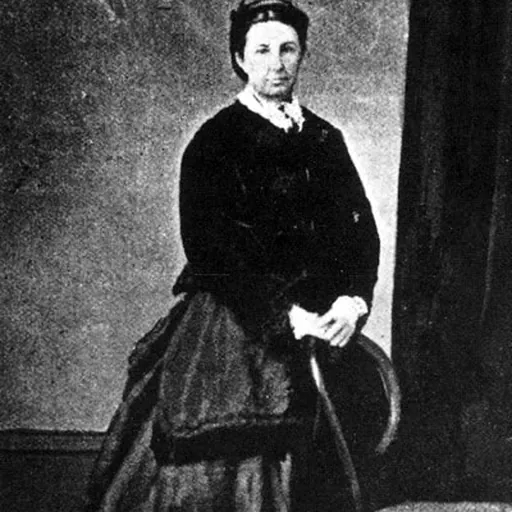
Minnie Dean
New Zealander murderer
About Minnie Dean
Lived 1844 – 1895 (aged 50). Minnie Dean was a British.
Williamina Dean (née McCulloch; 2 September 1844 – 12 August 1895) was a New Zealander who was found guilty of infanticide and hanged. She was the first and only woman to have been executed in New Zealand. Several other women have been sentenced to death in New Zealand, but all of them had their sentences commuted to either life imprisonment or a long imprisonment.
Early life Minnie McCulloch was born on 2 September 1844 in Greenock, Renfrewshire, Scotland. Her father, John McCulloch, was a railway engineer. Her mother, Elizabeth Swan, died of cancer in 1857. It is unknown when she arrived in New Zealand, but by the early-1860s, she was living in Invercargill with two young children. She claimed she was the widow of a Tasmanian doctor, although no evidence of a marriage has been found. She was still using her birth name, McCulloch. As such, a number of children under Dean's care died of various illnesses. In March 1889, a six-month-old child had died of convulsions; in October 1891, a six-week-old baby had perished from cardiovascular and respiratory ailments; and a boy allegedly drowned under her care in 1894 and she hid the body in her garden, arousing further suspicions. A coroner's inquest was held, and Dean was not held responsible for the deaths, due to universally-poor hygiene standards, even at childbirth itself. Nevertheless, the community came to mistrust Dean, and rumours of mistreatment circulated. Additionally, children under Dean's care allegedly went missing without explanation. In the public's mind, this linked Dean to cases of infanticide or baby farming in the United Kingdom and Australia, where women killed children under their care to avoid having to support them. At the time, lax childcare legislation meant that Dean did not have to keep records of the children she agreed to take in, so proving that the children had disappeared was difficult.
Before Dean's trial and execution, four other women had been tried and sentenced to death--Caroline Whitting (found guilty in 1872), Phoebe Veitch (1883), and Sarah-Jane and Anna Flannagan (1891). In each case, these sentences were commuted to life imprisonment; in each case, child murder was the culpable offence. 30 years later, in 1926, Daniel Cooper was also convicted of baby farming and executed for the offence, although his second wife Martha was acquitted. In a broader, international context, Dean's misdeeds may also have been viewed in the same light as late Victorian contemporaries and fellow "baby farmers" such as Amelia Dyer in the United Kingdom (convicted in 1896) and John and Sarah Makin (1893) and Frances Lydia Alice Knorr in New South Wales (1893), as well as previous New Zealand historical instances of ostensibly deliberate child deaths. Certainly, given the proximity of New South Wales, the Makin case featured in New Zealand newspapers during the same period as the Minnie Dean controversy and trial.
Murder case and execution On 2 May 1895, Dean was observed boarding a train in Winton carrying a young baby and a hatbox, but was later observed departing at Lumsden without the baby and with only the hatbox. As railway porters later testified, the hatbox was suspiciously heavy. A woman, Jane Hornsby, came forward claiming to have given her granddaughter, Eva, to Dean, and clothes identified as belonging to this child were found at Dean's residence, but Dean could not produce the child herself. A search along the railway line found no sign of the child. Dean was arrested on 9 May 1895, and charged with murder. Her garden was dug up, and three bodies (two of babies, and one of a boy estimated to be three years old) were uncovered. The cause of death for the third child was not determined. Dean was charged with their murder.
At her trial, Dean's lawyer Alfred Hanlon argued that all deaths were accidental, and that they had been covered up to prevent adverse publicity of the sort that Dean had previously received. On 21 June 1895, Dean was found guilty of Dorothy Carter's murder, and sentenced to death. Between June and August 1895, Dean wrote her own account of her life. Altogether, she claimed to have cared for 28 children. Upon being asked if she had anything left to say, Dean replied "No, I have nothing to say, except that I am innocent." She is the only woman ever judicially executed in New Zealand. She is buried in Winton, alongside her husband, who died in a house fire in 1908. Her crimes led to the Infant Life Protection Act 1893 and the Infant Protection Act 1896. The episode won the Best Director, Best Drama Programme, Drama Script, and Performance, Female, in a Dramatic Role categories at the 1986 Listener Television Awards (also called the GOFTA Awards), and "contributed to a re-evaluation of Dean's conviction".
Minnie Dean is referenced in Dudley Benson's 2006 song "It's Akaroa's Fault" ("I don't want to meet Minnie Dean at the end of my life/If I were to meet her I'd keep her hatbox in sight"). Authors Lynley Hood and John Rawle wrote posthumous accounts and reconstructions of the case as the centenary of her apprehension and execution occurred, in 1995.
On 30 January 2009, the Otago Daily Times reported that a headstone had appeared mysteriously on Dean's grave. The headstone reads "Minnie Dean is part of Winton's history Where she now lies is now no mystery". It is unknown who placed the headstone there. Her family had been considering it but claimed that this was not their doing. In February 2009, the family laid a headstone to honour Dean and her husband's grave. It was unveiled in a traditional Māori ceremony, the Hura Kohatu.
In 2013, the New Zealand musician Marlon Williams wrote a song inspired by Minnie's case, entitled "Ballad of Minnie Dean".
Don’t just read it —
keep it.
Full-length biographies made to live with: read them, listen on the way to work, watch them tonight.
- E-book
- Audio
- Video
Instant download · yours to keep · every purchase keeps this site free
Important facts
People in Minnie Dean's life
Named in this biography and alive at the same time



Contemporaries
People whose lives overlapped Minnie Dean's

Frequently asked questions
Who was Minnie Dean?
New Zealander murderer (1844-1895)
When was Minnie Dean born?
Minnie Dean was born on 2 September 1844 in Greenock.
When did Minnie Dean die?
Minnie Dean died on 12 August 1895 in Invercargill.
What nationality was Minnie Dean?
Minnie Dean was British.
Sources & further reading
Cite this page
APA: Biography.guide. (2026). Minnie Dean. https://biography.guide/minnie-dean/
MLA: "Minnie Dean." Biography.guide, https://biography.guide/minnie-dean/.
Chicago: "Minnie Dean." Biography.guide. https://biography.guide/minnie-dean/.
Data last updated: 2026-09-22 · Spot an error? Report a correction.
Portrait: Wikimedia Commons · author & licence
Page generated 2026-09-27 05:04 UTC